





Music of the 20th and 21st Centuries (1900-Present)
Currents in the New World: Minimalism

Minimalism takes a small amount of musical material and explores all of its possible permutations, moving only very gradually from one permutation to another; in the process, it can change a listener's perception of time. Minimalism represents a strong reaction against the grand gestures of the post-Romantics and the complexity of some modernist music. It substitutes discrete and varied rhythms with steady, even hypnotic ones, replaces directional melody with the unbroken repetition of small fragments, and pulls harmony back into a tonal framework. The steady backdrop means that subtleties of melody, timbre, and rhythm can be brought into the foreground. Minimalist composers were influenced by elements of non-Western music (Balinese gamelan, Indian music, African drumming) and religion (the meditative element of Buddhism), as well as by minimalism in the visual arts (artists such as Donald Judd and Frank Stella). Minimalist composers also grew up hearing rock music, with its repeated phrases, insistent rhythms, ostinatos, and clear tonality. Minimalism is a crucial component of many types of music written and performed today.
The first key figure in minimalism was La Monte Young (b. 1935) with works such as X for Henry Flint (1960), in which an unspecified object is repeatedly struck for "a very long period of time," and Death Chant (1961), in which a two-note phrase is very gradually expanded into five notes as a male chorus sings it over and over again. In C (1964) by Terry Riley (b. 1935), who studied with Young at the University of California at Berkeley, established minimalism as a major movement. However, the three best-known American exponents of minimalism arguably are Steve Reich, Philip Glass, and John Adams.
In his own words...
"In African music, there are what they call 'changing patterns.' Very simple patterns that sort of stick out because they're so simple. That means, 'Get ready, and off we go!'"
Steve Reich, in an interview with Gabrielle Zuckerman, American Public Media, July 2002
Steve Reich
Reich was born in New York City of Jewish heritage. At the start of his career, he was interested in jazz—early influences were Ella Fitzgerald, John Coltrane, and Alfred Deller—as well as drumming, West African music, and Indonesian gamelan music. He attended Cornell University as a philosophy student and graduated in 1957. He studied composition at Juilliard School in New York City (1958-1961) and later worked with Luciano Berio and Darius Milhaud in California.
The first movement of Reich's New York Counterpoint is a good example of the effect of interlocking textures and pulsating harmonies that are typical of Reich's style. The performance you will hear is played by a single clarinetist against a recorded tape of all the other parts, which he/she has recorded separately in a process called multi-tracking. Listen carefully at 01:30 where the various phrases played by the clarinet blend together to create new melodies and rhythms.
Composer: Steve Reich
-
"New York Counterpoint: Movement 1" [ 01:30-05:01 ]03:31

Steve Reich
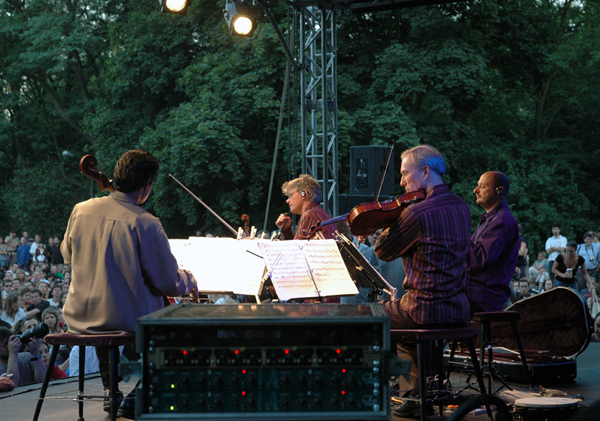
The Kronos Quartet
By the mid-70s, Reich's work began to display a more harmonic basis. Music for 18 Musicians (1976) uses rhythms and harmonies that reveal his interest in West African music and Indonesian gamelan. Different Trains (1988), written for string quartet and taped voices, explores the possible contrast between trains that took him to his mother's house in California and those that would have taken him to a Nazi concentration camp during World War II. In a devastatingly effective manner, he uses samples of recorded speech by five significant people: the governess who rode with him across the country, a Pullman train porter who traveled the same route, and three Holocaust survivors. In a kind of compositional turnaround, Reich uses the melodic and rhythmic patterns in the spoken words to generate the instrumental melodies and rhythms. The work, which won a Grammy for Best Contemporary Composition in 1989, was written for the Kronos Quartet, an ensemble that actively seeks out new music and music from around the world.
One of the most influential American composers, Reich's work has impacted countless musicians, musical groups, visual artists, and choreographers, including European composers such as Michael Nyman (b. 1944), who coined the term minimalism (vis-à-vis music) in his 1974 book Experimental Music: Cage and Beyond. A chance encounter with a BBC broadcast of Steve Reich's Come Out in 1968 had previously opened Nyman's ears to new compositional vistas.
Nyman's The Piano Concerto (1991) is derived from the score for the film The Piano—Jane Campion's film with its story of tragic marital tensions in a remote New Zealand setting in the nineteenth century. What minimalist influences do you hear in this piece?
Composer: Michael Nyman
-
"The Piano Concerto: I. The Beach"