





Music of the 20th and 21st Centuries (1900-Present)
Currents in the New World: Minimalism
Philip Glass
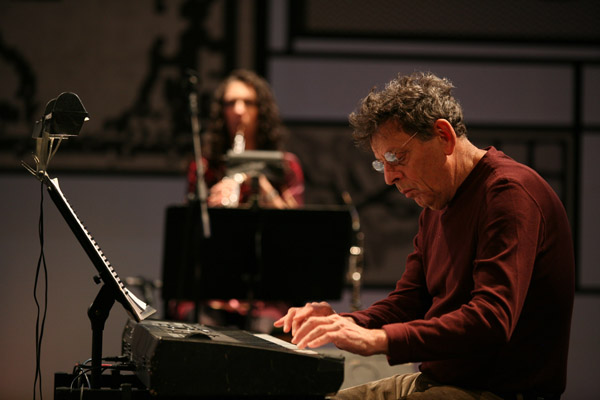
Philip Glass transcends several boundaries with his music, collaborating with classical, pop, rock, and world musicians, as well as with visual artists, choreographers, and playwrights, and appealing to audience members across a wide age range. He has composed numerous film scores, beginning with the highly experimental Koyaanisqatsi (Hopi for “life out of balance”) with Godfrey Reggio and continuing with Candyman, A Brief History of Time, The Hours, The Illusionist, Notes on a Scandal, The Truman Show, and The Thin Blue Line.
Born in Baltimore, Maryland of Jewish immigrant parents, Glass began his early musical studies on the flute at the Peabody Conservatory of Music and later studied mathematics and philosophy at the University of Chicago, where he discovered the serial music of Anton Webern. He went on to study piano and composition at the Juilliard School in New York, where he was a fellow student of Steve Reich. In the summer of 1960, he studied with the French composer Darius Milhaud at the Aspen Music Festival, and then Nadia Boulanger in Paris (1964–6), where he also worked with the Indian sitar player Ravi Shankar.
A period of study with the tabla player Alla Rakha followed in New York in the late 60s. During this time—together with Steve Reich—he became keenly interested in the rhythmic effects generated by the minimalist compositional process. In the mid-70s, however, he began to revisit traditional melody and harmony and started incorporating tunes and harmonic progressions into minimalist repetitive structures. By the 1980s, he was widely acknowledged as an important minimalist composer.
The result of this approach was Einstein on the Beach (1976), an openly tuneful work produced with the theater artist Robert Wilson, which shook up the opera world. The opera features no plot and little actual singing, and instead offers a few recurring images and the classic minimalist repetition of musical and text fragments. However, his use of melodic ideas and harmonic progressions allowed him to sustain musical and dramatic interest throughout this long work. Two other operas followed in quick succession: Satyagraha (1980), which tells the story of Mahatma Gandhi's time in South Africa, and Akhnaten, his third large-scale work.
Akhnaten, first performed in Stuttgart in 1984, was conceived as the last installment of a trilogy with Einstein and Satyagraha. The opera's three acts portray the rise and fall of the Egyptian pharaoh from the 14th century BCE who may have been the first monotheist, and who was ultimately overthrown and presumed murdered for his radical ideas. The libretto mixes ancient languages and English while the music makes use of the conventional Western orchestra.
We will listen to the opening prelude to Akhnaten, followed by a dance from the third scene of the second act. Note the strikingly different way time passes and musical motives unfold in this work. The prelude maintains a magnificent arc of rhythmic and melodic tension that doesn't quite seem to achieve a complete release.
Composer: Philip Glass
-
"Akhnaten: Prelude"
The dance from Act II, Scene 3 uses stronger rhythms to celebrate the new city of Akhetaten, which the new pharaoh has created. In the actual production, musicians appear on stage along with the rest of the cast.
Composer: Philip Glass
-
"Akhnaten: Dance (Arr. P. Barnes for Piano)"
In both examples above, notice Glass' use of rhythmic ambiguity to enhance the dramatic content of the music, as well as the overall dark mood created by the absence of violins—an omission actually brought about by practical restrictions at the Stuttgart premiere performances).
The Violin Concerto, whose first movement we will hear next, was the first of many commissioned works for orchestra that followed the wide acclaim of Satyagraha and Akhnaten. Glass—who was obsessed with opera at the time—found the concerto medium naturally theatrical and dramatic. The work was premiered in New York in 1987. Notice how the violin performs repeated arpeggiations that sometimes intertwine with the melody in the orchestra (again, performed in short repeated rhythmic patterns), and how those roles suddenly reverse with the violin playing a long, lyrical melody to the orchestra's more rhythmic backdrop.
Composer: Philip Glass
-
"Violin Concerto: First movement"