
Learning Objectives
At the end of this lesson, students will be able to do the following:
- Identify selected characteristics of African music and culture and how they relate to African American music’s history and its emergent significance as a sociocultural practice.
- Explain African musical traditions within the broader American and African American cultural landscape.
- Describe the musical styles and forms that characterize significant periods in African American music history.
- Discuss how African and African American music was performed based on the various examples of performers, composers, and their practices and audiences.
Introduction to Lesson 1
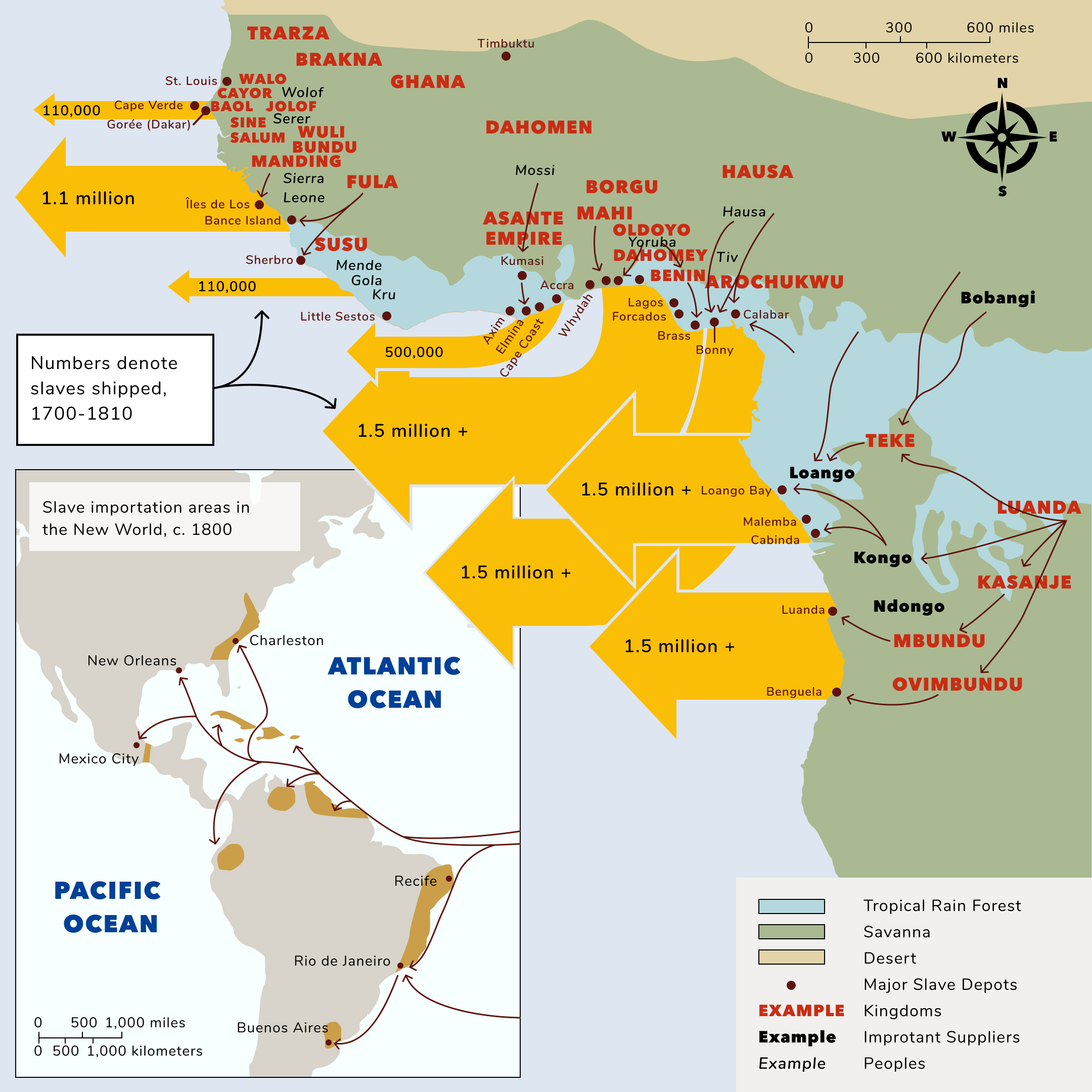
History marks August 20, 1619, as the beginning of the slave trade in America. Twenty West Africans arrived in Jamestown, Virginia, as part of the infamous triangular slave trade that began with the Portuguese colonization of a few islands in the Gulf of Guinea shortly after 1485 (Darden 2005, 27).
This map illustrates how millions of Africans from the Western and Central regions of the continent—present-day Nigeria, Cameroon, Gabon, Ghana, Gambia, Senegal, Liberia, and the Ivory Coast—were essentially stolen from their homeland and families to be sentenced to a lifetime of servitude and oppression (Curtin 1972, 157).
To understand how these enslaved Africans survived such a horrific and brutal experience, one must first examine the life-source that helped sustain them. When one thinks of the music of the African continent, the first instrument that comes to mind is the drum.
Drumming plays a central role in African society and has been called the highest cultural, social, and religious expression of the African people. The drum provides a diversity of complex and highly syncopated rhythmic configurations. Thus, it is the very foundation of the transcending and incredible power that is expressed and accompanied by song and dance. Samuel Floyd suggests that understanding the elements of rhythm, song, and dance as a unit is central to the proper study of African music’s transformation into African American music, with its elaborations and social, cultural, and aesthetic underpinnings (Floyd 1991, n.p.). Through this lens, this lesson identifies relevant characteristics of Western and Central African music, their spiritual and cultural practices, and the traits that were retained by the enslaved African in America.
A.M. Jones
Rhythm is to the African what harmony is to the Europeans, and it is in the complex interweaving of contrasting rhythmic patterns that he finds his greatest aesthetic.