
Learning Objectives
At the end of this lesson, students will be able to do the following:
- Describe the musical landscape in which blues-derived music developed.
- Describe various aspects of the Jim Crow laws and their impact on African American society.
- Describe the antecedent musical genres that impacted the development of the blues.
- Define the term blues.
- Explain why W.C. Handy is affectionately referred to as the “Father of the Blues.”
- Illustrate the textual and musical form—three-line structure—of the blues.
- Name blues compositions/performers from the three broad stylistic categories—Country, Classic, and Urban blues—and their respective contributions.
Introduction to Lesson 9
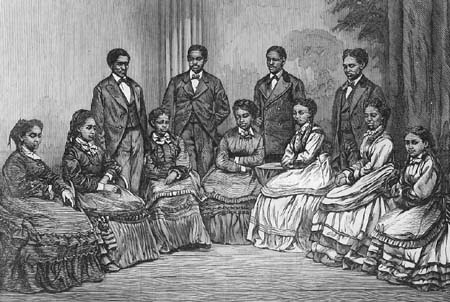
After the rise and disbandment of the original Jubilee Singers of Fisk University in 1878, many other copycat groups sprung up, using Fisk’s business model for raising funds for Black universities. In 1904, Charles Williams from Holly Springs, Mississippi, formed the Williams Jubilee Singers, "The World's Greatest Harmonizing OctetteA composition written for eight solo instruments. ." Previous jubilee companies had often had ten or a dozen members or an octet making a "double quartet."  SIDE NOTEJubilee quartets were popular African American religious musical groups in the first half of the 20th century. The name derives from the Fisk Jubilee Singers, a group of singers organized by George L. White at Fisk University in 1871 to sing Negro spirituals. The members of the original Fisk Jubilee Quartet (1909–1916) were Alfred G. King (first bass), James A. Myers (second tenor), Noah W. Ryder (second bass), and John W. Work II (first tenor). Students at other historically black schools, such as Hampton Institute, Tuskegee Institute, and Wilberforce University, followed suit. Many independent jubilee troupes also found inspiration in the Fisk Jubilee Singers, such as the Original Nashville Students. Still, the increasing tendency was to reduce the groups' size and feature, as did Williams, a popular quartet (or quartette) (Oliver and Smith 2012, n.p.).
Publicity material for the Williams Jubilee Singers emphasized their musical training at universities and colleges as Rust, Drake, Livingston, and Oberlin. However, as more jubilee companies were formed trying to capitalize on the “Jubilee Singers” brand, it became common practice to emphasize the singers' formal training and musical credentials. Some of those groups include the Eva Jessye's Dixie Jubilee Singers, the Pace Jubilee Singers—a sextet managed by Charles Henry Pace —and the Elkins-Payne Jubilee Singers, led by William C. Elkins, who also directed the Williams and Walker vaudeville show.
Let’s listen to two different approaches to jubilee-style singing. The 1921 version of “ The Old Ark’s A Movering ” by the Virginia Female Jubilee Singers appears rooted in the earlier rural style of harmony singing. By contrast, the Norfolk Jubilee Quartet features a more contemporary, secular style in "Quartet Blues,” issued under the Norfolk Jazz and Jubilee Quartet name. Under that name, the group was as much in demand on the vaudeville stage as they were at church functions (Oliver and Smith 2012, n.p.).