
Overview
Objectives
Upon completion of this lesson, you will be able to do the following:
- Recognize some of the key American and Cuban jazz artists and their contributions to Latin jazz
- Recognize some of the international figures in jazz who contribute to the globalization of jazz
- Recognize some of the recent jazz artists, both mainstream and progressive, whose art continues to fuel the debate about the future of jazz—and what jazz is
Medeski, Martin & Wood
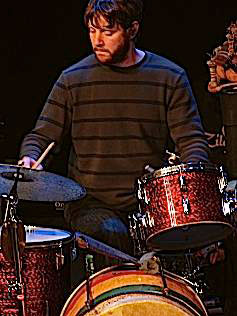
Keyboardist John Medeski (b. 1965) grew up in south Florida, exhibiting prodigious musical talent from an early age. He studied classical piano as a child, and by his teens had also turned his attention to jazz piano. At the New England Conservatory of Music in Boston, Medeski continued his study of classical music and also jazz. He gained valuable experience as a performer, notably with drummer Billy Higgins, and also as an accompanist for a local blues singer, playing the Hammond B-3 organ. After graduating, Medeski moved to New York, where he collaborated with a number of bass players in a duo setting4.
In 1991, Medeski joined drummer Billy Martin (b. 1963) and bassist Chris Wood (b. 1969) in forming an acoustic piano trio. When the group began to tour, Medeski played the Hammond organ, mainly as a way to avoid the bad pianos that populated some of their performance venues. Soon, though, Medeski was adding more electronic keyboards for their performances. The electronic keyboard has since become a hallmark of the trio's sound.
In 1996, Medeski Martin & Wood (MMW) toured the alternative rock circuit and began to find increasing favor among college students. Their association with the underground rock band Phish further enhanced their reputation, as did collaborations with fusion jazz guitarist John Scofield and postmodern saxophonist John Zorn.
MMW's style has been described as "neo-funk groove," incorporating elements of blues, straight-ahead jazz, hip-hop, soul, and avant-garde5. We can hear this sort of sound on a track from the group's 1998 album Combustication, Hey-Hee-Hi-Ho ♫. Medeski's use of several keyboards includes hand-clap samples and electric guitar samples alongside the conventional sounds of the Hammond organ6. The distinctive sound of the Hammond is easily recognizable, and it carries the principal funk melody. But it is Medeski's extraordinary facility playing multiple keyboards simultaneously that allows him to fill the role of two or more musicians, lending the trio a larger sound than we might otherwise expect. Let's listen Hey-Hee-Hi-Ho ♫.
Their 2000 album The Dropper ♫ demonstrates the band's development as they continue to explore the potential inherent in their collective approach to improvisation. The fusion/hip-hop/avant-garde elements come to the fore on the album's title track. This piece also makes clear the trio's commitment to exploring electronic sound. Medeski has a greater sonic arsenal at his disposal, which he unleashes with almost devilish delight. The effect is a darker sound that might easily conjure images of night. Let's listen The Dropper .





"I Heard it Through the Grapevine" has been recorded by several different artists, including Gladys Knight and the Pips, Marvin Gaye, and Roger Troutman, who all had #1 R&B hits with their versions, making this the only song to hit #1 on R&B charts for 3 different artists.
