
Objectives
- Relate the social, cultural, and political background during the Medieval period (500-1450) to the function of music during this time.
- Characterize the music of the early Christian church, i.e., Gregorian chant.
- Describe the difference between the Proper and the Ordinary of the Mass.
- Examine the influence of the Cathedral of Notre Dame as a center for organum in medieval music.
- Describe the differences between troubadours and trouvères in medieval secular music.
- Trace the rise of secular polyphonic chansons set to fixed text forms (rondeau, ballade, virelai) in the French Ars nova.
- Define and classify the instrumental music of the medieval period.
- Trace the four major developments that took place in Western music during the Middle Ages: the development of pitch and rhythmic notation; the transition from monophony to polyphony; the initial stages of regularly metered music; and the development of the motet and instrumental music.
Music in the Middle Ages (500-1450) - Medieval Instruments
Some instruments that are familiar to us today began to appear in their earliest forms in the Middle Ages. Because they were probably handed down from the instruments of Ancient Rome or Northern Europe, medieval instruments are our only real link to the instruments of ancient times. For example, the harp, probably one of the oldest instruments still in use today, dates back to at least Roman times.
The lute or ud, precursor to the guitar, is a plucked stringed instrument with a round back that originated in the Middle East. Other plucked instruments used at the time were the cittern and the saz.
Composer: Anonymous
-
"A la nana"
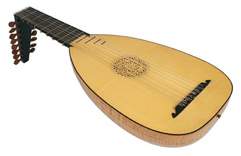
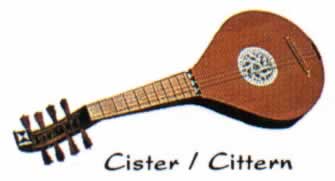
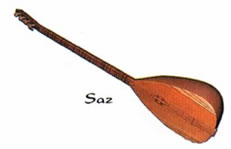
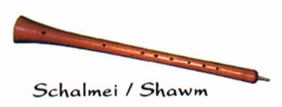
The shawm, a shrill wind instrument, is the predecessor of the modern oboe.
Other popular medieval wind instruments include the family of recorders, the bagpipe, and the gemshorn, which is one of the oldest wind instruments known to man.
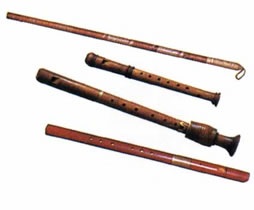
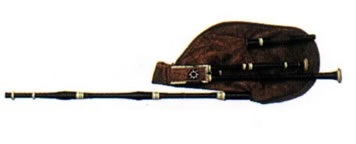
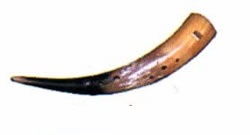
Composer: Berenguier de Palou
-
"Domna, pos vos ay chausida"
"Domna, pos vos ay chausida (Lady, for you)"Anonymous (Instrumental)
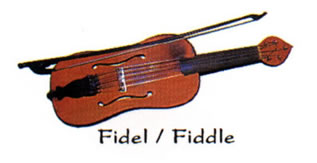
Precursors of modern string family instruments include the rebec, the fiddle, and the vihuela d'arco. The rebec along with the shawm were most likely descendants of Arabian or Turkish instruments brought back to Europe during the Crusades.
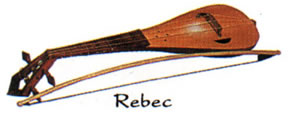
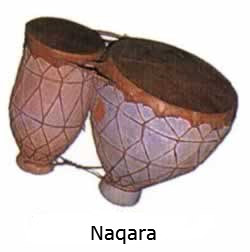
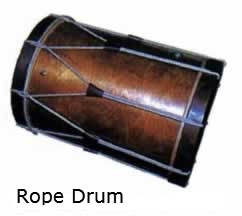
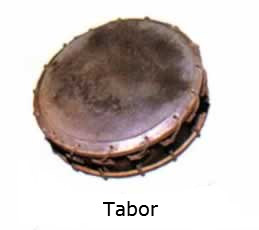
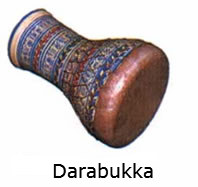
Percussion instruments used during medieval times include the naqara, rope drum, tabor, and darabukka.
Ara lausatz, lausat, lausat
Anonymous (Monastery of Saint Joan de les Abadesses, Catalonia)
Praise now, praise, praise
Composer: Anonymous
-
"Ara lausatz, lausat, lausat"
Ara lausatz, lausat, lausat,
il comandament l'abat.
Praise now, praise, praise,
the abbot's command.
Bela, si vos eravatz monja
de nóstra maison,
a profiéch e tots los monges
vos prenditz liurason.
Mas vos non estaretc, bela,
si tots jorns enversa non,
ço ditz l'abat.
Fair one, if you are a nun
in our house,
to the profit of all the monks
you would take tribute.
But you shall not pass a day, fair one,
except on your back,
so the abbot says.
The medieval sackbut also has a modern equivalent—the trombone. The flute, trumpet, organ and horn were all used during the Middle Ages, although their appearance differed from their present-day counterparts. For example, the organ underwent some refinements during the 14th century with the addition of the keyboard and pedals, as well as stops that enabled a performer to play different sets of pipes.
The Cantigas de Santa Maria (c. 1270)
Some of the instruments illustrated above feature prominently in the Prologue of the famous Cantigas de Santa Maria, assembled by Alfonso X "El Sabio" (The Wise). These pieces have come down to us in four splendid manuscripts, three of them with notation. The illustrations in these rare documents depict the king surrounded by scholars and musicians from all countries and cultures. There are more than forty instruments depicted including the fiddle, rebec, lute, harp, shawm, traverse and straight flute, trumpet, horn, bagpipe, portative organ, drums, castanets, cymbals, and various other percussion instruments. All in all, the prologue offers a unique compendium of medieval instruments.
Composer: Alfonso X El Sabio
-
"Cantigas de Santa Maria: Prologo (CSM 60)"

The Cantigas de Santa Maria showcase a unique collection of medieval instruments...

Aquel que de volontade, another piece from the Cantigas de Santa Maria, tells the story of a master-builder who, through a miracle by the Virgin, survives a fall from a high scaffolding. The Cantigas are, in fact, a four-volume collection of more than 400 songs, most of which praise the Virgin Mary. Each song describes a miracle, and every tenth song is, more or less, a general extolling of the virtues of the Virgin.
Composer: Alfonso X (El Sabio)
-
"Cantigas de Santa Maria: Aquel que de volontade"
"Aquel que de volontade"From Cantigas de Santa Maria"



