
Learning Objectives
- Relate the social, cultural, and political background during the Medieval period (500-1450) to the function of music during this time.
- Characterize the music of the early Christian church, i.e., Gregorian chant.
- Describe the difference between the Proper and the Ordinary of the Mass.
- Examine the influence of the Cathedral of Notre Dame as a center for organum in medieval music.
- Describe the differences between troubadours and trouvères in medieval secular music.
- Trace the rise of secular polyphonic chansons set to fixed text forms (rondeau, ballade, virelai) in the French Ars nova.
- Define and classify the instrumental music of the medieval period.
- Trace the four major developments that took place in Western music during the Middle Ages: the development of pitch and rhythmic notation; the transition from monophony to polyphony; the initial stages of regularly metered music; and the development of the motet and instrumental music.
Medieval Period (1150-1450)
Sacred Music: Gregorian Chant
During the Middle Ages, Gregorian Chant—also known as plainsong or plainchant—acquired so much importance within the Roman Catholic Church that it eventually came to be regarded as holy, almost as much as the Bible itself.
Composer: Anonymous
-
"Quem Quaeritis"
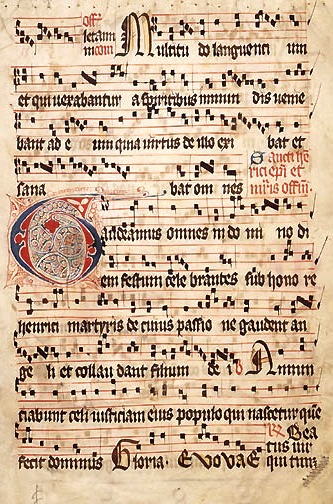
Gregorian chant, also known as plainchant or old Roman chant, is the official music of the Western Roman liturgy. The Church considers it to be the sung rather than spoken prayer, i.e., not an aesthetic vehicle to support the liturgy, but rather liturgy itself. Gregorian chant features a) an unaccompanied—a cappella—sacred, single melodic line (monophonic texture), b) a mainly smooth, step-wise melodic motion with narrow range, c) free rhythm, and d) Latin texts mainly derived from the Bible, particularly the Book of Psalms. Music in early Roman Catholic Church services was confined to vocal music, i.e., no instruments, and its function was strictly limited to teaching religious doctrine to the common people. It was widely believed that the social hierarchy (class system) upheld by the Church was the reflection of a preordained, natural, and unquestionable order. Gregorian chant, with its unaccompanied single-line, static melodies, was the perfect sound picture of that balance and order. These one-line musical structures form the basis for the ritual of the Mass, and continued to be mandated in the Catholic Mass up until the 20th century.
Pope Gregory I, also known as Pope Gregory "The Great," is often given credit for creating Gregorian chant. However, most modern music historians believe that plainsong evolved slowly over the preceding centuries, gradually incorporating musical traits from different cultures. It is nonetheless likely that Pope Gregory played an important part in regulating and organizing the musical aspects of the Mass, which contained Gregorian chant.
The meditative, soothing, and otherworldly qualities of Gregorian chant have appealed to listeners throughout the ages. In 1994, a recording made by the Benedictine monks at the Monastery of Santo Domingo de Silos in Spain sold more than two million copies to become the fastest, best-selling “classical” record up until that point.
Musical Forms of Gregorian Chant
The earliest musical settings of the mass contained melodies that featured one-voice parts in free rhythm. From the 9th to the 16th centuries, some plainchants were expanded by means of tropes—new music and new texts added to the original chants.
The liturgy includes chants of the Ordinary of the Mass, i.e., those portions of the mass that are generally constant throughout the year, and chants of the Proper, which are those that vary according to the liturgical season, saint, or event to be celebrated. The Kyrie, Gloria, Credo, Sanctus, and Agnus are part of the Ordinary. The Proper includes the Introit, Gradual, Alleluia, Offertory, and Communion.
The following table summarizes the different components of the Ordinary and Proper of the liturgy.
| Ordinary | Proper |
|---|---|
| Introit | |
| Kyrie | |
| Gloria | |
| Gradual with Hallelujah or Tract Sequence | |
| Credo | |
| Offertory | |
| Sanctus, including Benedictus and Hosanna | |
| Agnus Dei | |
| Communion | |
| Ite, missa est or Benedicamus |
The Introit
The introit accompanies the entrance procession of the celebrant (priest) and his ministers.
Composer: 0
-
""Puer Natus, Ett barn ar fott" (A Child is Born)"
The Gradual
The gradual is one of the responses to the reading of the Epistle during the Mass. It is constructed from a form of psalmody with refrain. Originally, the congregation responded with a simple formula to a soloist who sang the verses of the psalm one by one. As the musical embellishments increased, less wordy texts were used from the 5th century onwards.
Composer: Léonin
-
"Viderunt omnes"
The Alleluia
The literal translation of this Hebrew word is “praise the Lord.” Originally, this was a chant reserved for Easter day. However, it is now (in the present day) used in weekly celebrations of the Resurrection.
The Offertory
The offertory chant consists of verses sung by a soloist and a response (refrain) sung by the choir.
The Communion
This chant accompanies the procession of distribution communion.