
Objectives
Be ready to...
- Relate the social, cultural, and political background during the Medieval period (500-1450) to the function of music during this time.
- Characterize the music of the early Christian church, i.e., Gregorian chant.
- Describe the difference between the Proper and the Ordinary of the Mass.
- Examine the influence of the Cathedral of Notre Dame as a center for organum in medieval music.
- Describe the differences between troubadours and trouvères in medieval secular music.
- Trace the rise of secular polyphonic chansons set to fixed text forms (rondeau, ballade, virelai) in the French Ars nova.
- Define and classify the instrumental music of the medieval period.
- Trace the four major developments that took place in Western music during the Middle Ages: the development of pitch and rhythmic notation; the transition from monophony to polyphony; the initial stages of regularly metered music; and the development of the motet and instrumental music.
Society and Culture in the Medieval Ages (476–1450)
The term Middle Ages or Medieval period is commonly used to describe the period of European history from the fall of Rome in 476 CE to the beginning of the Renaissance in the middle of the 14th century. This period is itself subdivided into the Early, High, and Late Middle Ages. The term “medieval” comes from the Latin words medium (middle) and aevum (age). It was coined during the 14th and 15th centuries by Italian artists and scholars who saw themselves as responsible for the rebirth of the intellectual and artistic glory of ancient Greece and Rome after what they saw as the dark middle period of intellectual decline after the fall of Rome—a largely mistaken idea that has, nonetheless, persisted to the present day.
The European Middle Ages were by no means a cultural desert. All was not ignorance, disease, and war during this time. Despite natural and man-made disasters, the population of Europe increased, trade flourished in large part due to technological and agricultural innovations, and universities were founded based on the ideals of scholasticism—a philosophy that emphasized joining faith to reason. The oldest one of them, the University of Karueein, was founded in 859 AD in Fez, Morocco. The oldest one in Europe, the University of Bologna in Italy, was founded in 1088. The Sorbonne University in Paris, founded in 1253, was originally attached to the Cathedral of Notre Dame under the bishop of Paris, who presided over the faculty. Among the first important scholars at the university were the theologian Thomas Aquinas and a young student of theology named Peter Abelard, who later became known as a famous philosopher. The cathedral itself was where the earliest school of polyphonic flourished from about 1160 to 1250.

The European Middle Ages were by no means a cultural desert...

During the Late Middle Ages—12th and 13th centuries—villages developed into towns and cities, and inter-regional trade increased. Still, the vast majority of the populace was poor and worked land that was owned by an elite ruling class. However, a small but important middle class of merchants and artisans began to appear, helping to spearhead economic growth and recovery in Europe. In Northern Italian cities, nobles and citizens grew rich as a result of the cloth industry. The manufacture and sale of textiles provided the necessary wealth for cultural development and financed the establishment of learning centers. The spread of education fueled discoveries based on creative experimentation and philosophical investigation. These developments foreshadowed the onset of the modern age.
In other parts of the world there was activity and exploration as well. The Polos, of which Marco Polo (1254-1324) is the most well-known, opened up travel and commerce to the Far East with their journeys to China. In the Americas, the Mayans and the Olmecs emerged from what had been a scattered tribal existence. In Asia, the Khans (Kublai and Genghis) stepped out of Mongolia and into history books with their conquest of the continent.
The Fall of the Roman Empire
The history of Europe and the Near East during medieval times is inextricably linked to the fate of the Roman Empire. At its peak in the 2nd century, this magnificent empire encompassed most of present-day Europe, a large swath of the Middle East, and the northernmost slice of Africa—an area of 2 million square miles (5 million km²). However, by the beginning of the Middle Ages, deep changes were underway as invasions, civil wars, plague and economic depression led to the near-collapse of the Empire.
The fall and fragmentation of the Roman Empire, and the corresponding waves of “barbarian” invasions that followed, caused a period of slow economic growth, political conflict, disease, and famine in Europe during the Early Medieval period.
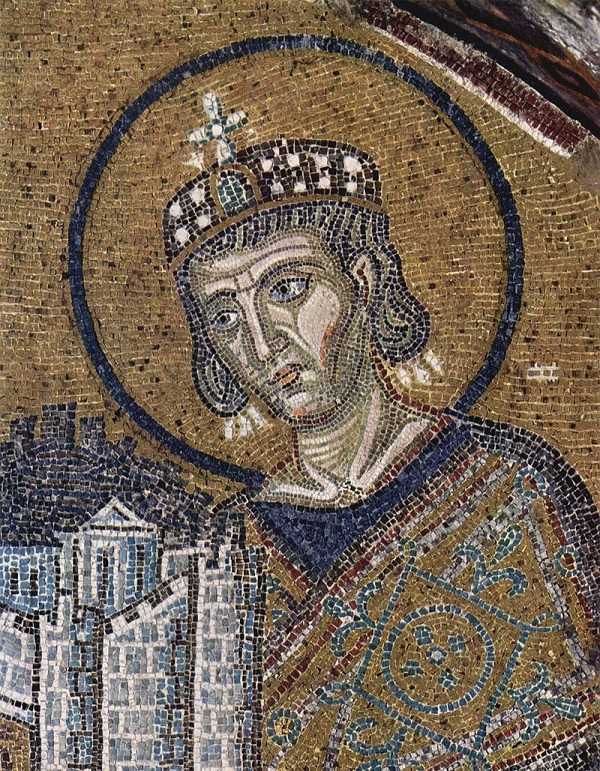
In 284 AD, the emperor Diocletian split rulership among co-emperors, which effectively led to the formation of a Western and an Eastern Roman Empire. In 330 AD, Constantine The Great moved the capital from Rome to the ancient Greek port of Byzantium in the Eastern Roman Empire, later Constantinople (officially renamed Istanbul in 1930, in present-day Turkey). The inhabitants of this Eastern part of the Empire spoke Greek rather than the traditional Latin that had been used in Rome since antiquity, and they called themselves Romaioi, or Romans. The Eastern Roman Empire is commonly known as the Byzantine Empire.
In the Western Roman Empire, strife, turmoil, and political trouble were the order of the day, and by the 5th century, it was under the control of different Germanic tribes. Disent among the tribes led to civil wars, economic and political weakness, and invasions from other peoples. While the Byzantine Empire remained strong, the Western Roman Empire steadily declined, culminating with the abdication by the Western emperor Romulus Augustulus to the Germanic general Odoacer, thus putting an end to the Western Roman Empire. By contrast, the Byzantine Empire would survive another thousand years.
Under Constantine I the Great, Constantinople had become the imperial residence and a bastion of military and classical culture. In addition to his political achievements, Constantine was the first Christian Roman Emperor, known for his great influence on the Edict of Milan (313 AD) and the Council of Nicea (325 AD), which legalized and legitimized Christianity in the Roman Empire. For the next 1,100 years, Constantinople served as the seat of power for the Byzantine Empire. However, the city and eventually the Empire itself fell to the Ottoman Turks in 1453.
Four main religious traditions were prevalent in the world between 400 and 800 AD: Hinduism—the world's oldest religion—in India and parts of Asia; Buddhism, which started to spread from India into China and Japan during this time; Christianity, which flourished in the Byzantine Empire and would eventually become the main religion in Europe; and Islam, which began in Arabia around 600 AD and spread throughout the Middle East and into several countries bordering on the Mediterranean Sea. In the Americas, the great Mayan and Teotihuacán civilizations practiced their own religions and built magnificent temple-pyramids to their gods, such as the Pyramid of the Sun in Teotihuacán.
Rise of Christianity
Christianity originated in the Roman province of Palestine, which comprised parts of modern-day Israel, Jordan, and Syria, and it spread quickly to other parts of the Roman Empire after the death of Jesus. It became the leading religion of the Roman Empire under Constantine I in the early 4th century, survived the fall of the Western Roman Empire, and from roughly the 5th to the 11th century, was one of the few unifying forces in the Western world.
With the rise of Christianity came the establishment of monasteries and their corresponding communities of monks. Monks spent a significant amount of their time in repentance, prayer, and, later on, in scholarly pursuits. The abbeys of the Middle Ages served as retreats for scholars and safe haven for people trying to escape the ravages of famine, war, and the bubonic plague—described by writers of the time as the "Great Mortality"—that scoured Europe during the 14th century.
Monasteries and abbeys were crucial to the preservation of knowledge and the development of a written musical tradition, and thus became the primary educational centers of the time.
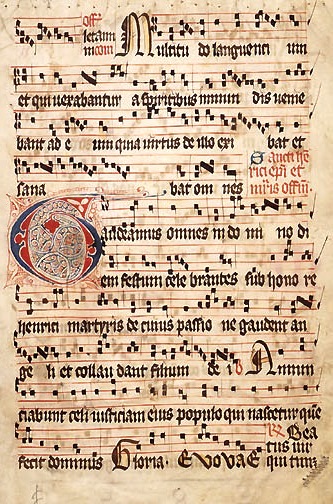
In rooms known as scriptoria (sing. scriptorium), monks painstakingly copied manuscripts from Greek and Roman times and from contemporary sources, preserving knowledge that would otherwise have been irretrievably lost. These scriptoria produced the earliest musical manuscripts, illuminated with finely executed miniature paintings and highly decorative letters. In such manuscripts we can trace the development of music notation, from rudimentary notes called neumes through the additions of staff lines and rhythmic symbols. Music notation also played a key role in the period's most significant innovation: polyphony.
Composer: Anonymous
-
"Laudate Deum"
The piece you just listened to, Laudate deum ("Praise God"), comes from a body of work known as Gregorian chant. Gregorian chant was named for Pope Gregory I (papacy 590–604), who was long credited with inventing Gregorian chant, but is now considered by most scholars to have been responsible for organizing and codifying the significant body of chants as part of a general standardization of Roman Catholic worship. All across the far-flung regions of the former Roman Empire, chants like "Laudate deum" served to unite populations under the common banner of Christianity.
In Europe, the story of the Middle Ages is intertwined with the history of the early Christian Church. As the Church grew in territory and power, so did its influence in the lives of the European people. As the population grew in size and number, cathedrals became the centerpiece of European city life during the latter half of the Medieval Period.
“Monasteries and abbeys were crucial to the preservation of musical tradition... ”
St. Mark's Basilica is a testament to the early power of the Christian Church, as well as to the importance of saints. Doge Giustiniano Partecipazio commissioned the basilica to celebrate the arrival of the body of St. Mark to Venice in 828 AD. After a fire in 976 AD, Doge Pietro Orseolo I ordered a rebuilding. The word Doge, from the Latin Dux, was the official title given to the nominal head of the city council.
In the second half of the 11th century, Doge Domenico Contarini, using much of the ancient foundations and masonry, had the church entirely rebuilt on a much larger scale. It was consecrated in 1094.
The great churches and cathedrals of the world, especially those of Europe, were particularly important in the development of Western music. Notre Dame (Paris), St. Mark's (Venice), and Santiago de Compostela (Spain) are just three of the many holy places where polyphony was developed and first performed.
The Christian Church employed the majority of professional musicians during the Middle Ages. The Church was opposed to ancient Greek and Roman paganism, and, therefore, did not encourage performances of music associated with those rites. Consequently, this type of music died out.
Crowned first Holy Roman Emperor by Pope Leo III in St. Peter's Basilica (Rome), Charlemagne (c.742-814) ruled over much of the continent in the 8th and early 9th centuries and instituted reforms that gradually pulled Europe into modern times.
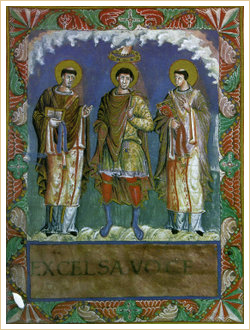
Because of the great flowering of scholarship, literature, art, and architecture, his reign is known as the Carolingian Renaissance. Charlemagne also had a profound influence on Church music.
During the 11th century, clashes between the Roman Catholic Church and the Eastern Orthodox Church (which sprang from the Western Roman Empire and the Byzantine Empire, respectively) provoked a formal rupture. The split between the Western Latin) branch of the Catholic Church, controlled from Rome by the Pope, and the Eastern (Greek) branch, led by the patriarch of Constantinople, resulted in linguistic and theological differences and the adoption of dissimilar church policies evident to this day. Referred to as the Great Schism, this division was not healed until 1965.
The Crusades
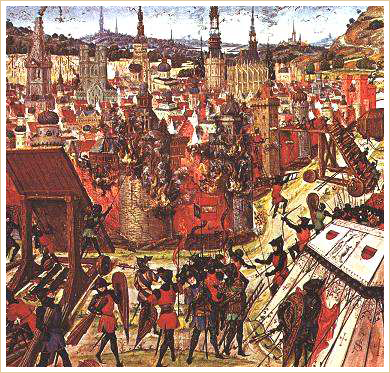
The Crusades, one of the major events of the Middle Ages, spanned several centuries of this era. They were a series of religious wars launched by the Christian Church to recapture Jerusalem and the Holy Land from Muslim rule. Four main crusades took place between 1095 and 1204, with several minor crusades lasting until 1291. Battles over the land between Rome and Palestine would continue until the fall of Constantinople to the Turks in 1453.
Plagues
From 1347 until 1351, a devastating outbreak of bubonic plague (known as the “Black Death”) struck Europe and the Mediterranean, killing millions of people. Referred to at the time as the Pestilence or the Great Mortality, this epidemic was the first of a cycle of European epidemics that continued until the early 18th century. The plague played a part in the termination of an outdated way of life governed solely by religious dogma. Concurrently, it lent impetus to new currents of thought in the cities of Northern Italy, where humanist philosophies, together with more democratic forms of government, started to flourish.
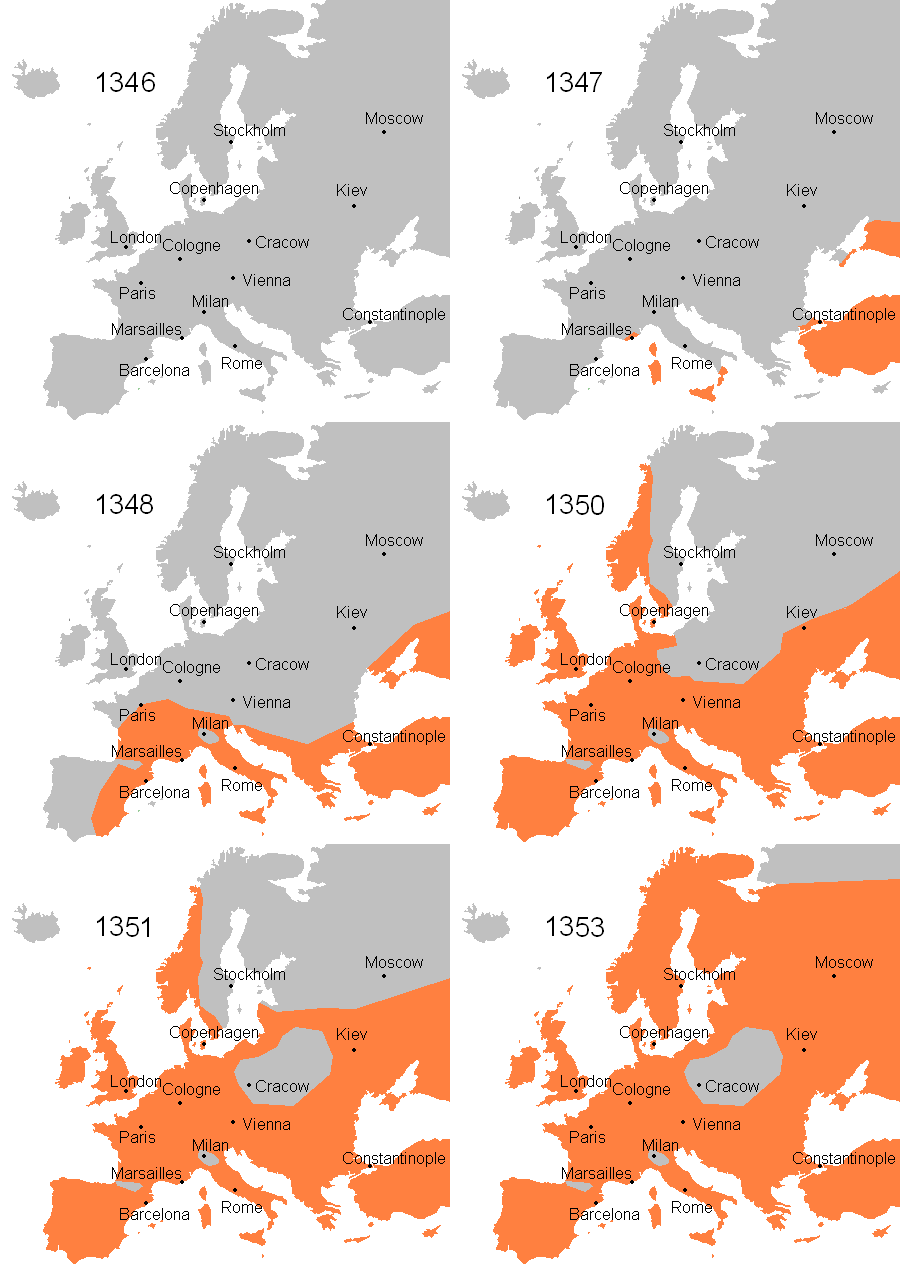
The last major plague outbreak occurred in Marseilles in 1722. The Black Death, however, wasn't the first or the last wave of devastating disease to strike Europe; plagues had already struck between the 6th and 8th centuries. Another cycle of modern, less deadly plagues began in the late 1800s and continued into the early 20th century.
In retrospect, it seems obvious that many characteristics of Renaissance art and society originated during the Middle Ages, and indeed many of the cultural accomplishments of the Renaissance had their roots in medieval times. Cultural and scientific changes were progressive rather than sudden then as they are now.



