
Learning Objectives
- Define the musical concept of melody.
- Define the following terms: melodic contour, melodic direction, shape, range, themes, imitation, tonal center, melodic tension, and balance.
Melody (Continued)
Pitch
Melody (from the Greek melōidía, meaning "singing" or "chanting") may be narrowly defined as an organized linear succession of tones (pitches). Admittedly, a melody is more than just a series of pitches—those pitches also have qualities of rhythm, dynamics, and timbre. In this lesson, however, we are going to focus on the pitch aspect of melody.
One of the most basic and engaging elements of music, melodies are heard every day and everywhere: on the radio, on television, in films, on portable sound equipment, at work, and at all kinds of social and public functions. The melody is the aspect of a song that we usually remember the most. When we whistle or hum a song—or just hear it in our heads—we are mainly recalling its melody.
The most precise way to think about or communicate a melody is to perform it, either mentally, singing it out loud, or playing it on an instrument. Music notation, or at least a rough sketch of the piece's melodic contour (i.e., the way it rises and falls) depicts a melody's overall shape. Listen to the following melody and try to follow its melodic contour as depicted in the written notation.

Composer: Giuseppe Verdi
-
"Aida: Act II: Triumphal March" [ 03:28-03:53 ]00:25
If you were going to sing or play this melody in a very precise way, you would need to have an acute sense of hearing—a "good ear"—and musical memory, or you would have to be able to interpret its notation. We do not need to be quite so precise, however, to describe melodies in more general terms.
Melodic Contour
The arrangement of successive pitches that a composer uses when building a melody gives it a unique melodic contour and, to a large extent, its unique character. While a melody’s contour cannot be precisely represented in written form without musical notation, the shape of a melody may be described in general terms as consisting of conjunct motion, disjunct motion, or repeated pitches. Keep in mind, however, that few melodies fit neatly within these categories.
Disjunct Melody
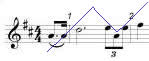
Notice that the beginning of the following melody from the Triumphal March (from Act II of Verdi's Aida) leaps from one pitch to another. If you were to draw a line connecting the dots of this melody, you would have a disjunct line. We refer to melodies that jump from one pitch to another as disjunct melodies.
Composer: Giuseppe Verdi
-
"Aida: Act II: Triumphal March" [ 03:27-03:29 ]00:02
Conjunct Melody
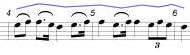
As the melody from the Triumphal March continues, the pitches get closer together. To play it on a keyboard, you would move from one key to the next. If you connected the dots in the notation, the result would be the smooth line below.
Composer: Giuseppe Verdi
-
"Aida: Act II: Triumphal March" [ 03:48-03:53 ]00:05
We refer to melodies that move between adjacent pitches as conjunct melodies.
Repeated Pitch Melody
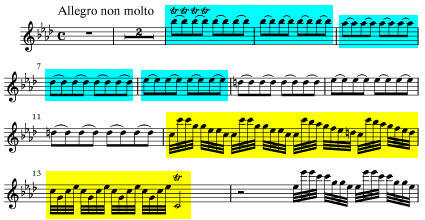
Sometimes melodies—or at least portions of melodies—just repeat the same pitch. The opening measures of Vivaldi's Concerto Op.8 in F minor—the famous "Winter" from The Four Seasons—illustrate a clear example of a repeated pitch melody followed by a combination of disjunct (hear and see the big leaps) and conjunct melodies (the smooth runs in measure 12). (Note: The repeated pitch melody portion is in blue, while the disjunct and conjunct melody portions are in yellow.)
Composer: Antonio Vivaldi
-
"The Four Seasons, Violin Concerto in E Major, Op. 8 No. 1, RV 269 "
Tchaikovsky's Marche from The Nutcracker is another example of a melody that makes extensive use of repeated pitches. How would you describe the feeling created by the repeated tones and instrument choice (brass) in this melody?
Composer: Pyotr Ilyich Tchaikovsky
-
"The Nutcracker Suite, Op. 71a, TH 35: II. March"
Listen again to the trumpet melody from the Triumphal March, and think about its unique contour—roughly shown in the contour line below. Notice how it combines all three kinds of melody movement above the notation.

Composer: Giuseppe Verdi
-
"Aida: Act II: Triumphal March" [ 03:28-03:53 ]00:25