Barlines and Measures
Rather than using accents to mark strong beats in the music, metric patterns are usually indicated through the use of barlines. A barline is a thin vertical line through the staff that marks the beginning of a metric pattern. Barlines help to organize the music into clearly visible units called measures. In the example below, there are six measures, with two quarter-note beats per measure (thus it is duple meter). Each barline marks the beginning of a new measure. Numbers above the barlines identify the measures.
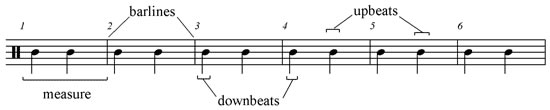
Six measures of duple meter
The strongest beat of the metric pattern is always the first beat in the measure, occurring right after the barline. This initial beat is also known as the downbeat, since in conducting, the first beat of the measure is always marked with a downward stroke of the hand. The beat immediately preceding the downbeat is called the upbeat, since in conducting, the hand must be raised up in preparation for the next downbeat. The upbeat provides a strong impetus towards the downbeat.
Although it is commonly used as a synonym for measure, the term bar refers strictly to the vertical lines that separate measures rather than to the measures themselves.
Types of Barlines
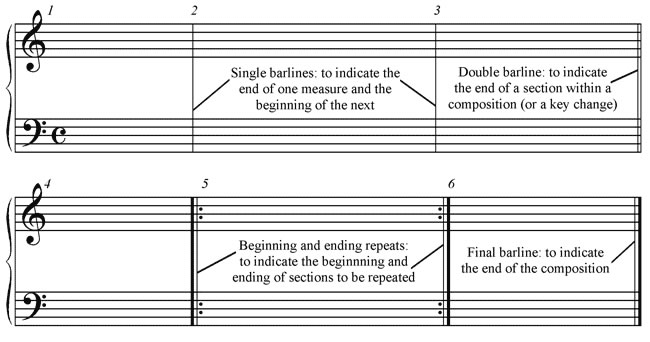
As illustrated in the example below, different types of barlines are used to mark off measures (single barlines), sections (double barlines), repeated sections (repeat signs), and the end of a composition (a final barline).