
Simple Quadruple Meter
Recall that meters can be duple (with two beats per measure), triple (with three beats per measure), or quadruple (with four beats per measure) and that in simple meters, the beat divides into twos and subdivides into fours.
A simple quadruple meter is a meter that has four beats per measure (triple), where each beat divides into two equal parts (simple) and subdivides into four equal parts. For instance, if the value of each beat is a quarter note, then the beat divides into two eighths and subdivides into four sixteenths.

Remember:
In simple quadruple meters there are four beats per measure, and each beat divides into two equal parts and subdivides into four equal parts.
Counting Simple Quadruple
Simple quadruple meter is counted as follows:
| Beat |  ONE |
TWO |
THREE |
FOUR |
| First division |  ONE and |
TWO and |
THREE and |
FOUR and |
| Second division | 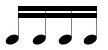 ONE e and a |
TWO e and a |
THREE e and a |
FOUR e and a |
Try counting the beat first (ONE TWO THREE FOUR), then add the divisions (ONE and TWO and THREE and FOUR and) while continuing to tap the beat on the table. Then you can further divide the beat into four parts (ONE e and a TWO e and a THREE e and a FOUR e and a) while continuing to tap the beat.
Conducting in Quadruple Meter
Here is the conducting pattern for quadruple meter:
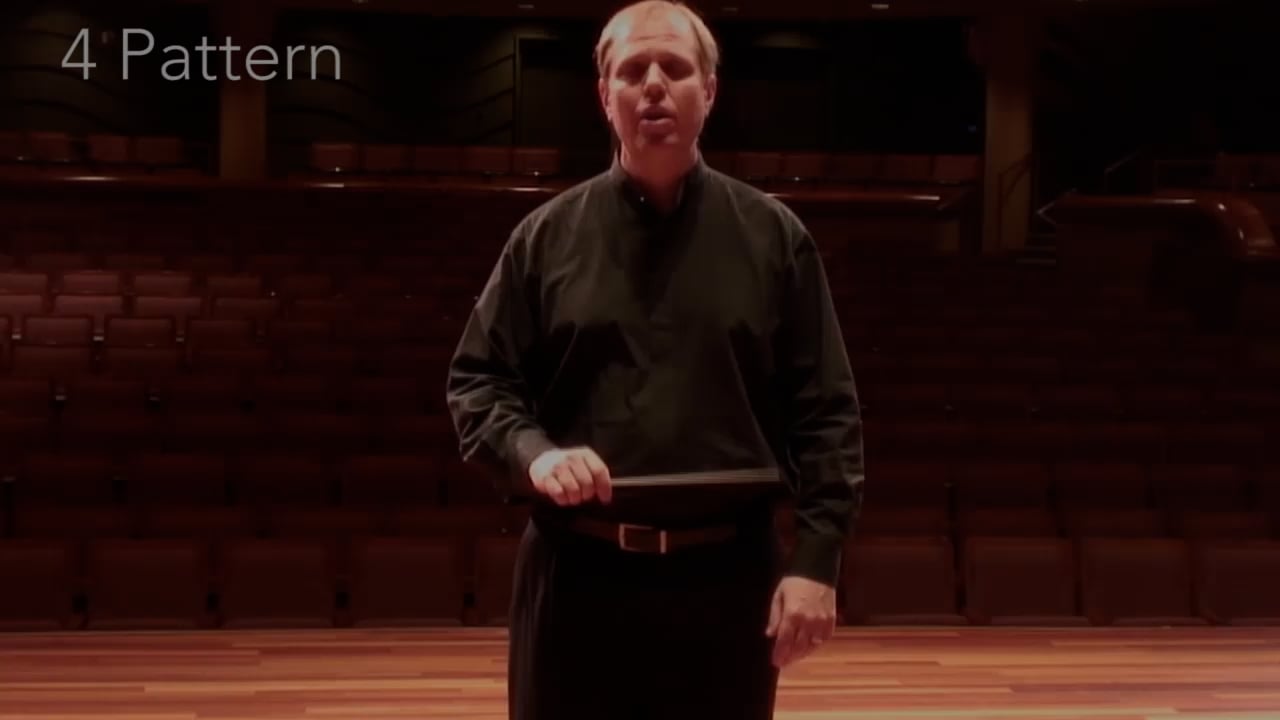
Conducting Pattern - Quadruple Meter
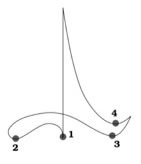
Quadruple Meter Conducting Pattern
To conduct in quadruple meter, start with your hand in a raised position, then bring it down for beat 1 (the downbeat). For beat 2, sway your hand to the left. For beat 3, swing your hand over to the right. For beat four, sway your hand back to the center and upwards to the initial position (the upbeat.) Practice this conducting pattern while counting ONE - TWO - THREE - FOUR. You can also practice counting and conducting along with the examples that follow.
Time Signatures
The top number in a simple quadruple time signature is always the number four (4). The most common time signatures for simple quadruple meter are 4/8, 4/4, and 4/2. The top number in the time signature indicates that each measure contains four beats: one strong and three weak. The third beat in quadruple meter is stronger than the second and fourth beats, but not as strong as the first beat. The bottom number indicates the note value that represents the beat (in this case an eighth note, a quarter note, or a half note).
The examples below will illustrate that 4/8, 4/4, and 4/2 all share the same basic meter type (simple quadruple). Although different values are used to represent the beat, if the tempo of that beat is set to the same speed (such as the three examples set to 100 beats per minute below), then the meters will sound identical.
Four-eight meter

The top number (4) in the four-eight time signature tells us that there are four beats per measure. The bottom number (8) indicates that each beat is represented by an eighth note. 4/8 is a simple quadruple meter; therefore, each eighth-note beat can be divided into two sixteenth notes. Click on the music below to hear a metric pattern played in 4/8, then try conducting and counting along.

Simple Quadruple Meter (Four-Eight)
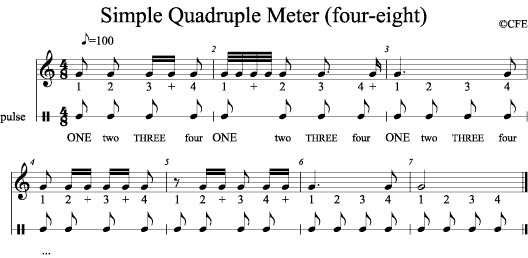
Simple Quadruple Meter (four-eight)
Four-four meter

The top number (4) in the four-four time signature tells us that there are four beats per measure. The bottom number (4) indicates that each beat is represented by a quarter note. 4/4 is a simple quadruple meter; therefore, each quarter-note beat can be divided into two eighth notes. Click on the music below to hear a metric pattern played in 4/4, then try conducting and counting along.
Simple Quadruple Meter (Four-Four)
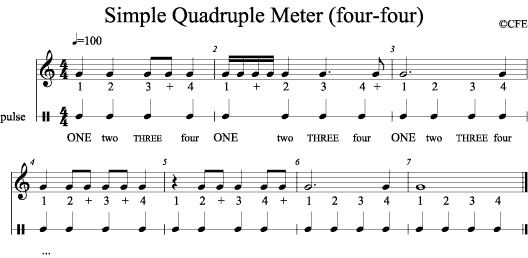
Simple Quadruple Meter (four-four)
Four-four is one of the most frequently used meters. For this reason it is often referred to as common time. Here is an excerpt from the "New World" Symphony (Symphony No. 9 in E minor) by Antonín Dvorák (1841-1904). It is written in four-four time, but note that its meter is represented in the music by the symbol C. Many people think that the letter C stands for "common time," but this symbol actually derives from medieval notational practices, using an incomplete circle to represent "imperfect time." In any case, when you see the symbol C, remember that it means 4/4 meter.
Antonin Dvorak: New World Symphony
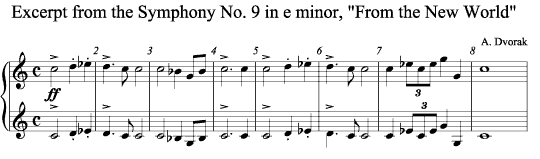
Excerpt from the New World Symphony by Antonin Dvorak
Four-two meter

Four-two meter
The top number (4) in the four-two time signature tells us that there are four beats per measure. The bottom number (2) indicates that each beat is represented by a half note. 4/2 is a simple quadruple meter; therefore, each half-note beat can be divided into two quarter notes. Click on the music below to hear a metric pattern played in 4/2, then try conducting and counting along. The note value in measure 7 is called a double whole note or breve. Its value is equal to two whole notes.
Simple Quadruple Meter (Four-Two)
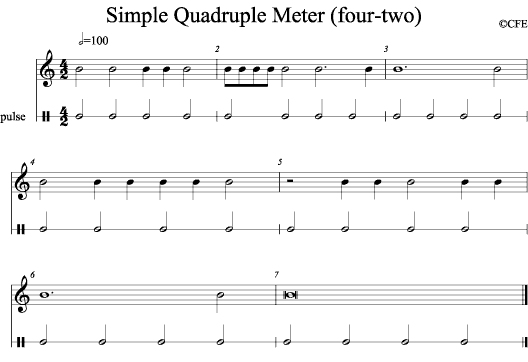
Simple Quadruple Meter (four-two)
Here is one example of a piece in four-two time: Adagio For Strings by the American composer Samuel Barber (1910-1981), a piece that has been used in many films (including Platoon, The Elephant Man, El Norte, and Lorenzo's Oil). This excerpt also illustrates how the time signature of a piece can change from measure to measure. In measure 4, Barber switches to 5/2 time, a time signature that belongs to the category of irregular meter. Then in the following measure, it returns to 4/2 time.
Composer: Samuel Barber
-
"Adagio for Strings, Op. 11"
Samuel Barber: Adagio for Strings (excerpt)
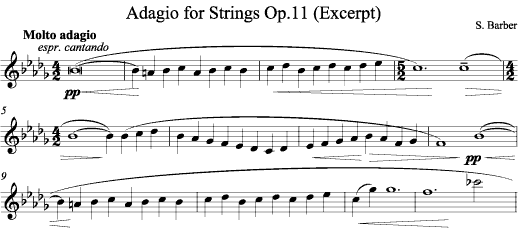
Adagio for Strings Op.11 (Excerpt)

- Identify quickly and accurately the note values involved in simple quadruple meters.
- Conduct simple quadruple meters fluently.
- Count beats, divisions, and subdivisions in simple quadruple meters fluently.