
Overview
Objectives
Upon completion of this lesson, you will be able to do the following:
- Recognize some of the key American and Cuban jazz artists and their contributions to Latin jazz
- Recognize some of the international figures in jazz who contribute to the globalization of jazz
- Recognize some of the recent jazz artists, both mainstream and progressive, whose art continues to fuel the debate about the future of jazz—and what jazz is
Michael Brecker
Michael Brecker (1949-2007) is widely considered one of the most influential tenor saxophonists since John Coltrane. Born in Philadelphia, he was already playing sessions in New York by age 18. He showed the ability to excel and innovate in jazz-rock fusionA musical genre blending jazz and rock and roll music. as well as mainstream approaches. He and his brother Randy formed The Brecker Brothers in the 1970s and explored a highly successful funky approach to fusion. During the 1980s he began experimenting with the newly invented EWI (Electronic Wind Instrument), becoming one of the few experts on this instrument.
Brecker's eclectic style of playing made him the most widely copied saxophonist of the day. His robust approach to improvisation made him the most in-demand horn player in the 1990s and early 2000s.
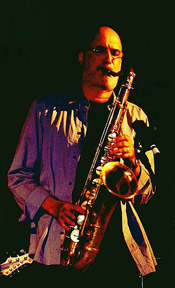
From his 1987 self-titled debut album as bandleader comes the piece Nothing Personal ♫.
It's an abstract-sounding 24-bar blues in G minor, built around a sort of call-and-responseA musical “back-and-forth” characterized by alternations between two groups, or between a soloist and a group. , which we hear twice (0:24-1:09). Short melodic bursts led by sax are answered by piano. The tempo is brisk, but the 24-bar form broadens the sonic terrain, providing lots of space for the soloists to stretch out. Guitarist Pat Metheny leads the way, and he is superb (1:10-2:22). Then we hear from the bandleader (2:23-4:22), demonstrating in two minutes' time the luminous sound, the wealth of invention, the logical coherence of his improvisatory flights, all of which earned him widespread acclaim and admiration. Let's listen Nothing Personal ♫.
Brecker was also a composer. From his critically acclaimed 1996 album Tales from the Hudson, the opening track, Slings and Arrows ♫, is one of his compositions, an AABA song form with irregular section lengths. It's a bright, engaging, modal piece that — like Grolnick's Nothing Personal ♫ — provides plenty of space for the soloists.
Pat Metheny joins Brecker again, and he leads the way with a dazzling solo (0:52-1:52). Brecker follows suit, once again treating us to his energetic and highly expressive virtuosity (1:53-3:20). Pianist Joey Calderazzo is next, keeping pace with his own admirable solo work (3:21-4:44). After an abbreviated return to the head, a broad codaThe concluding passage of a piece of music, typically forming an extension to the basic structure. closes the piece, featuring solo work from drummer Jack DeJohnette, along with some closing licks from Brecker. Let's listen Slings and Arrows ♫.



