
Learning Objectives
- Examine the history of modes in Western music.
Minor Scales I: Introduction
Overview
We began our unit on major scales by noting that there are many types of scales. In this unit, you will learn about another very important type of scale: the minor scale. Major and minor scales are both seven-note scales that are made up of whole steps and half steps. Another word for this type of scale is a mode. When a piece is based on a major scale, it can be said to be in the major mode. Similarly, if it's based on a minor scale, it is in the minor mode.
The origin of the major and minor modes can be traced back to the church modes that were in use during the Middle Ages and the Renaissance (ca. 800-1600). Each of these modes had a different order of whole and half steps within a seven-note scale. There were originally eight different church modes, which were given Greek names like Dorian, Phrygian, and Mixolydian. These modes were associated with different moods or characters. Gradually, the music that composers wrote gravitated towards the two modes that are in common use today: major (which they called Ionian mode) and minor (which they called Aeolian mode). These two modes presented two contrasting moods, with major generally being perceived as bright and cheerful while minor was percieved as dark and sad.
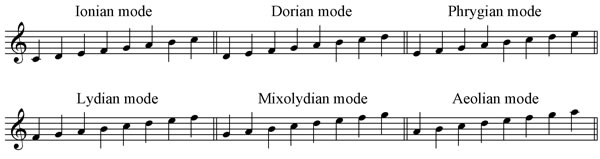
From the seventeenth century to the early twentieth century, most music in the Western tradition was written using major and minor keys alone. In the twentieth century, composers began to experiment with other types of scales as well, and some composers began writing atonal music, which does not convey any sense of a tonic or key. This does not mean that composers stopped using major and minor. There is certainly still plenty of music being written today in major and minor keys, but modern composers have many other alternatives as well, ranging from the church modes of ancient times to the atonal music of the twentieth century.
The older church modes are sometimes used today in jazz, folk music, and popular music. We will not be studying them further in this class, but if you are interested in learning more about them, it should not be hard to do with the knowledge you have gained from this course. We will now turn our attention to the minor mode and in particular to the minor scale.