
Learning Objectives
- Use the circle of fifths to compare and relate all of the major and minor scales.
Minor Scales VIII: Circle of Fifths
The Circle of Fifths in Minor
When we learned about major scales, we used the circle of fifths to better visualize all of the major keys and key signatures. We can also use the circle of fifths to represent minor keys. Click on "Minor" in the interactive diagram below to see the minor keys around the circle of fifths. Now click on "a" to see the key signature of A natural minor. Continue around the circle with E minor (1 sharp), B minor (2 sharps), F-sharp minor (3 sharps), and so on. As you click around the circle, you can use the virtual keyboard in the middle of the circle to play the scale that corresponds to each key. Click on "Major" to see how the major and minor keys are related on the circle of fifths.
The Circle of Fifths
| The circle of fifths |
We can also combine these two systems into a "double circle of fifths," with the major keys shown along the outside of the circle (using uppercase letters) and the minor keys on the inside of the circle (using lowercase letters), as illustrated below. This double circle of fifths shows the 15 major keys and their corresponding relative minors. Remember that relative keys share the same key signature, so they should always line up together on the circle. See, for example, the relative keys of F major and d minor (1 flat) or G major and e minor (1 sharp). These pairs of relative keys are always on the same "slice" of the circle of fifths "pie."
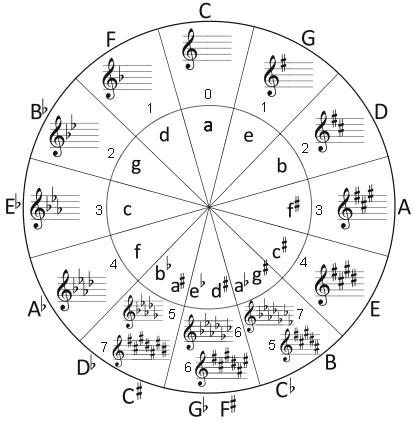
Although not represented quite as directly in the diagram, we can also see parallel keys in the circle of fifths. Remember that parallel keys have the same tonic but different key signatures, and that their signatures differ by three accidentals. Therefore, by shifting three positions to the right or to the left, we can find keys that have parallel relationships. For example, if we start with C major (outer circle) and shift three positions to the left (adding three flats), we land on c minor (inner circle). Likewise, if we start with a minor (inner circle) and shift three positions to the right (adding three sharps), we land on A major (outer circle).
The circle of fifths can help you to synthesize all of the information you have learned about major and minor keys, key relationships, and key signatures. Take time now to review all of this information to prepare for the two quizzes that follow. The first quiz will test your knowledge of key signatures (both major and minor) and the second will test your knowledge of minor scales (including the natural, harmonic, and melodic forms).