
Overview
In the early 1940s, a number of innovative and daring jazz musicians began searching for a new style. In after-hours jam sessions, they experimented with new melodic and harmonic vocabularies that challenged listeners and musicians alike. This music would come to be known by its onomatopoeic description: bebop.
In this section, we will first focus on the two principal innovators of this new jazz style: Charlie Parker and Dizzy Gillespie. We will also discover how the swing-style jazz of Count Basie provided a basis for the transition to bebop and the advent of the modern jazz era. In the second half of the section, we will discover other influential musicians who helped shape bebop and modern jazz.
Objectives
Upon completion of this lesson, you will be able to do the following:
- Identify Charlie Parker and Dizzy Gillespie as the principal innovators who contributed to the development of bebop
- Appreciate bebop as a new approach that ushered in modern jazz
Misterioso and Straight, No Chaser
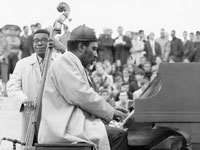
One of Monk's earliest recording sessions as bandleader took place in 1948 when he put together a quartet featuring vibraphonist Milt Jackson. Misterioso ♫ is one of several pieces he recorded with Jackson. It's a standard 12-bar blues piece with a theme based on a very simple presentation of "walking sixths," as jazz musicians would say.
Walking sixths involve the alternation of two scale-wise lines a sixth apart, either ascending or descending.
In their normal up-tempo setting, walking sixths are often heard in the boogie-woogie style of early jazz piano, a relative of stride piano. In this case, though, the tempo is slow, and Monk is not even swinging the eighth notes in his initial presentation of the tune — arguably, a brilliant stroke of simplicity.
Jackson is the first to solo, and at that time the rhythm section begins to swing. Jackson's lines bear the intricacy of bebop while also conveying a blues-infused warmth. Monk also takes his turn soloing, and we are treated to the intricacies and nuances of his melodic and harmonic language, which can at times seem deceptively simple. Let's listen Misterioso ♫.
As a composer, Monk contributed several standards to the bop repertoire. Straight, No Chaser ♫ and Round About Midnight ♫ were two of his most frequently performed works by other beboppers. Still, it was Monk's own recordings that provided touchstones to which other performances were compared. And many of his compositions were so distinctive that they seemed to belong to Monk alone. Fortunately, the composer recorded extensively through the '50s and early '60s in different ensemble settings.
Let's listen to Monk's quintet from 1951 in a performance of his classic piece Straight, No Chaser ♫, an up-tempo 12-bar blues number that gains distinction compositionally by Monk's rhythmic displacement of a repeated motif. This is a distinctive performance that might well be regarded as one of his touchstone recordings. After a 12-bar introductory solo by drummer Art Blakey, Monk carries the melody over the first chorus. Like so many jazz performances of blues pieces, the tune is repeated, this time with alto saxophonist Sahib Shihab reinforcing the melody. Then follow five choruses of solos, two from Monk, one from Shihab, and two from Jackson. The tune returns for the final two choruses, and the entire piece is completed — compactly and perfectly.
The overall effect is a marvel. The tune is simple, a study in economy, yet the rhythmic displacement of the motif reaches us at an unconscious level. The piece is infectious, and the soloists here do not overreach. They simply realize the tune's potential through their own expressive means.



Dizzy Gillespie played his trumpet with the bell turned upwards at a 45-degree angle. Gillespie discovered he liked the sound that it created after someone fell on his trumpet stand causing the bell to bend.
