





Baroque Period (1600–1750)
Claudio Monteverdi
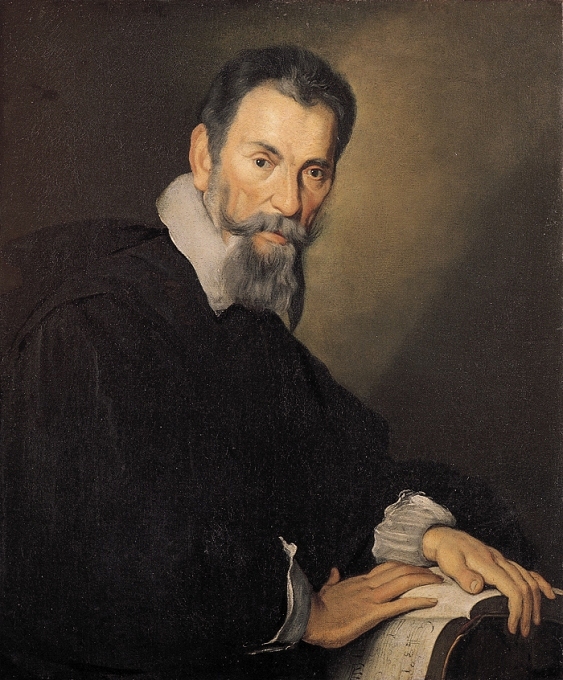
Monteverdi is the most important Italian composer of the early to middle Baroque period, and, indeed, one of the most influential figures in the history of music. His music represents the transition from the Renaissance to the Baroque period.
Born in Cremona in 1567, Monteverdi served at the court of the Dukes of Mantua from the early 1590s until 1612. That year, he moved to Venice as maestro di cappella (the chapel music master in charge of all musical activities) at the basilica of St. Mark—one of the most coveted musical posts in Italy at the time, which Monteverdi was able to retain until his death in 1643. His importance as a proponent of the stile moderno is unquestioned, as is his preeminence in the development of opera that sprang from the combination of music and speech called the Italian monody. Monteverdi's early baroque stile moderno—also called seconda pratica ("second practice")—advocated for freedom from the rigorous limitations of dissonances and counterpoint characteristic of the prima pratica ("first practice") of his predecessors at St. Mark's: Andrea and Giovanni Gabrieli, Palestrina, and the theorist Gioseffo Zarlino.
Composer: Claudio Monteverdi
-
"Canzonette d'Amore; Monteverdi, Claudio"
Monteverdi's Works
Operas
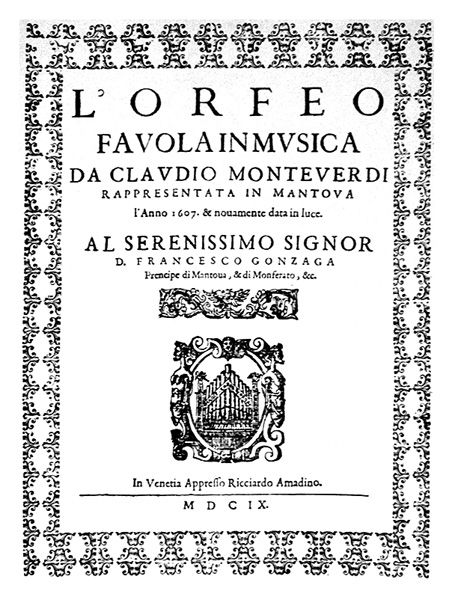
In 1607, Monteverdi established himself as a composer of major works with his opera L'Orfeo, which is considered to be the first great opera. L'Orfeo is based on the legend of Orpheus, the musician who sought to bring his beloved Eurydice back from the Underworld by the power of music. L'Orfeo synthesized several important operatic elements: instrumental overture, aria, recitative, ensemble, and chorus.
Instrumental Overture
Composer: Claudio Monteverdi
-
"L'Orfeo: Overture"
Aria
Composer: Claudio Monteverdi
-
"L'Orfeo: Possente spirto (Excerpt)"
Recitative
Composer: Claudio Monteverdi
-
"L'Orfeo: Rosa del ciel"
Ensemble
Composer: Claudio Monteverdi
-
"Canzonette d'Amore; Monteverdi, Claudio"
Chorus
Composer: Claudio Monteverdi
-
"L'Orfeo: Lasciate I monti"
After L'Orfeo, L'Arianna (Mantua, 1608) became one of the most influential operas in Europe. Wildly popular, the opera featured the celebrated aria "Lamento d'Arianna", which was admired and imitated by composers until the end of the century.
Composer: Claudio Monteverdi
-
"L'Arianna: Lamento d'Arianna"
Two major works represent the culmination of Monteverdi's operatic output: Il Ritorno d'Ulise in Patria (The Return of Ulysses, first performed in Venice in 1640), based on the final portion of Homer's Greek epic The Odyssey, and L'incoronazione di Poppea (The Coronation of Poppea, first performed in Venice in 1642), which was set in imperial Rome in the time of the Emperor Nero, whose love for the courtesan Poppea is the subject of the opera.
Monteverdi's operas introduced elements that held tremendous public appeal; so much that these elements would remain intact in Italian opera for almost 300 years with only minor modifications.
- Topics were simultaneously classic and modern as the basis for entire productions, thus creating powerfully dramatic situations.
- Bel canto arioso was used for virtuoso singers. The bel canto arioso had tuneful, rhythmic, easy-to-remember melodies with major and minor harmonies.
- Music contained a combination of recitative and arioso passages.
- The orchestra was not merely a background but an active participant, adding to the expressiveness of the music. L'Orfeo alone contained 14 independent orchestral pieces (symphonies). Monteverdi was one of the first composers to include indications for specific instruments in the orchestral parts.
Madrigals
Monteverdi is also famous for the madrigals he published between 1587 and 1606. Until his 40th birthday, he mainly worked in this genre, composing a total of nine books. These works are particularly important because they highlight the transition between the prima pratica—Renaissance polyphony based on equality of voices—and the seconda pratica—in which an increasing hierarchy of voices emphasized the soprano and bass. Pieces like Canzonette d'Amore, although not as extreme in the use of chromaticism as those of Gesualdo, provide further evidence that madrigals featured the most daring music to be found in the early Baroque period and underscore Monteverdi's basic artistic tenet that music must carefully follow the declamation of words and the mood of the verse.
Composer: Claudio Monteverdi
-
"Canzonette d'Amore; Monteverdi, Claudio"
Church Music
When Monteverdi arrived at St. Marks in 1612, opera had not yet been introduced in Venice. Earlier in 1610, he had composed a setting of the service of Vespers of the Blessed Virgin Mary in the stile moderno, possibly to showcase his abilities to the officials of St. Mark's. In the tradition of the great Giovanni Gabrieli (c. 1554-1612), his predecessor in the post, Vespers exploited the possibilities of the new style by taking advantage of the open spaces available to performers in the great basilica of St. Mark. Along the same lines, the piece also featured repetition and contrast, with many of the parts having a clear ritornello. The grand scale of the work foreshadowed such masterpieces of Baroque church music as Handel's Messiah and J. S. Bach's St. Matthew Passion.
Composer: Claudio Monteverdi
-
"Vespro della Beata Vergine, SV 206: Vespers of the Blessed Virgin: Domine ad adiuvandum"
Jean-Baptiste Lully
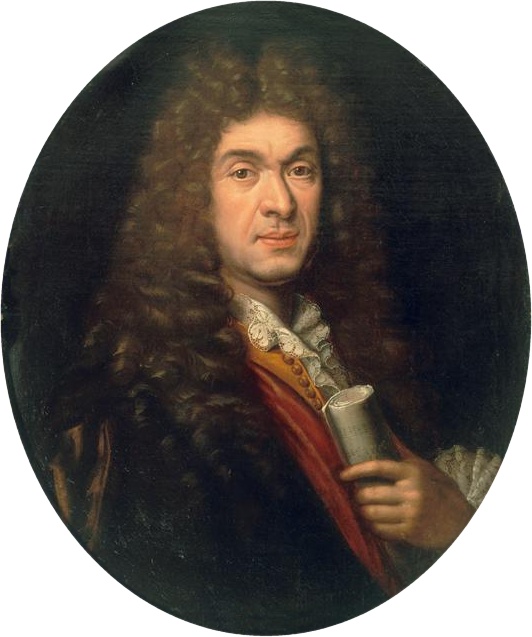
France was the last European country to embrace opera during the 1670s under King Louis XIV. It did so with the help of Italian-born composer Jean-Baptiste Lully (1632-1687), who became one of the most powerful musical figures of the late 17th century in France.
Lully succeeded in transforming the Italian opera into a distinctly French form called tragédie lyrique ("lyric tragedy") with operas such as Armide (1686), which showcase the typical characteristics of the tragédie lyrique:
- Plots based on stories from Classical mythology or, as is the case in Armide, on tales of medieval chivalry, taken from the romances of Italian writers such as Montalvo, Ariosto, and Tasso.
- The stories may not have a tragic ending—in fact, they generally don't—but the atmosphere must be noble and elevated.
- Opera is divided in five acts, which usually open with an aria in which one of the main characters expresses their feelings, followed by dialogue in recitative interspersed with short arias (petits airs), in which the main plot is developed.
- Use of chorus and ballets.
Composer: Jean-Baptiste Lully
-
"Ballet de Xerxes: Bourrée pour les Basques"
Though not his final composition, Armide was his last complete lyric tragedy. It was an instant and enduring success: a crowd-pleaser at its initial production and a perennial favorite of audiences and critics in the eighteenth century. Much to the French audience's delight, Lully was able to successfully adapt the recitative to the intricacies of the French language.
Another key feature of Lully’s opera was his addition of the French overture. This independent instrumental composition opened the opera, and it was later also used as the first movement of instrumental compositions such as the sonata and concerto.
Henry Purcell
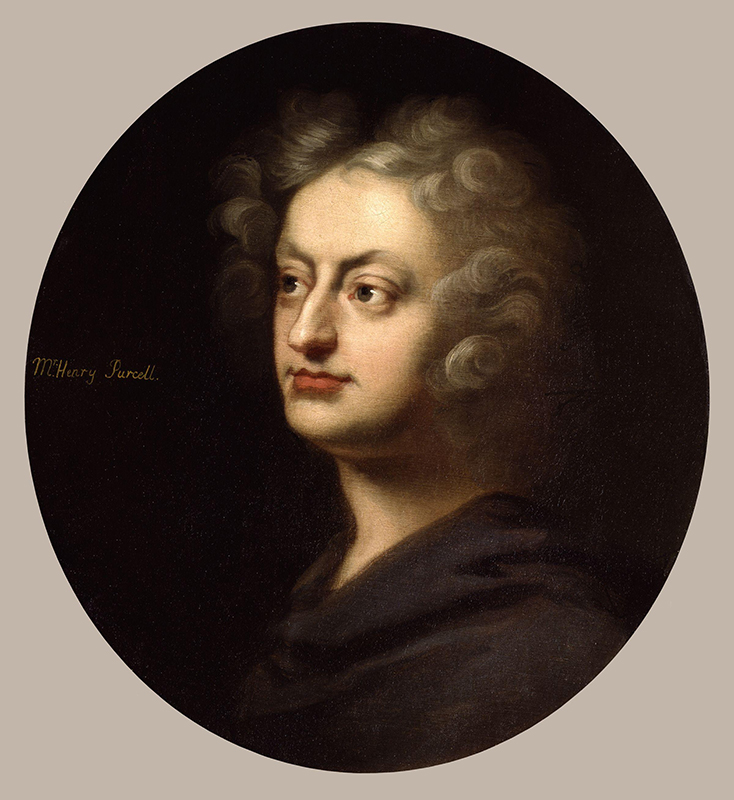
The last great English-born composer until Sir Edward Elgar in the late nineteenth century, Purcell represents the culmination of the English Baroque style. English composers of the time ignored the styles of continental Europe in favor of an English national style. Purcell, however, strongly resisted this trend. Instead, he adopted Italian forms. In doing so, he established a foothold for opera in England, while simultaneously composing in all of the major genres. His operatic works include Dioclesian (1690), King Arthur (1691), The Fairy Queen (1692), and The Tempest (1695). His masterpiece Dido and Aeneas (1689), the story of a doomed love affair between Aeneas (the hero of Virgil's Aeneid) and Dido (the queen of Carthage) was the first resounding public success in the history of English opera.
Dido's arias "Thy Hand, Belinda", and "When I'm Laid in Earth" are two of the best-known moments in all of opera. "Thy Hand, Belinda" is also a fine example of ground bass, a Baroque technique whereby the composer repeats a melodic pattern in the bass continuously through the piece.
Composer: Henry Purcell
-
"I will sing unto the Lord"
Composer: Henry Purcell
-
"Dido and Aeneas: Thy Hand Belinda"
Composer: Henry Purcell
-
"Dido and Aeneas: When I am laid in Earth"