
Overview
Around the turn of the twentieth century, several styles and genres of music came together, and the city of New Orleans provided the catalyst for the formation of jazz. The earliest style of jazz, and one that remained popular for decades after its inception, was called Dixieland. Dixieland, like other types of jazz, allows us the chance to look at many issues of musical, racial, and commercial issues in the first quarter of the twentieth century.
Objectives
- Examine the predecessors of jazz and the diversity of styles and genres that combine in order to create the earliest jazz
- Identify the instruments, musical form, and performance style of Dixieland jazz
- Examine how the issues of race affected the earliest commercial distributions of jazz
- Identify the key figures and songs in Dixieland jazz
Musical Components of Dixieland jazz
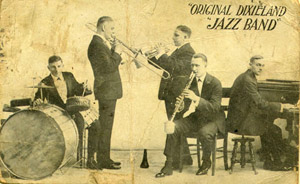
The earliest type of jazz was typically known as Dixieland. A Dixieland jazz combo almost always had a trumpet, a clarinet, and a trombone. The rhythm section of the combo varied, including some combination of banjo, guitar, piano, tuba, upright bass, or drum set. The banjo, guitar, and piano provided the harmony, the tuba or bass provided the bass line, and the drum set kept time and sometimes offered contrasts and fills. Much like in ragtime, the rhythm section played relatively steady beats and rhythms, and the trumpet, clarinet, and trombone played syncopated melodies.
This combination of instruments resulted from the collision of several musical genres. First, the brass instruments (trumpet, trombone, and tuba) came from the marching band tradition. The banjo and guitar were instruments common to the rural blues, as we learned in an earlier lesson. The piano provided harmony, and most middle-class homes had pianos in the nineteenth century. The upright bass came later, and it replaced the tuba as the bass line instrument. Finally, the clarinet came not from the marching band tradition but from the orchestral tradition. Although black musicians typically were not permitted to play in theater and professional orchestras, musicians who were Creoles of color could. In New Orleans in the late nineteenth century, most Creoles of color, who were of mixed French and African heritage, were treated equally to whites. After the Supreme Court decision of Plessy v. Ferguson (1896) determined that "separate but equal" laws were constitutional, Creoles of color were crowded out of theater and professional orchestras and left with nowhere to go. Thus, they began playing their instruments alongside black musicians and introduced the clarinet to the Dixieland combo.
The vast majority of the earliest jazz pieces were in the 12-bar blues form. As we saw in earlier lessons, the 12-bar blues was a popular genre of African American music throughout the nineteenth and twentieth centuries. To review, the 12-bar blues was 12 measures (bars) long and featured a predictable harmonic and textual structure. The performers relied on gestures such as blue notes, or harmonic and timbral variations, as a means of musical and emotional expression. Blue tones and timbral variety were not limited to vocal genres: instrumental jazz musicians exploited harmonic and tonal palettes of sound in order to make their performances as exciting as possible.
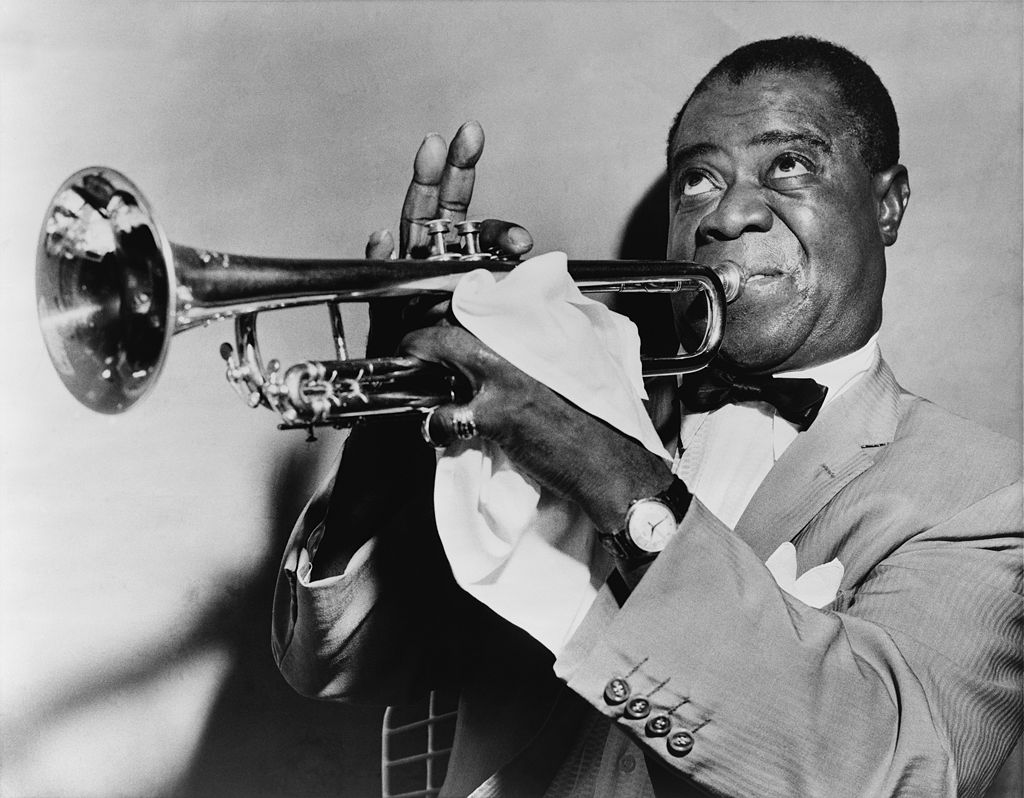
Playing with mutes, singing into the instrument while playing, slurring through several pitches, and wavering or shaking on sustained pitches were just a few of the ways that early jazz musicians experimented with interesting tone colors and timbres.
Most Dixieland jazz performances featured multiple repetitions of this 12-bar blues pattern, and each repetition was called a choruseach repetition of a 12-bar blues pattern in performances of Dixieland jazz. This term should not be confused with the refrain (chorus) of a popular song, because these Dixieland choruses did not have any verses. The ensemble would play the first chorus and the last chorus together, but each chorus in the middle featured a different soloist from the ensemble. "West End Blues ♫," recorded by Louis Armstrong and his Hot Five in 1928, is a classic example of this Dixieland style. In fact, one of the choruses of "West End Blues ♫" features not an instrumental solo, but Armstrong singing in his classic "scat" style in a duet with the clarinet, demonstrating call and response. In scatsinging style where nonsense syllables take the place of actual words, and the voice often imitates the sound of an instrument; Louis Armstrong is often credited as the inventor of this style of delivery singing, nonsense syllables take the place of actual words, and the voice often imitates the sound of an instrument. Timbre is a critical part of "West End Blues ♫": Armstrong’s gritty voice and scatted syllables, the use of woodblocks, the lengthy trombone slides, and each instrument’s use of wide vibrato all create timbral variety and interest throughout the recording.



