
Overview
The history of jazz rightly begins in the city of New Orleans. In this section, we will learn about great New Orleans jazz musicians and their early recordings in Chicago. In the process, will also learn about the emerging Chicago jazz scene and some of the artists from that area who helped develop early jazz musical styles. Finally, we will do a short overview of early jazz in New York.
Objectives
Upon completion of this lesson, you will be able to do the following:
- Define collective improvisation
- Identify early jazz musicians and their contribution to jazz music
- Appreciate the significance of Dixieland jazz
- Recognize the impact Chicago had for musicians of early jazz
- Recognize the growing importance of New York for further developments in jazz
- Define chord substitutions
New Orleans Jazz
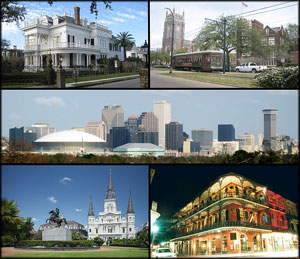
The earliest jazz was performed in the dance halls, barrelhouses, bordellos, and streets of New Orleans, and on the banks of Lake Pontchartrain. In and around New Orleans, music was the focal point of nearly every aspect of life. Bands there, drawing upon the various influences of ragtime, blues, and the brass band repertoire, would "jazz up" the music by taking liberties with it. The melody might be syncopated and embellished. The accompaniment instruments might also be improvised according to a performer's understanding of the chord progression. The music that resulted came to be known as New Orleans jazzThe earliest jazz, created and performed in and around New Orleans during the first two decades of the twentieth century by African Americans.(New Orleans Bump ♫), a style noted for its collective improvisationA characteristic feature of New Orleans jazz in which multiple instrumentalists improvise together according to agreed-upon conventions.. The interweaving of the various accompaniment lines around the main melody created this characteristic sound.
The trumpeter (often on cornet in the early years) carried the melody. The clarinetist would provide a decorated counter-melody in the upper register, referred to as the obbligato melodyIn New Orleans jazz, a second melody played on the clarinet, subordinate to the principal melody played on cornet, characterized by arpeggios that often outline the chords of the progression, weaving around the principal melody.. The trombonist would reinforce the chord progressions in the middle-lower register, while the tuba or double bass player provided the bass notes. Frequently a banjo or piano player would sound the chords on the beat, while the drummer provided additional rhythmic drive.
To gain an idea of what this collective improvisation sounds like, let's have a preview of a recording we will listen to again shortly, Dippermouth Blues ♫. We can hear distinctly the interweaving of the three principal horns — cornet, clarinet, and trombone — especially in these three passages: 0:05-0:36, 1:10-1:26, and 2:15-2:32.
While some musicians could earn a living playing music, most members of the dozens of New Orleans bands pursued their music at the end of a day's labor. The hot and "dirty" sounds of New Orleans' nascent jazz music came from African American skilled laborers: masons, carpenters, plasterers, cigar makers, and the like. By and large, these musicians played by ear, and the art of jazz improvisation originated with them. Their sound became so popular that other musicians — the black Creole bands and the white bands — began to imitate them1.



Joe Oliver was innovative in his use of a variety of mutes (including derbies, bottles, and cups) to alter the sound of his cornet.
