
Learning Objectives
- Differentiate between orally transmitted folk music, called minsok kugak, and recent cultural globalization, fushion kugak (“fusion Korean music”) and ch’angjak kugak (“newly made Korean music”), which have come to dominate the contemporary traditional Korean music scene.
- Examine Korean music as acoustic reflections of Korea's historical, geographical, and ethnic identity, addressing such attributes as tone quality, tempo, vibrato, continuity, syncopation, modal and rhythmic shifts.
- Analyze the philosophical foundations of Korean court music, which is rooted in the teachings from the ancient Book of Ceremony, one of the most important sources of Confucian scholarship.
- Distinguish between Korean musical instruments, such as the 21-string kayagûm, a zither from Kaya, and the 6-string kômun´go with their other East Asian counterparts such as the Japanese koto, the Chinese guzheng, and Vietnamese dan tranh
- Analyze Korean music´s transition from workplace to stage as a metaphor of human evolution from tribe to a complex, industrial society.
- Examine the context of the hierarchy of court music, folk music as classified by regions, as well as differentiate these music(s) in terms of functionality, such as ceremonial, celebratory, processional, leisure, labor, healing, purging, or praying.
Philosophical Foundations of Korean Music
In matters private and public, official and unofficial, practical and philosophical, secular and sacred, ancient Koreans sought guidance and direction from the timeless principle of ûmyang-ohaeng—"two ways and five roads," i.e., two complimentary axles transacting with five universal elements and their material, seasonal, directional, color, and animal symbolisms:
| ûmyang-ohaeng | |||||
|---|---|---|---|---|---|
| 1 | 2 | 3 | 4 | 5 | |
| Material | Wood | Fire | Earth | Metal | Water |
| Season | Spring | Summer | Autumn | Winter | |
| Direction | East | South | Center | West | North |
| Color | Blue | Red | Yellow | White | Black |
| Animal | Blue Dragon | Red Peacock | White Tiger | Black Turtle | |
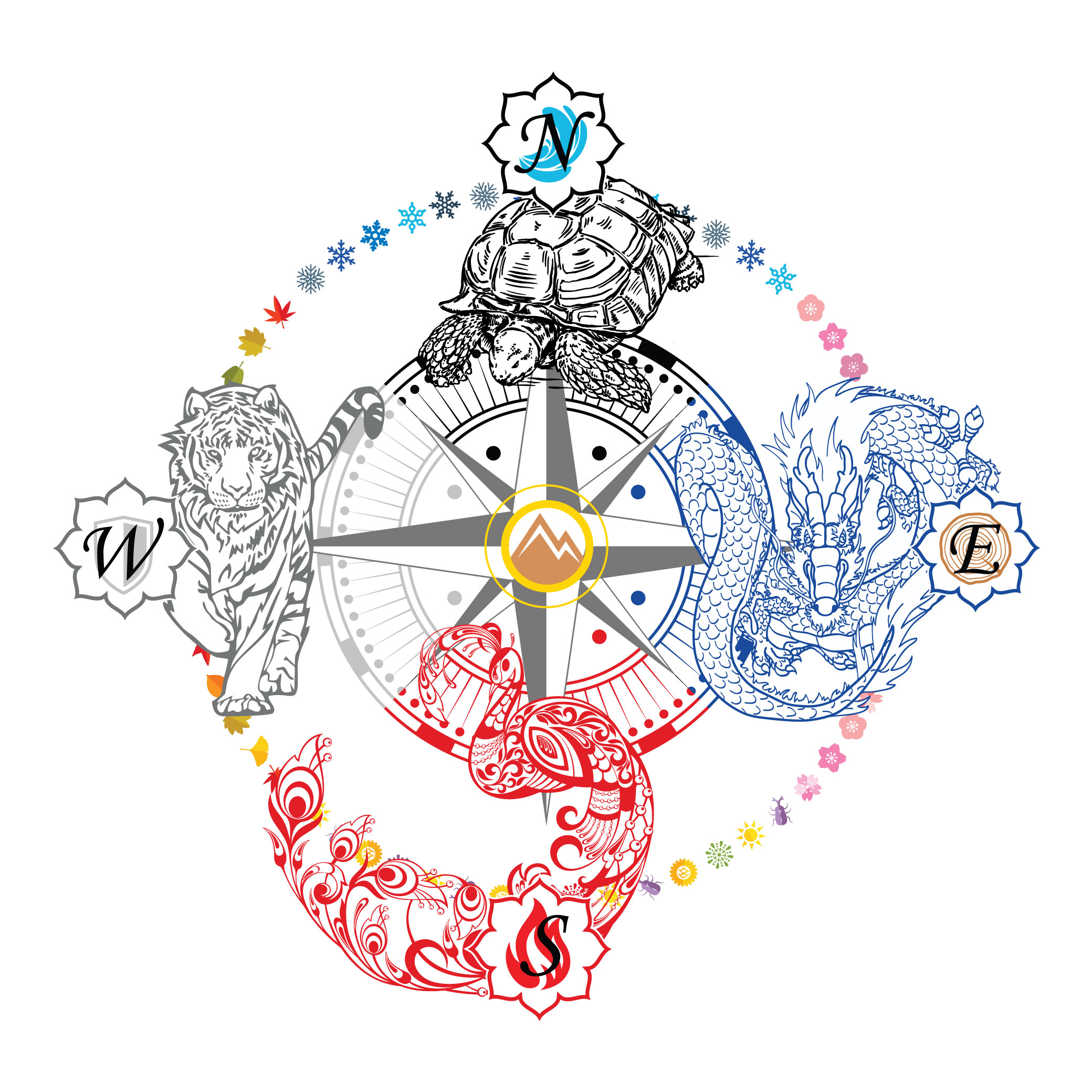
All physical and mental transactions in life are the results of their encounters, and ancient Koreans took care to make favorable such important matters as matrimony, birth, healing, and burial. The five elements in the context of human physiology represent the five organs, as the mystic explains in his diagnosis of the cause of Dragon King's illness in the p'ansori[2]Indigenous Korean tradition of story singing. version of Song of the Underwater Palace:
|
Lyrics
|
|
Heart and small intestines are fire, liver and gallbladder, wood,
Lung and large intestines, metal, kidney and bladder, water, and spleen and stomach, earth. When liver’s enlarged, Wood suppresses earth and weakens spleen and stomach. Gallbladder over-activity causes nerve hypersensitivity, ung and large intestinal over-activity weakens liver and gallbladder[3]Translated from <em>The Song of Medicine</em>, from P'ansori <em>Sugungga</em>, <em>Song of the Underwater Palace</em>, one of the five remaining p'ansori narratives still sung. The Dragon King of the Underwater Palace falls ill. All the medicines and doctors cannot cure him. But a mystic lands from heaven, and checking the king's pulse, delivers this basic diagnostic principle.. |



Korean traditional music can be divided into Korean folk music, aristocratic chamber music, Korean court music, and religious music.
