





Renaissance Period (1450–1600)
Music in the Renaissance Period
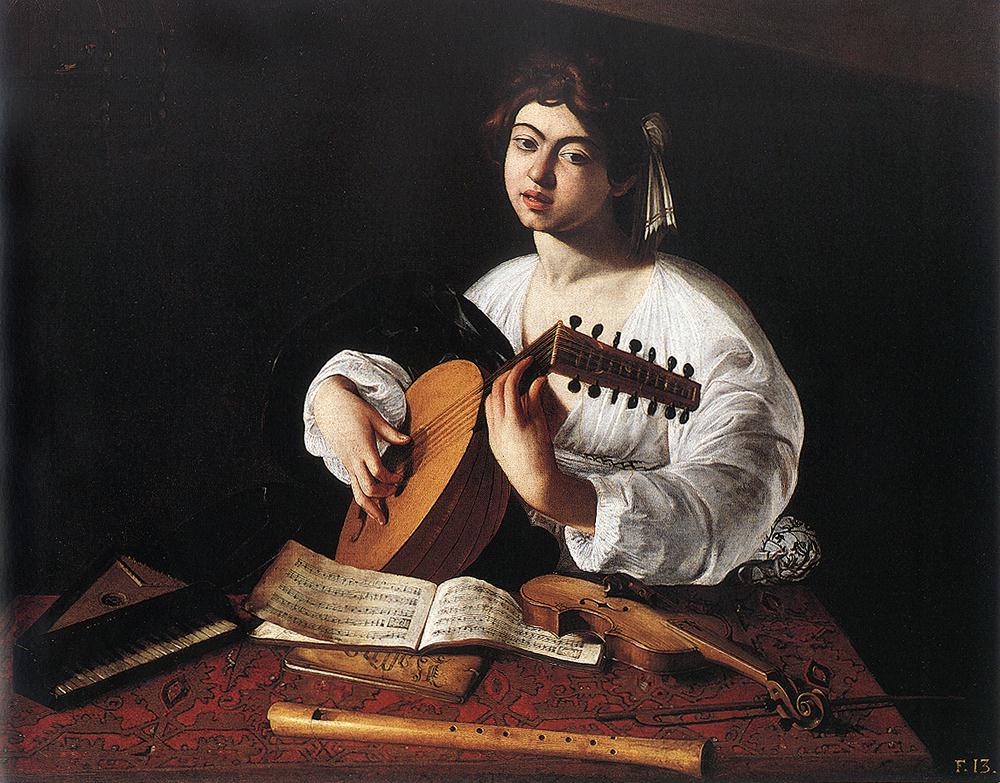
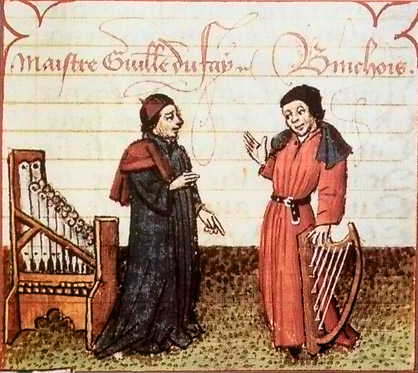
Precisely when the Renaissance period in music began is a matter of debate. Some historians place it at about 1400 with the generation that includes Gilles Binchois, also known as Gilles de Binche or Gilles de Bins (c. 1400-1460), and Guillaume Dufay (c. 1398-1474). Other historians argue that the rise of imitative counterpoint around 1450 ushered in the Renaissance, while still others place the beginning closer to 1500, when humanism created a strong link between music and poetry. Nevertheless, it is commonly accepted that the secular music associated with the Renaissance period flourished in the 15th century, mainly in the Court of Burgundy. The next few sections, will highlight the main characteristics of Renaissance music.
Polyphony
The polyphonic experiments of the Middle Ages reached fruition during the Renaissance, a period in which polyphonic music was produced more abundantly and beautifully than at any other time in music history. New developments in harmony and polyphony meant that music during the Renaissance gradually departed from the rules that had governed it for most of the Medieval period.
Composer: Clément Janequin
-
"Le Chant des Oiseaux"
Vocal Music
The Renaissance is considered the Golden Age of choral music for three main reasons. First, more choral music—mainly for small ensembles—was written in this period than at any other time in music history. Most of these compositions were performed a cappella. Second, all the important forms of the age (motet, mass, anthem, chanson, and madrigal) were choral music forms. Third, across Europe, instruments were still undergoing a standardization process. However, it would still be another 150 years before the modern orchestra took shape.
Choral Music
Composer: John Farmer
-
"Fair Phyllis"
Anthem
Composer: Orlando Gibbons
-
"O Clap Your Hands"
Chanson
Composer: Josquin des Prez
-
"Faulte d'argent"
A cappella
Composer: Tomás Luis de Victoria
-
"O Magnum Mysterium: Kyrie"
Motet
Composer: Josquin des Prez
-
"Ave Maria...virgo serena"
Mass
Composer: William Byrd
-
"Mass for Four Voices: Credo"
Madrigal
Composer: John Farmer
-
"Fair Phyllis"
Gregorian chant was still used as the basis of many polyphonic church compositions. During the Renaissance, composers of sacred music continued the practice of keeping the original chant as the basis for the main melody; they called this chant the cantus firmus (the "fixed song"). The cantus firmus did not necessarily have to occupy the tenor part, although that was still the most common place for it.
Composer: Thomas Tallis
-
"Spem in alium"
Modes and Harmony
Although Renaissance composers, particularly sacred music composers, continued to use church modes, they gradually began adopting modes equivalent to our present major and minor scales. Probably the most important development in Renaissance music, due in part to the work of English composers, was to give harmony a much more important role within the composition.
Composer: Orlande de Lassus
-
"Missa Entre Vous Filles: Credo"
Composer: Tomás Luis de Victoria
-
"O Magnum Mysterium: Kyrie"
Composer: Johannes Ockeghem
-
"Missa Prolationum: Agnus Dei"
Characteristics of Renaissance Music
Below are some of the basic characteristics of Renaissance music.
Form
- Composers made use of pre-existing music, often including entire pieces within a larger composition.
- Repetition and contrast were used in dance forms.
Melody
- An emphasis on melody was one of the most important factors in Renaissance music. Harmonic and rhythmic interest in compositions was centered mostly on the melodic part.
- A large number of compositions of the period were solo songs based on a melody with instrumental accompaniment.
- Melodies, even those for instruments, were vocal in style. Ranges rarely spanned more than one octave.
Rhythm
- Rhythms were free from strict meters, and they were often very complicated.
- Rhythmic phrases were long and overlapped between voices.
Harmony
- Harmony resulted from the interaction of independent melodic lines rather than from pre-planned chord progressions.
Texture
- Until the 16th century, textures were mostly polyphonic, at which point some homophonic textures were used for contrast and variety.
- For the most part, polyphonic textures included the cantus firmus (chant melody) in the lowest voice.
Timbre
- For much of the Renaissance, the human voice was the chosen timbre. Instruments doubled the voices in both sacred and secular music.
- In the 16th century, composers began using instruments without vocal accompaniment, particularly the organ and harpsichord.
- Toward the end of the 16th century, ensembles of string and wind instruments became popular with audiences and composers.
- The lute was the most popular stringed instrument. The vihuela—considered by many to be the precursor of the modern classical guitar—evolved in the mid-1400s in Spain.
Composer: Luis de Milán
-
"Tiento No. 1"