
Learning Objectives
- Recognize the differences between the Medieval and Renaissance periods in terms of society, religion, art, science, and freedom.
- Explain how Renaissance musicians made their living.
- Use relevant musical vocabulary to analyze Renaissance a cappella singing.
- Distinguish the characteristics of Renaissance music, and differentiate between Renaissance music and Medieval music.
- Illustrate how composers used the motet, a sacred genre with a Latin devotional text, to experiment in musical style and texture.
- Describe how Renaissance composers set texts from the Ordinary of the Mass for their polyphonic Masses.
- Describe how instrumental dance music was performed by professional and amateur musicians.
Renaissance Period (1450–1600)
Sacred Music
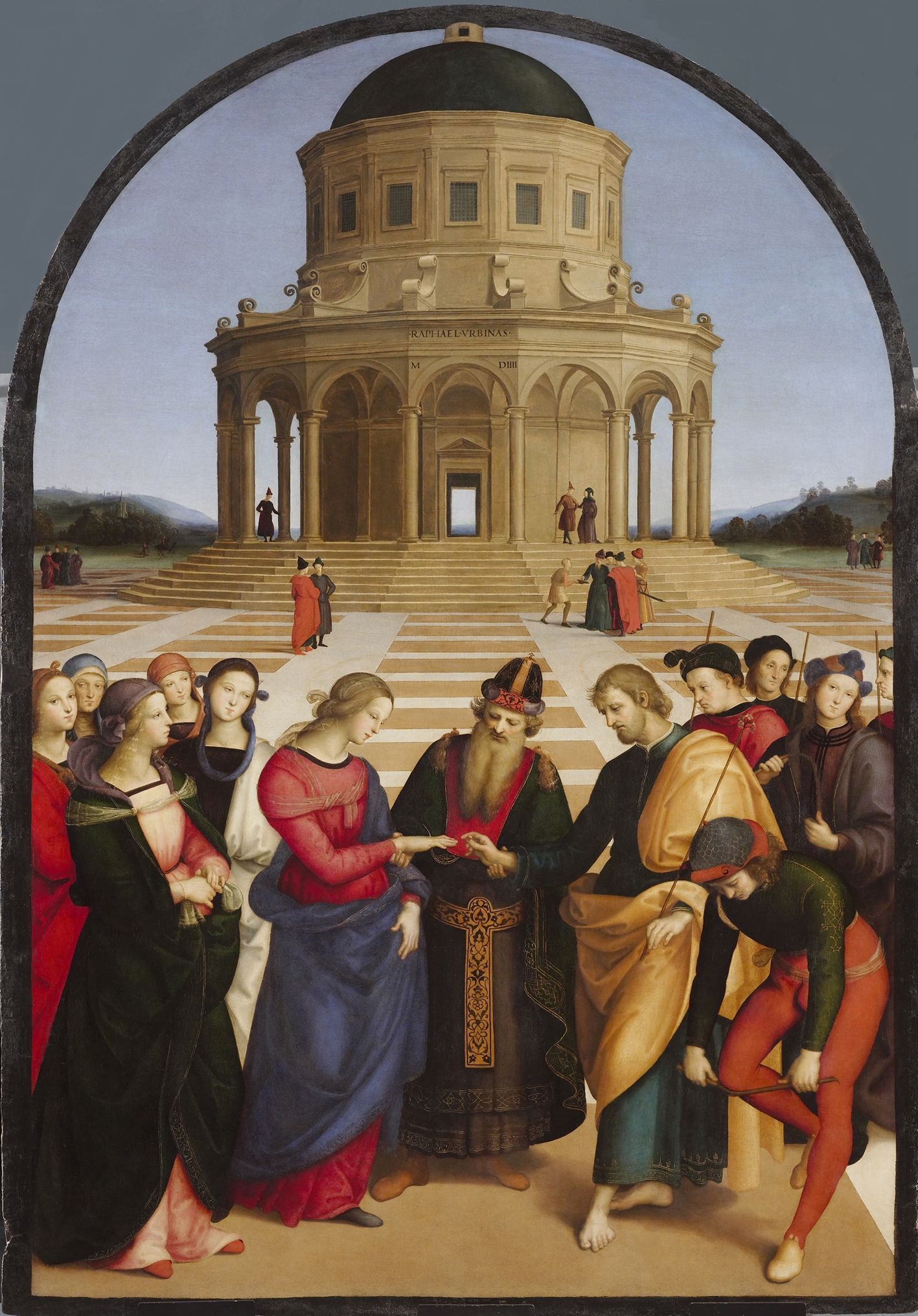
The two principal types of music in the Catholic Church today, the mass and the motet, are both legacies from the Middle Ages and the Renaissance. Previous classes touched upon the texts of the Proper of the Mass, which vary based on the date or occassion. In contrast, the texts of the Ordinary of the Mass (the "ordinary texts") are those that generally do not change. The Renaissance mass was a setting of the ordinary texts to music: Kyrie, Gloria, Credo, Sanctus, and Agnus Dei. It was common practice to use Venit ad Petrum as the basis (cantus firmus) for the mass, although a popular tune might be used instead of a chant melody. Witness, for example, the use of the French secular song "L'homme armé" (The Armed Man) as the cantus firmus in various masses titled Missa L'homme armé, such as Guillaume Dufay's. Certain masses became widely known because of the circumstances under which they were composed, for example, Giovanni da Palestrina's Pope Marcellus Mass, written for the Pope's premature death.
Composer: Josquin des Prez
-
"Ave Maria...virgo serena"
Composer: Giovanni Pierluigi da Palestrina
-
"Pope Marcellus Mass: Kyrie"
Composer: Jacob Obrecht
-
"Missa Caput: Venit ad Petrum"
The Council of Trent in the mid-16th century came close to banning all polyphonic music from the Church, with some religious officials pushing for a return to chant instead. Several scholars maintain that the Pope Marcellus Mass saved polyphony from banishment from the Catholic service. The Kyrie from that mass showcases the style of Giovanni da Palestrina that became the model for future generations of composers. These characteristics are:
- Melodic, plainsong-like quality in individual parts
- Smooth-sounding polyphony and homophony, the melodic movement suggesting the shape of an arch
- Long and elegant music phrases
- Extremely clear texture
- Controlled expressiveness
Evolution of Sacred Music
The music of the Catholic Church underwent a major transformation during the Renaissance. The popularity of the motet toward the end of the 15th century led an increasing number of composers to experiment with church music forms, extending the boundaries of what was acceptable and altering the original chant to the point that it became almost unrecognizable.
The career of Josquin Desprez (c. 1450/55-1521) exemplified the dominance of composers from Northern France and the Netherlands during the Renaissance. He was employed at several locations throughout his career: Milan, the Papal chapel in Rome, in France by King Louis XII, the court of the d'Estes in Ferrara, and finally in his native Condé, where he died in 1521.
Josquin wrote a large number of motets. Many consider him the epitome of Renaissance music achievement with respect to the motet form.
Composer: Josquin des Prez
-
"Ave Maria...virgo serena"
Dominus tecum, virgo serena,
the Lord is with you, Virgin serene,
solemni plena gaudio,
caelestia, terrestria,
nova replet laetitia,
full of solemn joy,
heaven and earth
newly fills with happiness.
nostra fuit solemnitas,
ut lucifer lux oriens,
verum solem praeveniens.
was our solemnity,
so that like a torch, the rising light
the true sun might herald.
sine vero fecunditas.
cuius annunciatio,
nostra fuit salvatio.
without a man made fruitful,
whose annunciation
has been our salvation.
immaculata castitas,
cuius purificatio,
nostra fuit purgatorio.
spotless chastity,
whose purification
has been our cleansing.
angelicis virtutibus,
cuius fuit assumptio,
nostra glorificatio.
angelic virtues,
whose assumption has been
our glorification.
memento mei. Amen.
remember me. Amen.