
Learning Objectives
- Recognize the differences between the Medieval and Renaissance periods in terms of society, religion, art, science, and freedom.
- Explain how Renaissance musicians made their living.
- Use relevant musical vocabulary to analyze Renaissance a cappella singing.
- Distinguish the characteristics of Renaissance music, and differentiate between Renaissance music and Medieval music.
- Illustrate how composers used the motet, a sacred genre with a Latin devotional text, to experiment in musical style and texture.
- Describe how Renaissance composers set texts from the Ordinary of the Mass for their polyphonic Masses.
- Describe how instrumental dance music was performed by professional and amateur musicians.
Renaissance Period (1450–1600)
Secular Music
In addition to being a time of great religious significance, the 16th century was also a period of bawdy earthiness, irreverent humor, and celebration of sensual love. The same composers who created works for the greater glory of God also wrote compositions of an entirely different character. No longer concerned only with the purity of their music and glorifying God, these composers were very much aware of how important it was for the public at large to be aware of their work. In Italy and England, the principal form of secular music was the madrigal, which in France was called chanson and in Germany, lied. The madrigal embodies many of the developments in Renaissance-era secular vocal music.
The first madrigals originated in Italy around 1530. They were designed to convey in as much detail as possible the meanings of the poems on which they were based. The 1588 publication of a volume of translated madrigals in London led to widespread adoption of the madrigal by English composers. Compared to the Italian madrigal, the English madrigal was lighter, less complicated, more humorous in style, and featured simpler melodies and harmonies. John Farmer's Fair Phyllis, included in his 1599 collection, is probably one of the best known examples of a four-part madrigal. Although the facts of Farmer's life are obscure, he is known to have been the organist of Christ Church Cathedral in Dublin, and later, to have lived in London. He is considered to be one of the most accomplished madrigalists of the English school.
Composer: John Farmer
-
"Fair Phyllis"
In addition to innovative forms, Renaissance musicians also looked to Italy for inspiration. In Italy, small, organized schools, referred to as academies, led to the regular gathering and exchange of ideas between artists, poets, and musicians, and to the performance of new musical works. This type of activity was soon imitated throughout Europe. No longer accessible only to the aristocracy and nobility, music gradually became part of the daily lives of common people.
Instrumental Music
During the Renaissance, musicians became increasingly aware of the possibilities of purely instrumental music as opposed to the use of instruments as mere accompaniment for voices. Popular instruments of this period include woodwinds (oboes and recorders of various sizes), strings (from the viol family, the precursor to the violin family), brasses (trumpets and trombones), plucked instruments (the lute), percussion instruments, and keyboard instruments (organ, harpsichord, and clavichord). In "Rodrigo Martinez", a piece with strong folk flavor, an anonymous Spanish composer combines voices, woodwinds, strings, and percussion instruments.
Composer: Anonymous
-
"Rodrigo Martinez"
Keyboard instruments, especially the clavichord, harpsichord, and organ, were also popular during the Renaissance. Keyboard music began as an accompaniment to vocal music and then crossed into dance music. Eventually, original solo compositions of increasing complexity were created based on the dance forms.
Composer: Loyset Compère
-
"Ave Maria Gratia Plena"
Instrumental ensembles of the time were referred to as consorts, and they often consisted of instruments from the same family. For example, there were consorts of recorders, consorts of viols, etc. Galliard a 5 by John Dowland (1563-1626) exemplifies a string consort.
Composer: John Dowland
-
"Galliard a5"
In addition to being one of the most published composers of his time, Dowland published The First Book of Songs or Ayres (1597), the most reprinted music book of its time. Dowland traveled extensively and was also a lutenist and singer. Many consider him among the most important and influential musicians, and possibly one of the greatest songwriters, of the Renaissance. He worked in Paris and Germany, and from 1598 to 1606, he was lutenist to Christian IV of Denmark. After many failed attempts, he was finally appointed as a lutenist in the Court of James I of England in 1612, a post he held until his death. Like so many other great composers, Dowland died in poverty and neglect despite his fame.
The Lute
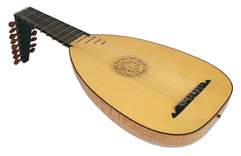
The lute is one of the world's oldest musical instruments, dating back to around 2500 BC. Originating from the Middle East, this instrument enjoyed wide adoption across many cultures. The word “lute” comes from the Arabic al-oud, which literally means branch of wood. Other versions of this instrument may be found in Japan and Africa. The Japanese shamisen is an example of a lute instrument.
Up until the end of the 1700s, the lute was one of the most popular instruments in Europe. Lute music was usually written using a complex system of notation known as tabular notation or tablature, in which numbers and letters of the alphabet represented pitches through finger placement on the instrument's neck and frets. Renaissance instrumental compositions were often written to explore the technical and expressive possibilities of different instruments, including the lute. To this day, there are many societies around the world devoted to the study of the lute, including the Lute Society of America.
The Vihuela
Considered by many to be the precursor of the modern guitar, the vihuela was a very popular instrument in 15th and 16th century Spain and also in Italy and Portugal where it was known as viola or viola da mano. Vihuelas have six doubled strings made of gut, tuned almost like a modern guitar, with the exception of the third string, which is tuned a semitone lower. The vihuela and much of its complex polyphonic repertoire faded away in the late 16th century. Today, modern replicas of historical instruments are used to perform early music.
Typical examples of compositions written for the vihuela include:
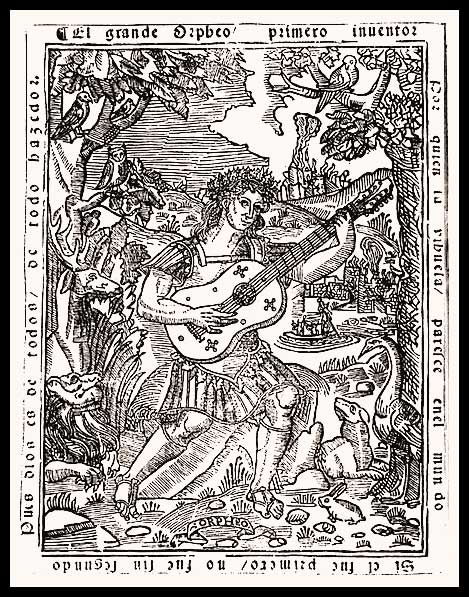

In these compositions, passages are played in fast, repetitive patterns designed to show off the instrument's capabilities and the player's skill.