
Dotted Notes
The duration of any note can be lengthened slightly by adding a dot. A dot placed to the right of a notehead increases its duration by one-half. For example, a dotted quarter note would be equal to the duration of a quarter plus an eighth note (since one-half of a quarter is an eighth note).

Remember
The value of a dotted note is equal to its original duration plus one-half of that duration
Another way of thinking of this is that a dotted note is equal to three of the next smallest note value, as illustrated in the following example. Click "Show Me" to see what happens when a dot is added to the quarter note.
Adding a dot
The following table provides all of the common dotted-note types and their equivalent values. Note that dots can be added to rests as well as notes. For example, a dotted half rest would be equal to three quarter rests.
| Note Value | Symbol and Equivalent Value | Equivalent Rest |
| Dotted Half |  = =  |
 |
| Dotted quarter |  = =  |
 |
| Dotted Eighth |  = =  |
 |
| Dotted Sixteenth |  = =  |
 |
When a notehead is written on a space, the dot simply goes in the same space on the right-hand side of the note. When a notehead is on a line, the dot is placed just above the line rather than on the line, so that it is clearly visible (as illustrated below).
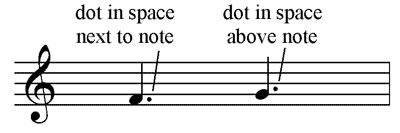
Dot placement
Remember
- Noteheads can be filled in (black) or unfilled (white); quarter notes and shorter durations are filled in.
- Unfilled noteheads may or may not have a stem, but filled noteheads always have stems.
- Flags are only added to the stems of filled noteheads.
- Adding a stem to a note (i.e., whole to half) decreases a note’s duration by half.
- Filling in a notehead (i.e., half to quarter) decreases a note’s duration by half.
- Adding a flag (i.e., quarter to eighth or eighth to sixteenth) decreases a note’s duration by half.

Core Skill
- Be familiar with the notarion rules of dotted notes and rests.
- Interpret the relative duration of dotted notes and rests fluently.