
Learning Objectives
- Relate how Romantic poets and artists abandoned traditional subjects, turning instead to the passionate and the fanciful.
- Relate how the Industrial Revolution impacted the technological development and affordability of musical instruments.
- Analyze how the orchestra grew in size and sound as new instruments were introduced and composers demanded greater levels of expression.
- Illustrate how Romantic composers explored nationalistic folklore and exotic subjects.
- Identify the form of romantic period songs, including strophic, through-composed, and the modified strophic forms.
- Examine the German art song (or Lied) as a favored romantic period genre.
- Discuss how the music of Franz Schubert impacted romantic period music.
- Discuss how the music of Frédéric Chopin impacted romantic period music.
- Trace the ascendance of program music in relation to absolute music.
- Summarize how political unrest throughout Europe stimulated the formation of schools of musical nationalism in Russia, Scandinavia, Spain, England, and Bohemia among other countries.
- Differentiate between the distinct national styles of romantic opera in France, Germany, and Italy.
- Discuss how the Italian nationalist composer Giuseppe Verdi impacted romantic period music.
- Trace how choral music became a popular artistic outlet for the middle classes.
- Discuss how the Russian composer Pyotr Ilyich Tchaikovsky impacted romantic period music.
Romantic Period (1820–1910)
Two Composer–Critics
Robert Schumann and Clara Wieck Schumann
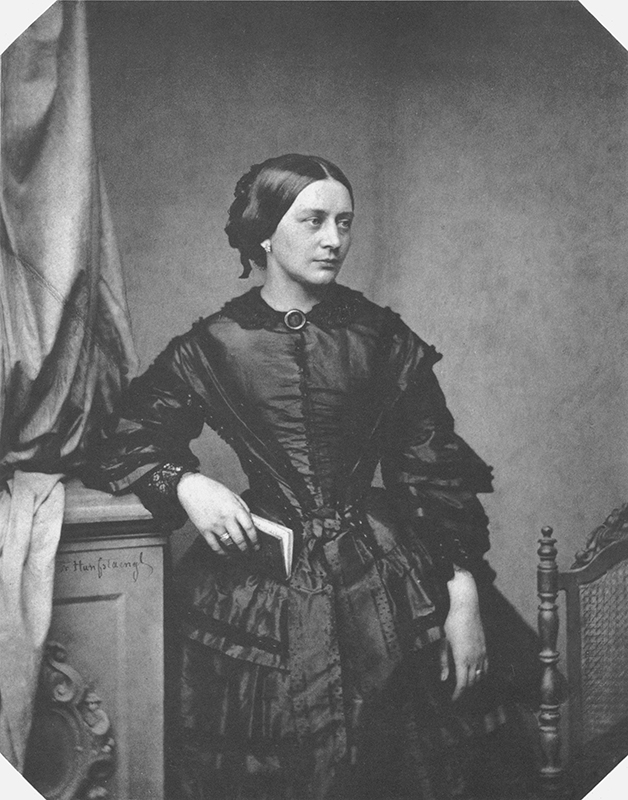
Clara Wieck and Robert Schumann number among the most famous couples in music history. Robert was and is known as the composer, while Clara was the piano virtuoso. Clara also composed many beautiful works, however. She published between 20 and 30 compositions, including a piano concerto, a piano trio in G minor, pieces for piano, Lieder, and works for chorus.
Here is the third movement, a scherzo and trio, from her Sonata in G Minor for piano.
Composer: Clara Schumann
-
"Piano Sonata In G minor: III. Scherzo And Trio"
Robert’s initial aim was to be a pianist, and it was while studying with Clara’s father that he met his wife-to-be. But an injury to his hand stopped him short, and he put his energy into composition. It was Clara who premiered many of his works. The two concertized widely together, with Robert conducting and Clara playing the piano.
Robert was a victim of mental illness and subject to sudden depression. He eventually suffered a mental collapse, attempted to take his own life, and was committed to an asylum, where he died two years later. Clara was left alone to support herself and the couple’s eight children. She did so by teaching and playing concerts. The younger composer Brahms helped her manage her affairs, and the two developed a deep attachment and enduring friendship.
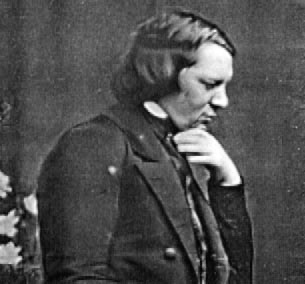
Robert Schumann was a master of the miniature. His piano compositions are, for the most part, loose collections unified by fanciful literary titles and wordplay. His popular Carnaval is a series of short musical scenes based on the letters of the composer's name (Robert A. Schumann) and those of the town of Asch, the home of Ernestine von Fricken, to whom Schumann was briefly engaged; the letters themselves are the German equivalents of the notes A, E-flat, C, and B, respectively. His Davidsbündlertäze (Dances of the League of David) refer to the imagined league of King David, friends of art united against the Philistines, or foes of true art (the term “philistine” is still used this way today). These and most of his other piano works, including the Symphonic Etudes, one of which we will listen to below, were composed during the 1830s, when he was first trying to make a name for himself as a pianist and then composer. His marriage to Clara in 1840 produced an outpouring of Lieder: more than 140, based on the writings of outstanding poets including Goethe, Byron, and Heinrich Heine. In 1841, he devoted himself to orchestral music; in 1842, to chamber music. His relentless pursuit of one genre at a time is sometimes seen as a sign of his lurking mental illness, but regardless of the cause, it did allow him to develop himself fully as a composer.
The Symphonic Etudes were originally a set of variations on a theme by the father of his early love interest Ernestine von Fricken, who, like Schumann, was a pupil of Clara’s father Friedrich Wieck. His interest in Ernestine proved to be insubstantial, and, much to the chagrin of their mutual teacher, Schumann eloped with Wieck’s daughter instead.
Composer: Robert Schumann
-
"Symphonic Études, Op. 13: Étude No. 3"