
Overview
Objectives
- Examine two specific types of blues to understand the musical form, instrumentation, harmony, and lyric content of each
- Consider the listenership of each type of blues music, examining how these musics were recorded, marketed, and consumed by both white and African American audiences
- Examine the specific aspects that are key to African American music, such as call and response and blue notes
- Identify the 12- bar blues form
- Identify the performers associated with rural blues
- Identify the performers associated with urban blues
Rural Blues
The blues were born in the southern United States, and the Mississippi Delta was a particularly fertile area for the development of the blues. Different blues styles emerged throughout the twentieth century as blues musicians migrated to different areas of the country. The majority of blues musicians played in order to earn a living, and they often provided the soundtracks for underground activities such as gambling, bootlegging, and prostitution. These activities often lent the blues a rather unsavory reputation.
One of the earliest styles of the blues was born in the Mississippi Delta, and this genre is called the rural blues. The rural blues a style of blues prevalent in the Mississippi Delta region that featured male performers accompanying themselves on guitar style favored spoken introductions and endings, strong "on the beat" phrasing, unamplified guitar, and relative freedom in the formal structure of the songs and texts. Rural blues musicians were almost always males who accompanied themselves on the guitar. In Texas, Blind Lemon Jefferson developed single-line guitar techniques, and musicians from the Mississippi Delta such as Charley Patton and Robert Johnson typically had a heavier, more intricate style of playing.
Robert Johnson is often regarded as one of the most virtuosic performers of the rural blues style, although he only recorded 29 songs during his lifetime (if we include alternate takes, he made a total of 41 recordings). His deeply troubled and short life also suggests what many people would come to associate with a blues lifestyle, as Johnson was a hard drinker and a womanizer. Johnson’s recordings from 1936 and 1937 show the rural blues tradition at its best. Rumored to have sold his soul to the devil in exchange for his ability to play the blues, Johnson frequently created call and response between his poignant lyrics and his guitar. Through his unusually poetic lyrics, he was able to speak of his buried longings, wanderlust, and torments. "Sweet Home Chicago ♫" is a classic example of Johnson’s music and of the Delta blues style. The 12-bar structure, blue notes, poignant lyrics, and call and response between voice and guitar all mark "Sweet Home Chicago ♫" as a quintessential example of the rural blues.
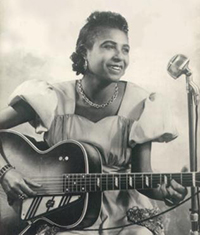
The rural blues was an overwhelmingly male-dominated field, although artists like Memphis Minnie were notable exceptions. By age 15, Minnie Douglas was singing in the streets of Memphis under the name "Kid Douglas," and then she joined the Ringling Brothers Circus. In 1929, she was discovered by a Columbia Records talent scout. She recorded extensively with her husband, Joe McCoy, who played a bass line on a second guitar. She took Chicago by storm with her formidable guitar technique and powerful, expressive voice. In fact, in a performance contest between Memphis Minnie and blues legend Big Bill Broonzy, Memphis Minnie easily defeated him with her performances of "Me and My Chauffeur Blues ♫" and "Looking the World Over ♫," taking two bottles of liquor as her prize.
The limited number of recordings Johnson and other rural blues artists made in the 1920s and 1930s were largely due to the fact that record companies at the time were, for the most part, not interested in recording, let along marketing, the type of music that Johnson and others were making. As a result, the rural blues largely survived through oral tradition rather than through recordings. It is entirely possible that many singers just as talented as Johnson, Charley Patton, and Blind Lemon Jefferson have been lost because their music was never recorded.
On occasion, a folklorist or scholar would "discover" a blues musician and record his music. A folklorist a scholar who studies music and traditions unique to a specific region or group, particularly those that exist in oral traditions (also sometimes called an ethnomusicologist) has a scholarly interest in researching and preserving music that is part of oral traditions. These musics are usually traditional to a specific region or group. During the early part of the twentieth century, many folklorists were determined to preserve music that they feared might one day die out or be swallowed up by the mainstream or popular music trends.
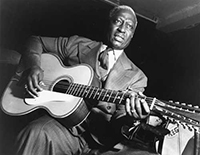
Many folklorists traveled to rural areas, foreign countries, or isolated regions to seek out interesting music to record and study. Leadbelly is a prime example of a blues musician whose work survives in large part because of interest from folklorists. Leadbelly earned his nickname from a gunshot wound to the gut at an early age, and he lived a rough life of violence, drink, and frequently imprisonment. Father-and-son folklorist team John and Alan Lomax got him out of prison several times, presented him in concerts and clubs, and recorded his best material for the Library of Congress archives. Leadbelly often served as the lead singer for the prison gang work songs that were so essential for coordinated effort in breaking rocks, digging out tree stumps, or driving steel spikes. Leadbelly’s recordings include a variety of work songs, 12-bar blues, and folk songs, such as "Good Night Irene ♫," "Cotton Fields ♫," and "Black Betty ♫."



"The advent of boogie woogie was the first time African American musicians succeeded in creating a piano music that was within the emotional tradition of African American music."
