
Learning Objectives
- Apply the rules for building a major scale, and then build a major scale. The major scale spans an octave that may be divided into two equal halves of four notes each ([1-4] and [5-8]) separated by a whole step (W), Each half is called a tetrachord.
The Major Scale Pattern
Using Tetrachords to Build Major Scales
The two tetrachords of any major scale have identical patterns of whole and half steps. Thus, any tetrachord of a major scale may be used as the basis for a new major scale.
We know that C major is the only major scale that uses no sharps or flats, and we have already used that scale as the starting point to build scales that use sharps. Now, let's use the C major scale to build scales that use flats.
Before we start, please keep in mind one very important point: When building sharp scales, we used the ascending C major scale. When building flat scales, we will use the descending C major scale. This method of building scales will require some adjustment on your part because we will be picturing descending scales from scale degree 8 to 1 instead of ascending ones from scale degree 1 to 8. That means that we also need to think of the major scale pattern in reverse, that is, HWW W HWWinstead of WWH W WWH
Building Major Scales that Use Sharps
There are seven major scales that use sharps. We will use the second tetrachord of the C major scale [G, A, B, C] as the first tetrachord of a new major scale starting on G. Remember that G is the dominant (scale degree 5) of C.
The following interactive exercise illustrates the process.
Click Show Me to start. When C major has finished playing, click Now Shift to G Major to see the following:
- The second tetrachord in C major [G, A, B, C] is identical to the first tetrachord in G major.
- The G major scale may be completed by adding a second tetrachord [D, E, F, G].
- It is, however, necessary to raise scale degree 7 (F) in the scale of G to maintain the WWH tetrachord pattern. [D, E, F, G] thus becomes [D, E, F sharp, G].
- By raising F natural to F-sharp, the newly built G scale conforms to the WWH W WWH major scale pattern.
C major to G major scale
| Remember |
|
Click the small keyboard icon below to bring up the virtual keyboard and follow the discussion that illustrates this rule.

Keyboard x
In the above interactive animation, we built a G major scale by taking the second tetrachord of C major [G, A, B, C] and adding the tetrachord [D, E, F, G] to it.
Then, we asked the question: does the new tetrachord [D, E, F, G] fit the WWH tetrachord pattern? In other words, is there a half step between scale degree 7 (F) and the tonic (G) of this scale? The answer is no. Play F and G on the virtual piano, and you'll notice that they are not adjacent keys. Therefore, the distance between them is a whole, not a half step. To change the whole step between F and G into a half step, we need to raise F natural by a half step, so we sharpen it. F-sharp is adjacent to G. Now, we have a half step between the leading tone and tonic. Without that half step, there would be no leading tone. F doesn't lead our ear to the tonic: F-sharp does. The two examples below illustrate this concept.
G major scale with F#
F-sharp means a half step between 7th scale degree and tonic. F-sharp leads the ear to G.
G scale with F-natural
F natural means a whole step between 7th scale degree and tonic. F natural does not lead the ear to G.
Raising scale degree 7 also created a whole step between scale degrees 6 and 7 (E and F-sharp). The tetrachord [D, E, F sharp, G] now fits the WWH pattern.
In summary, raising scale degree 7 achieved two purposes: (1) It created a half step between the leading tone and the tonic (F-sharp to G), and (2) It created a whole step (E to F-sharp) between scale degrees 6 and 7. Now, the second tetrachord of our G major scale fits the tetrachord pattern of whole and half steps (WWH ), and the scale as a whole fits the WWH W WWH major scale pattern.
Take a moment to play the scale of G major in the virtual piano (remember to click the keyboard icon). Sing the note names as you play them. Notice that the G major key signature has one sharp (F-sharp). A key signature is the grouping of sharp, flat, or natural signs placed at the beginning of a staff indicating the tonality of the composition.
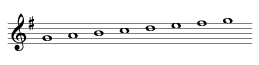
In the example above, we used the second tetrachord in C major [G, A, B, C] as the first tetrachord in G major. Similarly, the second tetrachord in G major [D, E, F-sharp, G], may be used as the first tetrachord of a new major scale starting on D. Scale degrees 5, 6, 7, and 8 [D, E, F-sharp, G] in G major simply become scale degrees 1, 2, 3, and 4 [D, E, F-sharp, G] in D major.
| Pitches | G major | D major |
| [D, E, F-sharp, G] WWH pattern |
Tetrachord 2 | Tetrachord 1 |
We know that tetrachord 1 [D, E, F-sharp, G] fits the WWH pattern, so we don't need to alter it in any way.
To build the rest of the D major scale, we need to add a new tetrachord [A, B, C, D]. Again, we need to ask the question: Does the new tetrachord [A, B, C, D] fit the WWH tetrachord pattern? Is there a half step between C and D; that is, between scale degree 7 and the tonic? The answer is no. Play C and D on the virtual piano, and you'll notice that they are not adjacent keys. Therefore, there is a whole, not a half step, between them. To make that whole step into a half step, we need to raise C natural by a half step, so we sharpen it. C-sharp is adjacent to D. Now, we have a half step between the leading tone and tonic. Without that half step, there would be no leading tone. C doesn't lead our ear to the tonic; C-sharp does.
D major scale with C-sharp
C-sharp means a half step between 7th scale degree and tonic. C-sharp leads the ear to D.
D major scale with C natural
C natural means a whole step between 7th scale degree and tonic. C natural does not lead the ear to D.
Again, raising the seventh scale degree achieved two purposes: a) It created a half step between the leading tone and the tonic (C-sharp to D), and b) It created a whole step (B to C-sharp) between scale degrees 6 and 7. Now, the second tetrachord of our D major scale fits the tetrachord pattern of whole and half steps (WWH ), and the scale as a whole fits the WWH WWWH major scale pattern.
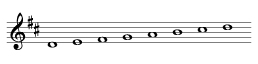
For a scale starting on D to be a D major scale, it must contain two sharps: (1) F-sharp, "inherited" from G major and (2) C-sharp, the raised seventh scale degree.
Take a moment to play the scale of D major in the virtual piano below. Sing the note names as you play them. Notice that the D major key signature has two sharps (F-sharp and C-sharp).
The following section will illustrate how to denote sharps in major scales.