
Learning Objectives
- Examine the inversions of seventh chords.
Sevenths III: Seventh Inversions
Seventh Inversions
Like triads, seventh chords can be inverted. But since seventh chords have four notes rather than three, there are more possible inversions. Four different pitches can be the lowest note of a seventh chord, as illustrated in the example below (showing the D dominant seventh chord in its four possible positions). Click on the speaker to hear all of these played.
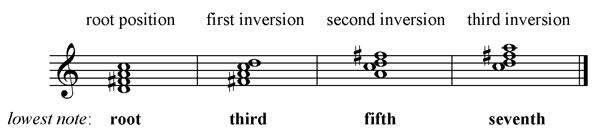
When the root of the seventh chord is the lowest note, we say that it is in root position. When the third is the lowest note, the chord is in first inversion. When the fifth of the chord is the lowest note, it is in second inversion. So far, the terminology is the same as the names for triads. But there is an additional possibility for seventh chords. If the seventh of the chord is the lowest note, we can also say that it is in third inversion.
Seventh Inversion Symbols
As with triads, we can indicate the position of seventh chords with figured bass symbols. Remember that figured bass symbols tell us about intervals above the bass note. So the complete figured bass symbol for a root position seventh chord would be 753, since there is a third, a fifth, and a seventh above the bass:
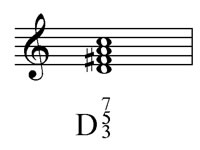
Rather than using three numbers for every inversion symbol, we use the following abbreviations to represent the seventh chord inversions: 7 for root position, 65 for first inversion, 43 for second inversion, and 42 or just 2 for third inversion, as illustrated below.
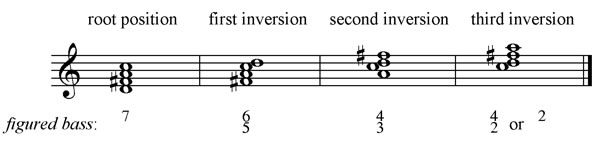
Although this may appear complicated at first glance, it is actually quite easy to remember the inversions for seventh chords if you notice the descending pattern 7 - 65 - 43 - 2.
| Remember | ||||||||
|