
Overview
In the 1920s, a new type of jazz emerged that was related to, but separate from, Dixieland. Called swing or big band, this music often had less improvisation, more dancing, and more instruments than its Dixieland counterpart. Led by bandleaders such as Duke Ellington, Benny Goodman, and Fletcher Henderson, swing bands provided the soundtrack for dancing and merrymaking during what were becoming increasingly difficult times in the United States.
Objectives
- Recognize the difference between swing music and Dixieland jazz such as instrumentation, form, purpose, and composition
- Examine how race relations affected the performance and recording of swing music throughout the 1930s and 1940s
- Identify various bandleaders and the way each cultivated a specific style within their individual groups such as Count Basie’s Kansas City swing style
Society Syncopators
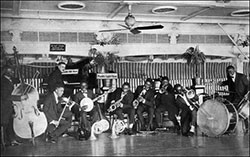
Big bands were not a completely new idea. Society syncopatorsa common term for bands, black or white, that played popular music in the restaurants, nightclubs, and dance halls in the 1920s was a common term for bands, black or white, that played popular music in the restaurants, nightclubs, and dance halls in the 1920s. In 1924, Fate Marable’s Society Syncopators featured nine pieces—piano, drums, banjo and tuba in the rhythm section, and trumpet, trombone, tenor saxophone, and two alto saxophones in the front line. Several musicians doubled on violin or mellophone (a piston-action instrument that is shaped like an oversized trumpet and sounds like a French horn). Louis Armstrong performed on the boats in the Fate Marable organization for a while, as did many of the New Orleans jazz musicians who worked their way up the Mississippi to settle in Chicago.
These society bands played a wide variety of dance versions of popular tunes of the day. This meant that there were no featured solos, creative moments of improvisation, or dramatic musical moments. Instead, society syncopators provided a continuous string of well-known tunes for dancing, conversation, and general socializing.
There were hundreds of bands. New Orleans had the Halfway House Orchestra, the Owls Orchestra at the Gruenwald Hotel, Fate Marable’s Capitol Revue (before he went on the Streckfuss boats), Johnny Bayersdoffer’s Band at Tokyo Gardens, Brownlee’s Orchestra, and Armand J. Piron’s Novelty Orchestra at Tranchina’s Restaurant. Chicago had the Midway Dance Orchestra, Merrit Brunies and his Friar’s Club Orchestra, Joe Jordon’s Sharps and Flats, and the Art Sims Creole Roof Orchestra. New York had Guy Lombardo and His Royal Canadians, Ben Bernie, Rudy Vallee, and Fred Waring and His Pennsylvanians. Notice that the word "jazz" does not appear in the name of any of the bands mentioned. A few of the bandleaders did occasionally include the word "jazz" to indicate that they had certain gifted improvisers among their sidemen and that the leader might occasionally dazzle the crowd with an inspired and creative solo. They would not, however, neglect their obligation to provide plenty of high-grade, energetic dance music in the service of showing off their skills as soloists or improvisers.



