
Overview
Objectives
- Examine the roots of soul music and the cultural and economic factors that led to its creation
- Identify several prominent artists from the genre of soul music including Sam Cooke, the Supremes, the Temptations, and Aretha Franklin
- Identify several record labels that were critical to the development of soul music, including Motown, Atlantic, and Stax
The African American Presence in Pop
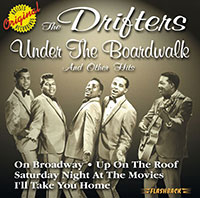
In the late 1950s and into the 1960s, a genre of popular music performed by African American musicians called sweet soulstyle of songs performed by African American musicians but that had crossover appeal; characteristic traits include a moderate tempo, fluid vocal delivery supported by backup vocals in doo-wop style, a string accompaniment, and Latin beats in the drums became popular with both black and white audiences. These songs had enormous crossover appeal in their pop-styled lyric delivery. Most of the songs were a moderate tempo, not too fast and not too slow. The fluid vocal melody was supported by backup vocals in the doo-wop style. Unlike rhythm and blues music, the sweet soul style usually featured string instruments, and the drummer’s rhythms often included Latin beats. The songwriting team of Jerry Leiber and Mike Stoller wrote a number of sweet soul songs that the Drifters made into hits, including "Save the Last Dance for Me ♫," "On Broadway ♫," and "There Goes My Baby ♫." When lead singer Ben E. King was fired from the Drifters, he began a solo career with the help of Leiber and Stoller, recording hits such as "Spanish Harlem ♫" and "Stand by Me ♫."
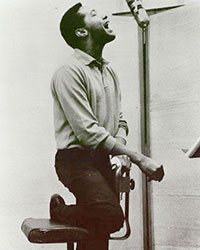
This light, "sweet soul" style was nowhere more apparent than in the music of Sam Cooke. Between 1957 and 1965, Cooke wrote and recorded 29 singles that appeared in the Top 40 pop charts. Before he began recording pop songs, however, Cooke was well known as a gospel singer. In fact, his first pop records were released under a different name so as not to negatively affect his reputation as a singer of gospel music. The success of Ray Charles in the early 1950s had indicated to record executives that gospel music could potentially supply a stream of singers for rhythm and blues numbers.
Cooke’s style shows the clear influences of gospel music in his frequent use of melisma (the singing of multiple pitches on a single syllable of text) as well as his improvisatory-sounding style and frequent melodic embellishments. "You Send Me ♫," Twistin’ the Night Away ♫" (which was inspired by Chubby Checker’s "The Twist ♫"), and "Chain Gang ♫" all demonstrate Cooke’s ability to balance pop, gospel, and rhythm and blues influences in his singing style. His song "A Change is Gonna Come ♫," written by Curtis Mayfield, is often considered a theme from the Civil Rights Movement because it plaintively and unashamedly addresses issues of racism and racial inequality.



"Sam Cooke was one of many R&B acts to tour extensively on the "chitlin' circuit," the name given to segregated clubs and venues that were friendly to African-American musicians during the segregated years of the 1950s-1960s. "
