Learning Objectives
- Learn how other accidentals work (double sharps and double flats).
- Define enharmonic pitches as two pitches that sound the same but have different names.
The Keyboard VI: Other Accidentals and Enharmonics
Other Accidentals
Although not nearly as common as sharps, flats, or naturals, there are two other types of accidentals that are sometimes encountered: the double sharp and the double flat. The purpose of these double accidentals will become much clearer as the course progresses. Use the keyboard below as you read more about these other types of accidentals.
Enharmonic Pitches
Double Sharps

Whereas a sharp raises the pitch of a note by a half step, the double sharp raises the pitch of a note by two half steps, or a whole step. For example, to play a D-double-sharp, find a D on the keyboard, then move up two half steps, passing through the black key to the following white key (i.e. a step higher than D). Normally, that key would be called an E, but in certain situations it can also be called a D-double-sharp. Note that these two pitches (E and D-double-sharp) sound exactly the same.
There is no triple sharp sign in music.
Double Flats

Whereas a flat lowers the pitch of a note by a half step, the double flat lowers the pitch of a note by two half steps, or a whole step. For example, to play a D-double-flat, find a D on the keyboard, then move down two half steps, passing through the black key to the preceding white key (i.e. a step lower than D). Normally, that key would be called an C, but in certain situations it can also be called a D-double-flat. Again, note that these two pitches (C and D-double-flat) sound exactly the same.
Whereas a flat lowers the pitch of a note by a half step, the double flat lowers the pitch of a note by two half steps, or a whole step. For example, to play a D-double-flat, find a D on the keyboard, then move down two half steps, passing through the black key to the preceding white key (i.e. a step lower than D). Normally, that key would be called an C, but in certain situations it can also be called a D-double-flat. Again, note that these two pitches (C and D-double-flat) sound exactly the same.
There is no triple flat sign in music.
Enharmonic Pitches
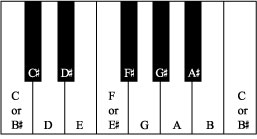
Two pitches that sound the same but that have different names (and look different on paper) are called enharmonic pitches. For example, D# sounds the same as E♭ (as you can see and hear on the keyboard below), but those two pitches would be written down differently, and often function in different ways. Other pairs of enharmonic pitches are C# and D♭, F# and G♭, G# and A♭, and A# and B♭. Find these on the keyboard below.
Enharmonic Pitches
| Remember |
|
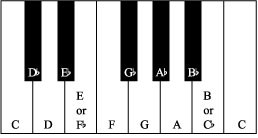
White keys can also have enharmonic names. Since there is no black key between B and C or between E and F, C can also be called B# and F can be called E#. Similarly, B can be called C♭ and E can be called F♭ (see the illustration below). You can even use double-sharps and double-flats to create enharmonic pairs, such as C and D♭♭ (D-double-flat) or E and Dx (D-double-sharp). As the course progresses, it will become more apparent why one enharmonic name for a pitch is chosen over another.