

The Organ
Introduction
The organ is a keyboard instrument whose tone is produced by wind flowing through pipes. The organist produces sounds by pressing keys or pedals that are connected to pipes of different lengths and materials. Air passes through the pipes, producing a tone. This means that, unlike the harpsichord and the piano, the organ may sustain sounds as long as keys or pedals are depressed and air is passing through the pipes.
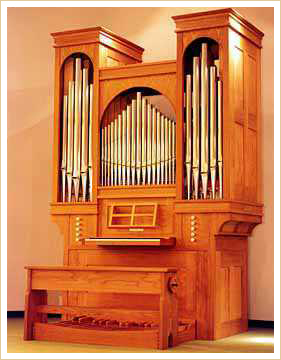
Pictured at right is a small church organ consisting of only one keyboard and pedals. The keyboard on an organ is called a manual. Notice the different lengths of the pipes and the two rows of stops (the white buttons located on either side of the manual), which control the flow of air to the different pipes.
As you know, the length of the pipe determines pitch. The pipes themselves may be made of wood or metal. Sometimes pure tin or copper alloy is used.
The two types of pipes are:
- reed pipes, which produce sound via a vibrating brass strip called a reed; and
- flue pipes, which produce sound solely from the vibration of the air column.
The majority of the organ pipes are flue pipes. However, reed pipes supply tones of great variety and brilliance.
Organ Console
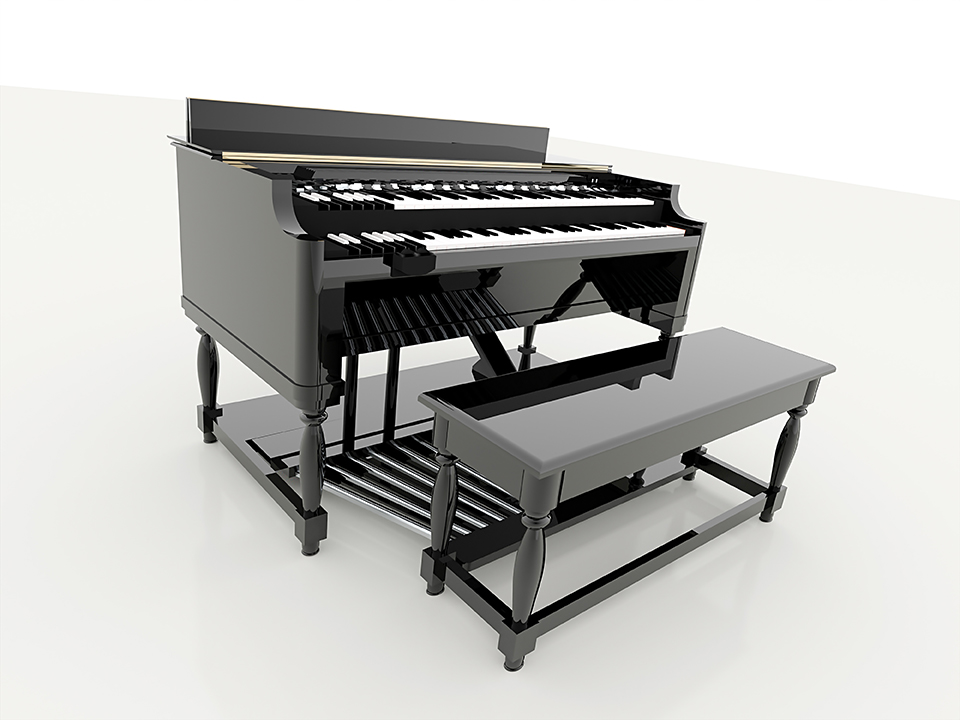
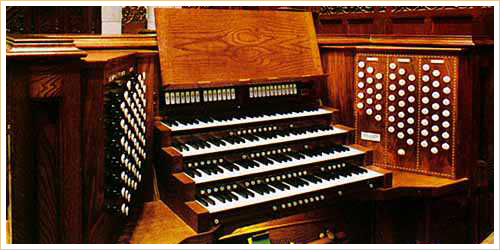
The organ has been called “the king of instruments.” The console that you see at right is indeed kingly. It consists of row manuals and 109 stops, which control 135 ranks. A rank is a complete set or row of pipes, one for each note of the organ keyboard. As opposed to the piano, which has only one keyboard, the organ may have as many as five keyboards (most have two or three) as well as a pedal board that is played by the organist's feet.
Organists control timbre and volume level by adjusting levers, buttons, and stops, by moving from one keyboard to another, and by using the pedal board. Volume is also a factor of wind pressure.
The organ is one of the most complex instruments, and it is certainly the oldest keyboard instrument. Ctesibius, an engineer from Alexandria, is credited with having invented the first organ around 250 BC. He called it the hydraulos, since water was used to control wind pressure.
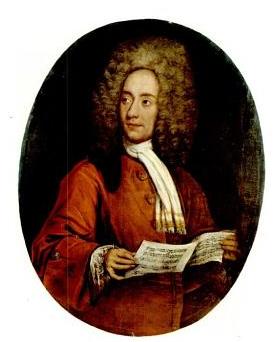
Although throughout its long and distinguished history it has been mostly associated with church music, the organ has also been used as a solo and an orchestral instrument, as in the famous Adagio in G Minor by Tomaso Albinoni.
Composer: Remo Giazotto
-
"Adagio in G Minor: Adagio in G Minor (attrib. To Albinoni) [Attrib. T. Albinoni]"