
Overview
Objectives
- Identify two important figures in early American folk music, Pete Seeger and Woody Guthrie
- Recall why Pete Seeger and Woody Guthrie were inspirational figures in the folk revival of the 1960s
- Examine the music and career of Bob Dylan
- Recall why Bob Dylan's electric performance at the 1965 Newport Folk Festival was so upsetting to folk music purists
- Recall the many stylistic and generic reactions to Dylan "plugging in," namely, the rise of the genre of folk rock
The Rise of Folk Rock
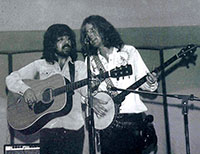
In 1965, a fledgling California-based rock group called the Byrds was building a career by recording rock versions of folk songs. They recorded a cover of Dylan’s "Mr. Tambourine Man ♫," and their recording went to number 1 on the popular music charts. The Byrds’ "Mr. Tambourine Man ♫" is considered the first folk rock hit. The instrumentation includes an electric twelve-string guitar, an electric six-string guitar, bass, and drums.Although the original Dylan version of the song was in verse-chorus form with many verses, the Byrds only included a single one of the original verses in their cover version.
This version is very short, but it had to be only two minutes long in order to accommodate the AM radio formula of the time.
It is important to note that the Byrds’ version of "Mr. Tambourine Man ♫" actually charted before Dylan performed his electric set at the Newport Festival. However, "Mr. Tambourine Man ♫" did appear on the electric side of Dylan’s Bringing It All Back Home, which was released on March 22, 1965. The Byrds released their cover of "Mr. Tambourine Man ♫" on April 12, 1965. Dylan performed his electric set at the Newport Folk Festival on July 25, 1965. The closeness of these events reveals how quickly folk rock was becoming popular with American listening audiences, and it also lays to rest any accusations that the Byrds had stolen any glory from Dylan or vice versa.
The Byrds continued to have success in the 1960s with their rock versions of folk songs. "Turn, Turn, Turn ♫" was a cover of a Pete Seeger song and went to number 1 on the American pop charts. The Byrds’ first two albums contained a number of Pete Seeger and Dylan tunes. As Dylan began to write and record his own folk rock music, however, the Byrds were no longer able to cover Dylan’s music. They also wrote their own songs, perhaps most notably "Eight Miles High ♫" from 1966. "Eight Miles High ♫" was an early example of psychedelic rock, and we will return to this song and to the Byrds in a subsequent lesson.



