
Learning Objectives
- Examine Central Asia in terms of diverse identities, such as Mongolia and Northwest Muslim China, Afghanistan, and the former Soviet Republics of Kazakhstan, Kyrgyzstan, Tajikistan, Uzbekistan, and Turkmenistan as well as the Caucasus such as Armenia, Georgia, Azerbaijan, the contested region of Norgorno-Karabagh, and portions of Russia.
- Analyze Mountain Instrumental Music called küü (literally “mood”) from Kyrgyzstan, including the komuz (three-stringed lute), kyl kayak (two-stringed bowl fiddle), choor (end-blown flute made from reed or wood), chopo choor (clay ocarina with three to six holes found in southern Kyrgyzstan), sybyzgy (side-blown transverse flute traditionally played by shepherds), jygach ooz komuz and temir komuz (wooden and metal jew's harp).
- Analyze classical music from Uzbekistan and Tajikistan, in particular the Shashmaqam or (six maqam) is a genre of music that includes instrumental pieces, songs, poetry, and dance.
- Examine the historical and cultural importance of the Soorp Badarak, the chief musical expression of the Armenian Apostolic Church from Armenia, a small land-locked country in the Caucasus.
- Examine the unique genre of Georgian secular polyphony in the context of supra, a traditional social gathering where people have a long celebrated meal.
The Shashmaqam
Maqam is a term that has many interpretations. In this case, it is defined as suites or cycles of music organized by melodic mode and meter.
Shashmaqam or (six maqam) is a genre of music, typical of Uzbekistan and Tajikistan, that includes instrumental pieces, songs, poetry, and dance. The origins of the shashmaqam remain unknown, though it is thought to have emerged in Bukhara (see Kushnarev 1958). The six maqams ('Buzruk,' 'Rast,' 'Nava,' 'Dugah,' 'Segah,' and 'Iraq') take their names from classical Persian modes. According to Zeranska-Kominek et al, the six "cyclic" forms contain more than 250 instrumental and vocal-instrumental works (Zeranska-Kominek, Kostrubiec, and Wierzejewska 1982: 74).
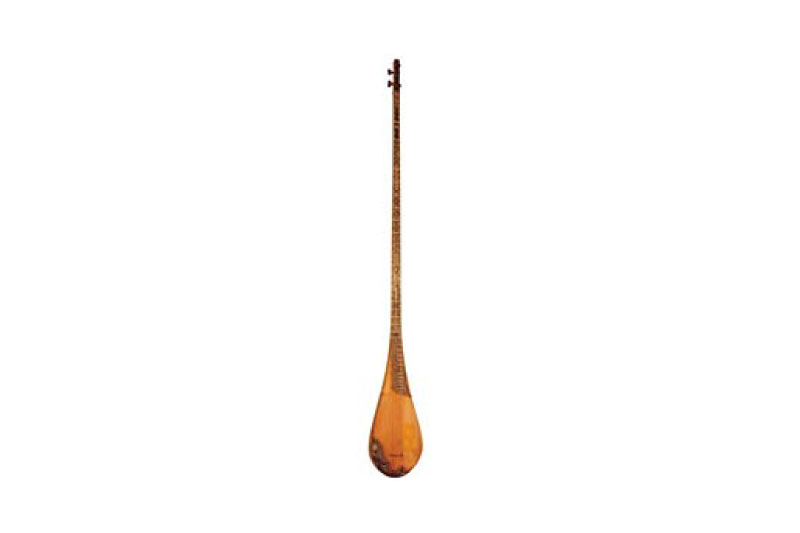
Tanbur
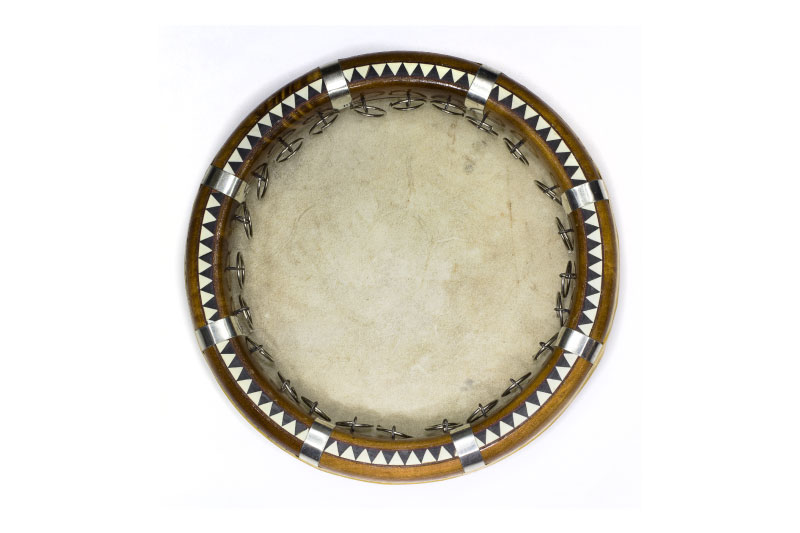
Doira
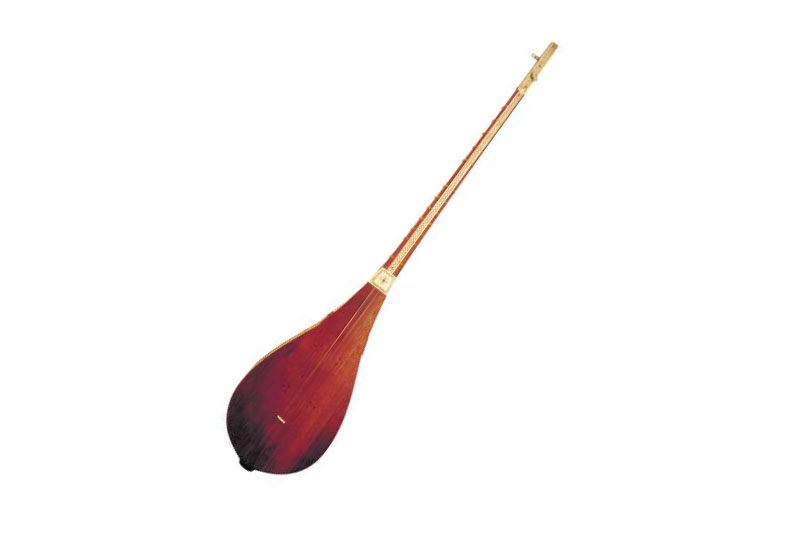
Dutar
The shashmaqam is traditionally associated with aristocratic and elitist culture (Levine 1993: 56). Each suite is named after a particular mode and each mode is characterized by a particular melodic motif. Exaggerating the differences in rhythm and meter between each piece creates contrasts. The performers of shashmaqam follow a system known as aruz, a system of meters.
Musicians must have a powerful voice with a large vocal range and be able to play the tanbur, a long-necked plucked lute. In addition, musicians must have a large repertoire of poetic texts and understand the theoretical principles for setting the text and music. Shashmaqam performers stylize the poetic texts, drawn from Sufi symbolic texts from classical Islamic poets, into rhythms that are short and long. The slideshow on this page features instruments used in the performance of shashmaqam.
Composer: 0
-
"Sarakhbor-i Râst - The Academy of Maqam"



After the 1917 revolution, traditional music was replaced by that celebrating communism and USSR nationalism.
