
Learning Objectives
- Examine how pitches are notated on the staff—a notational system using lines and spaces.
Leading Tone Seventh Chords: Introduction
Now that we have learned our first seventh chord, the dominant seventh, we will turn our attention to another seventh chord that has a similar function: the leading tone seventh chord.
Let’s look once again at the scale of triads, with the dominant seventh and leading tone seventh included.
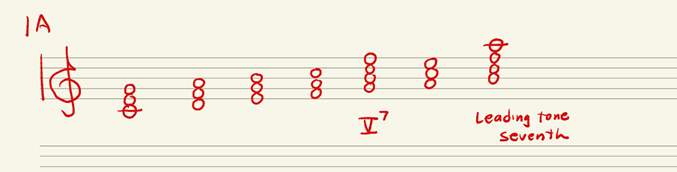
Notice how the dominant seventh and the seventh built on the leading tone have three tones in common: B (7), D (2), and F (4). These tones all have a strong pull towards the tonic chord: 7-1, 2-1, 4-3. As a result, the leading tone seventh generally will have a natural resolution to the tonic and functions similarly to a dominant seventh.
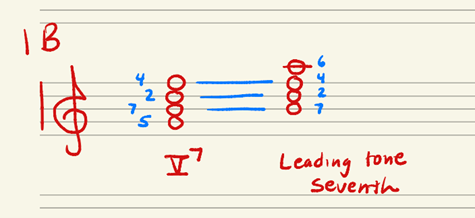
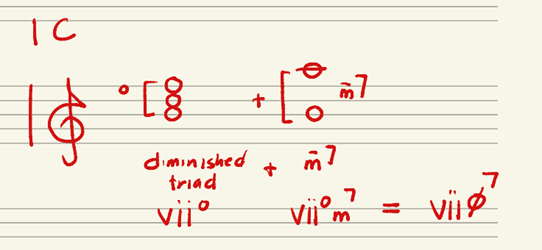
The leading tone seventh is the name given to any seventh chord that is built on the leading tone and exists naturally in either a major or minor key. As we can see from the example below, the leading tone seventh chord in a major key is a diminished triad with a minor seventh. The official name for this chord is “diminished-minor” since the triad is diminished and the seventh is minor. The most common name for this chord is “half-diminished.”
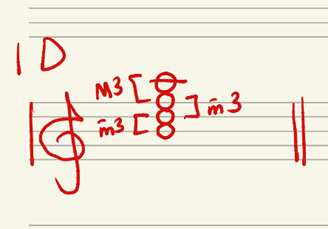
The half-diminished chord is three stacked intervals: m3/m3/M3.
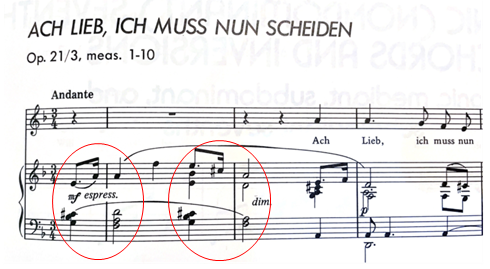
Listen to these examples of the leading tone seventh chords from the literature:
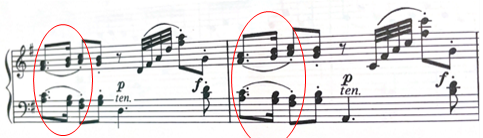
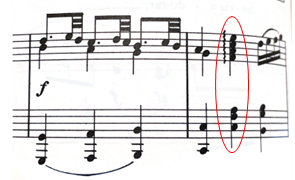
The half-diminished chord exists on tones other than the leading tone, and the leading-tone seventh may have qualities other than half-diminished.

Half-Diminished Leading-Tone Seventh Chords consist of:
- Scale degrees 7-2-4-6 in a major key.
- A diminished triad with a minor seventh.
- A triad made up of a m3/m3/M3.
Leading-Tone Seventh in Minor Keys
Let’s now look at leading-tone sevenths in minor keys. Look at the diagram below showing the triads built on every scale degree in the three forms of minor scale: natural, harmonic, and melodic, which include the sevenths built on the dominant and the leading tone scale degrees.
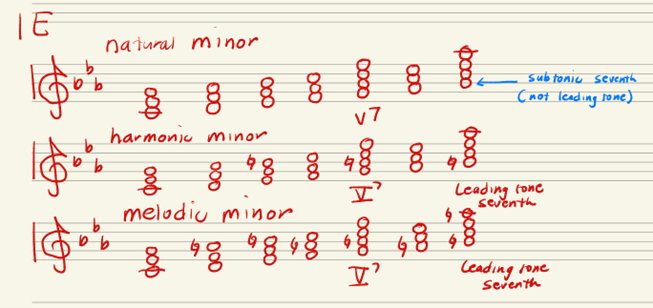
Notice that the seventh scale degree in natural minor is not a leading tone. We will address this chord in future chapters. Notice also that, similar to major keys, the leading tone seventh in melodic minor is half-diminished. However, harmonies derived from the melodic minor scale are a rare occurrence. Harmonies from the harmonic minor are much more common. Therefore, the leading tone seventh chord has different configurations in minor keys.
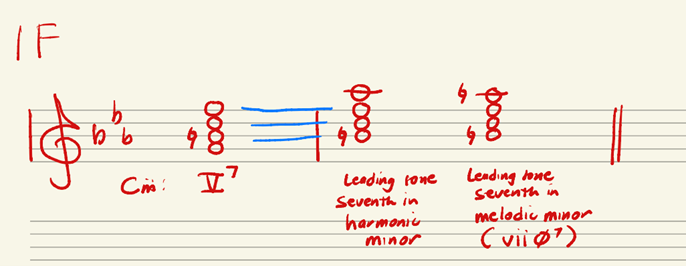
The resulting leading tone chord in harmonic and melodic minor keys is a diminished triad with a diminished seventh. Because the triad is diminished and the seventh is also diminished, the official name for this chord is “diminished-diminished.” The most common names for this chord are “fully-diminished” or diminished seventh.
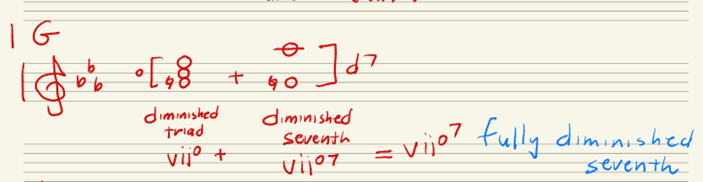
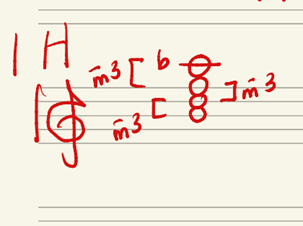
Fully-Diminished Seventh Chords consist of:
- Scale degrees 7-2-4-6 in minor keys, specifically harmonic minor.
- A diminished triad with a diminished seventh (so-called fully diminished or a diminished seventh).
- A triad made up three stacked minor thirds m3/m3/m3.
Listen to these examples of the leading tone seventh chords from the literature:
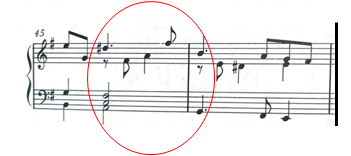
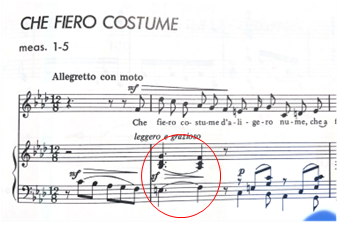
Although half-diminished chords exist on other scale degrees, specifically in minor keys, the fully-diminished seventh chord only exists on the leading tone in harmonic minor.