
Learning Objectives
- Practice writing pitches (notes and stems) and accidentals (sharps, flats, and naturals) on the staff.
The Staff III: Notation Practice
Introduction
It is important to be able to write music notation that is clear and legible. Music that is poorly notated is hard for musicians to read and perform. In this lesson, you will practice writing noteheads, stems, and accidentals on the staff.
Notating Pitches
Notes are written on the staff using oval-shaped noteheads that may be either open or filled in. The noteheads should be slanted upward to the right. Noteheads written on a space should fill in the space entirely, just touching the lines above and below. Noteheads on a line should be the same size as those that are written on a space.
| Note placement on the staff |
Notating Stems
As we will learn in the section on rhythm, some notes have stems attached to them. These stems are thin vertical lines that should just touch the notehead. Stems can go up or down from the notehead. Upward stems go on the right-hand side of the notehead. Downward stems go on the left-hand side. Stems should be about an octave in length (i.e. from C4 to C5), which is roughly four staff spaces. Click "Show Me" in the example below to see this illustrated.
| Notating stems |
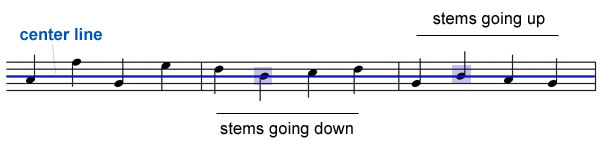
In general, noteheads written above the center line should have downward stems and those written below the center line should have upward stems (as illustrated below). If a note is on the center line, the stem can go either way. Often, it will go the same direction as the stems surrounding it.
Notating Sharps
Accidentals should be centered on the same line or space as the notehead they are attached to. Accidentals are always drawn on the left-hand side of the notehead (before the note). Remember that although you say "C-sharp," you actually write "sharp-C."
The vertical lines of a sharp are about three staff spaces tall. Make sure that the horizontal lines that cross these are slightly slanted upward (at about a 25 degree angle) to avoid drawing them on top of the staff lines.
| Notating sharps on a line |
| Notating sharps on a space |
Notating Flats
The vertical line of a flat is about two staff spaces tall. The rounded part of the flat should be about one staff space high.
| Notating flats on a line |
| Notating flats on a space |
Notating Naturals
The vertical lines of a natural are about two staff spaces long, with the left line going up from the center and the right line going down. Make sure that the horizontal lines are slightly slanted upward (at about a 25 degree angle) to avoid drawing them on top of the staff lines.
| Notating naturals on a line |
| Notating naturals on a space |
Notation Practice
Now, open and print out this Notation Practice Sheet. Once you have printed the sheet out, trace the pitches and accidentals to practice the notation rules outlined in this lesson. You might also want to print out some blank staff paper and practice notation without tracing.
| Remember |
|