
Overview:
Singing is one of the most natural vehicles for self-expression and communication in young students. Research indicates that is linked to neurological development in children and has benefits towards educational success later in life. In addition to building confidence, singing is also fun, helps students to become more calm and focused, and increases students’ sense of pitch.
Objectives:
Students will be able to:
- Identify the strategies for teaching a song to young students,
- Describe the strategies and the rationale for each,
- Define the use of and rationale underlying solfège as a tool in teaching a song,
- Identify and demonstrate best practices for using a song accompaniment,
- Demonstrate the processes used to teach songs,
- Identify the elements used to evaluate and select age-appropriate song literature,
- Identify ways in which technology can assist in teaching a song to students, and
- Evaluate and analyze a song being taught based on standards identified in the text.
What is a Starting Pitch?
In every singing experience, the students must be given the beginning pitch prior to singing. This is made more complex when teaching by rote in those cases when the final pitch of the teacher’s phrase is different from the students beginning pitch. This is particularly noticeable in phrase divisions when echo teaching. When this situation occurs, the teacher must maintain the correct pitch and tonality throughout the song. It may be necessary to have a fixed pitch instrument available to reinforce and check pitch.
How Do I Take a Preparatory Stance?
Taking a preparatory stance and giving students a verbal cue will teach students to focus on the song. After a slight pause following the pitch, the teacher should signal preparation for the downbeat with a gentle breath, lifted head, and hands in a conducting-like position. The teacher’s head and hands should fall on the downbeat and all preliminary gestures should be in the same tempo as the music that follows.
The preparatory stance is similar to the posture a conductor adopts before starting the ensemble. The teacher stands still and straight, looks directly at the students, and raises his or her hands. Important during and following the giving of pitch are the gestures or motions that let a group know when to begin singing. Most common motions are a head nod, a hand gesture, or the first step or movement of an activity. This must be done in an authoritative manner so that students are not confused as to when they should sing. An effective use of gestures will eliminate the need for unnecessary verbal directions and commentary. These gestures will help students to begin together and with confidence.
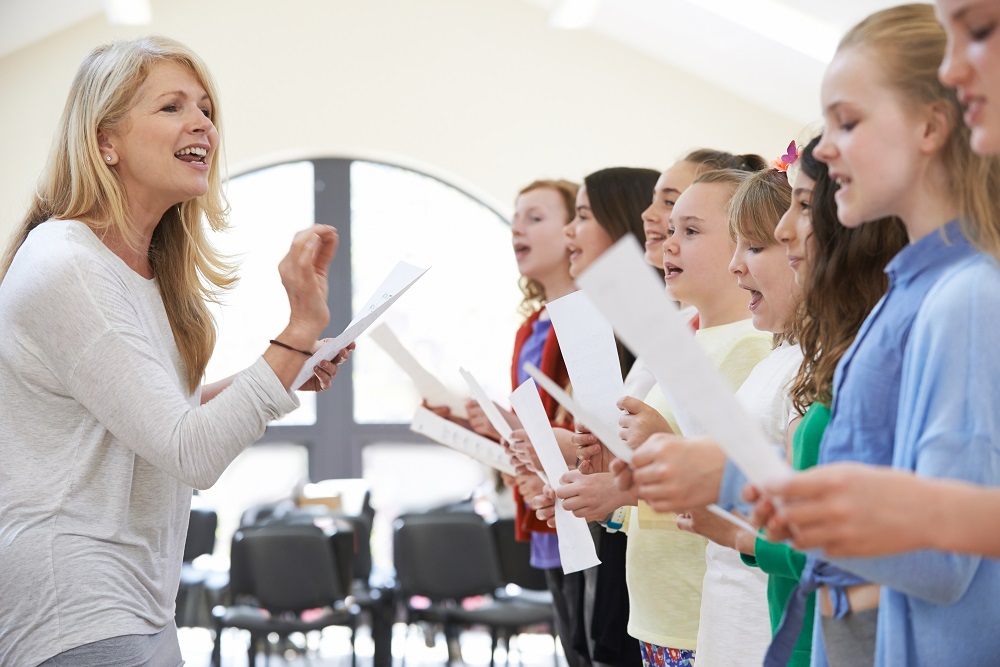
If the song begins with an anacrusis, the teacher should sing the word or words that are assigned to the anacrusis as the hands and head are lifted just prior to the downbeat.
It is natural to inhale in coordination with song-starting gestures. Caution should be taken about modeling tension in the breath and gesture. The teacher should help students appreciate the sense of ensemble that results when all members of a group know at what point and how they are to begin and end a piece of music together.
The teacher’s look and posture of anticipation help to give focus to the students’ attention and sends the message that the activity is about to begin. The students will then be ready to sing.