
Overview
In the evolution of jazz, the New Orleans and Chicago styles of the 1920s gave way to the emerging swing style of the 1930s. In this, and the next several sections, we will learn about some of the most influential jazz musicians of this era and how their musical contributions helped shape the jazz style known as swing.
Objectives
Upon completion of this lesson, you will be able to do the following:
- Identify selected swing musicians and their contributions to jazz
- Define charts
- Identify the significance of call-and-response in Fletcher Henderson's compositions, as well as in others‘
- Define antiphonal counterpoint
Wrappin' It Up
The Great Depression that began with the stock market crash of 1929 had profound economic and social effects on the nation and the world. Three years after the crash, the value of stocks stood at about one-fifth of what it had been at the peak. Industrial output had fallen sharply. Agricultural production plummeted, a situation greatly exacerbated by the Dust Bowl. By 1933, unemployment in the United States had reached almost 25 percent of the working population2.
For jazz musicians in New York, there were fewer jobs, and less money was paid for what jobs remained. But adaptation and survival are instinctual. Even in the midst of such a severe economic downturn, many institutions and enterprises carried on, and some actually did fairly well. For one, the Roseland Ballroom — where the band Fletcher Henderson and His Orchestra played — continued to draw sufficient crowds.
Whether the band would always be paid, though, was another story. Coleman Hawkins, who played tenor saxophone in Henderson's orchestra, offers insight into the experience of African-American jazz musicians in New York at that time; that is, of those fortunate enough to be working:
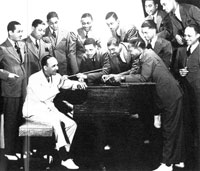
" You know what used to happen during the Depression? We used to play a lot of jobs and didn't get paid. Everybody belonged to the union and everything, but it seemed like there wasn't anything we could do about it when that happened. I was still with Fletcher then and we used to do quite a few nights for which we didn't see any money3.
Martin Williams, director of the jazz program at the Smithsonian Institution, has remarked on the significance of Henderson's music, stating that it "helped carry the human spirit through some rather desperate times in the 1930s."
Listen to Fletcher Henderson and His Orchestra as they play Henderson's tune and arrangement of Wrappin' It Up ♫, recorded in 1934. Listen for the technical aspects of his arrangement, notably the opening woodwind phrases, punctuated by brass responses. These sorts of arrangements were highly influential with respect to the style of swing that was about to sweep the country. Consider, too, whether you hear in the music, as Williams observes:
" that it denied nothing, not pain, not anger, not even fear. But like all jazz it encompassed all with an aesthetic that says, in effect, I am not just anger, nor pain, nor fear. I am also love and sensitivity, strength and beauty, and a man. I will not give in. And I will survive4.
There is an unmistakable "polish" to the big band sound in this piece that was simply not heard in earlier jazz. The arrangement is more sophisticated, and it is performed with a relaxed precision that became a hallmark of the big band sound. The soloists — Hilton Jefferson on alto sax, Henry "Red" Allen on trumpet, and Buster Bailey on clarinet — are self-assured, expressive, and swinging!



"Ellington's first composition was "Soda Fountain Rag," written when he worked at a soda bar as a teenager."
