
Learning Objectives
- Relate how Romantic poets and artists abandoned traditional subjects, turning instead to the passionate and the fanciful.
- Relate how the Industrial Revolution impacted the technological development and affordability of musical instruments.
- Analyze how the orchestra grew in size and sound as new instruments were introduced and composers demanded greater levels of expression.
- Illustrate how Romantic composers explored nationalistic folklore and exotic subjects.
- Identify the form of romantic period songs, including strophic, through-composed, and the modified strophic forms.
- Examine the German art song (or Lied) as a favored romantic period genre.
- Discuss how the music of Franz Schubert impacted romantic period music.
- Discuss how the music of Frédéric Chopin impacted romantic period music.
- Trace the ascendance of program music in relation to absolute music.
- Summarize how political unrest throughout Europe stimulated the formation of schools of musical nationalism in Russia, Scandinavia, Spain, England, and Bohemia among other countries.
- Differentiate between the distinct national styles of romantic opera in France, Germany, and Italy.
- Discuss how the Italian nationalist composer Giuseppe Verdi impacted romantic period music.
- Trace how choral music became a popular artistic outlet for the middle classes.
- Discuss how the Russian composer Pyotr Ilyich Tchaikovsky impacted romantic period music.
Romantic Period (1820–1910)
Nationalism
In the second half of the 19th century, increasing numbers of composers turned to folk idioms as the basis for their compositions. Frequently in connection with political independence movements, and other times as a reaction against the dominance of "mainstream" German, Italian, or French music, these composers incorporated folk dances, melodies, and rhythms into their music to portray the soul of a people. Their music combined the basic characteristics of folk music with the complexity and depth of art music as reflected in the adoption of nationalist subjects for operas, symphonic poems, songs, and instrumental pieces among other musical genres. Countries or regions most commonly associated with Western musical nationalism include Bohemia (Czech Republic), Scandinavia, Russia, Poland, Spain, UK, Latin America, and the United States.
Bohemia (Czech Republic)
For geographical and political reasons, Austrian and German composers such as Haydn, Mozart, and Beethoven exerted a direct influence over the music of Bohemia (now the Czech Republic). In the 19th century, Bohemian composers looked for the roots of their own style in the folk music of their region.
Bedřich Smetana
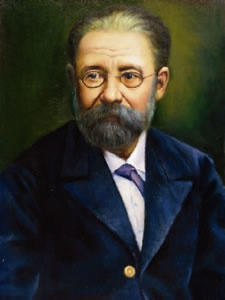
Bedřich Smetana grew up under the Austrian domination of Bohemia, and the 1848 revolutions fueled his nationalistic feelings. Czech radicals fought hard for political freedom and liberation of the serfs, and he was likely among those fighting in the streets. The revolution was put down and followed by harsh repressive measures from Austria, and Smetana ultimately fled to Sweden, where he could pursue his uniquely nationalistic style without scorn or undesirable repercussions. He only returned to Prague in 1862, after Austria had consented to a more liberalized society and more tolerance for the Czech language and culture. Like Beethoven, he lost his hearing completely, but not until he was 50. His most famous work, the cycle of six symphonic poems titled Má vlast (My Country) was composed after he became deaf—an amazing feat. The best known of them, "Vltava" (The Moldau), paints a musical portrait of the Moldau River and the landscapes and people along its banks. Smetana wrote the following about the work:
The composition describes the course of the Vltava, starting from the two small springs, the Cold and Warm Vltava, to the unification of both streams into a single current, the course of the Vltava through woods and meadows, through landscapes where a farmer's wedding is celebrated, the round dance of the mermaids in the night's moonshine: on the nearby rocks loom proud castles, palaces and ruins aloft. The Vltava swirls into the St. John's Rapids; then it widens and flows toward Prague, past the Vyšehrad, and then majestically vanishes into the distance, ending at the Labe (or Elbe, in German).
Composer: Bedřich Smetana
-
"My Homeland, JB 1:112: Ma vlast (My Fatherland): No. 2. Vltava (Moldau)"
Smetana’s opera The Bartered Bride, based on Bohemian folk material, is still enjoyed in opera houses today.
Antonìn Dvořák
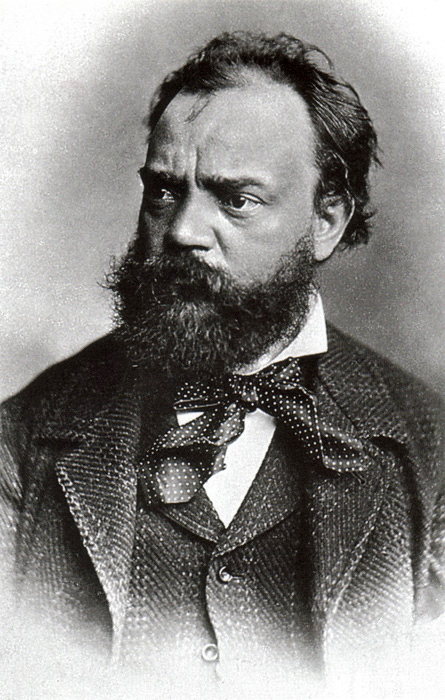
Antonìn Dvořák was the most successful of the Czech nationalist composers. Influenced by the Smetana's nationalistic ideals, he too, used the flavor of Bohemian dances and folksongs in some of works, which include pieces for orchestra (nine symphonies and three concertos), diverse chamber ensembles (including the famous American String Quartet), choral pieces, ten operas—Rusalkabeing the most popular—and song cycles.
Composer: Antonín Dvořák
-
"Slavonic Dances, Op. 46: No. 8 in G Minor"
Composer: Antonín Dvořák
-
"Rusalka, Op. 114, B. 203: Song to the Moon"
With the help of Brahms, who became his mentor and friend, Dvořák established a solid reputation in Europe during the late 1870s and the 1880s. He also made a strong connection to the United States, where he was director of the National Conservatory of Music in New York for three years from 1892 to 1895. His travels in the United States brought him into contact with Native American and African American music, both of which he considered a fertile source for a true American national sound. His ideas regarding American national music had a profound impact on subsequent generations of composers. Although the Symphony No. 9 ("From the New World"), one of his best-known compositions, does not contain any authentic American tunes (Dvořák wrote, "[In the 9th symphony] I have simply written original themes embodying the peculiarities of the Indian music") it does, nevertheless, incorporate syncopation, five-note (pentatonic) scales, and other American folk music characteristics. Here is the second movement from that symphony:
Composer: Antonín Dvořák
-
"Symphony No. 9 in E Minor, Op. 95, "
Dvořák wrote the American String Quartet in only three days during the summer of 1893 in Spillville, Iowa, home of a large Czech immigrant community. As you listen, notice how the opening theme of the quartet is built on the pentatonic scale, a sound that permeates most of the work and lends it most the open, simple character that is frequently associated with American folk music.
Composer: Antonín Dvořák
-
"String Quartet No. 12 in F Major, Op. 96, B. 179 "