
Learning Objectives
- Relate how Romantic poets and artists abandoned traditional subjects, turning instead to the passionate and the fanciful.
- Relate how the Industrial Revolution impacted the technological development and affordability of musical instruments.
- Analyze how the orchestra grew in size and sound as new instruments were introduced and composers demanded greater levels of expression.
- Illustrate how Romantic composers explored nationalistic folklore and exotic subjects.
- Identify the form of romantic period songs, including strophic, through-composed, and the modified strophic forms.
- Examine the German art song (or Lied) as a favored romantic period genre.
- Discuss how the music of Franz Schubert impacted romantic period music.
- Discuss how the music of Frédéric Chopin impacted romantic period music.
- Trace the ascendance of program music in relation to absolute music.
- Summarize how political unrest throughout Europe stimulated the formation of schools of musical nationalism in Russia, Scandinavia, Spain, England, and Bohemia among other countries.
- Differentiate between the distinct national styles of romantic opera in France, Germany, and Italy.
- Discuss how the Italian nationalist composer Giuseppe Verdi impacted romantic period music.
- Trace how choral music became a popular artistic outlet for the middle classes.
- Discuss how the Russian composer Pyotr Ilyich Tchaikovsky impacted romantic period music.
Romantic Period (1820–1910)
Richard Wagner and the “Total Work of Art”
If the Romantics' greatest wish was to achieve a unity of all the arts, Richard Wagner pursued this ideal with the greatest fervor and ultimately the most far-reaching consequences. Wagner's notion of the Gesamtkunstwerk, which means "total (or comprehensive) work of art," was borne out in his essays, his operas, and finally the unique opera house he designed himself.
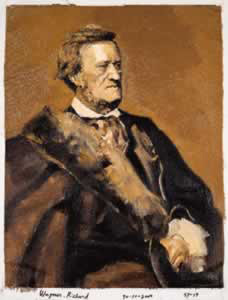
Perhaps no figure in the history of music has simultaneously inspired such devotion and loathing as Wagner. On one hand, he seems to have been mean-spirited, intolerant, anti-Semitic, and focused on bending others to his will. On the other hand, he was a devoted husband, a visionary, an iconoclast, and a pivotal figure in the arts. And many people simply love his music. He was a strong believer in German unification and the creation of a national, heroic myth that embodied Aryan virtues.
Born in Leipzig, Germany, to a police official and a baker's daughter, Wagner was raised by his mother and a family friend. (His father had died a few months after Wagner's birth.) Theater was a regular part of the young man's life; he was particularly taken with the incidental music that often accompanied the plays. Wagner began writing his own plays, and he has said that the only reason he began composing was so he could have incidental music for his plays. Even at that early age, he had an inclination for drama before music. Wagner wrote all of his librettos himself, which is extremely rare in the history of opera.
His career began slowly, but by 1843 he had his first two operatic successes with Rienzi and The Flying Dutchman. Shortly thereafter, he received an appointment as director of the Dresden Opera. With each successive opera, his reputation and confidence increased.
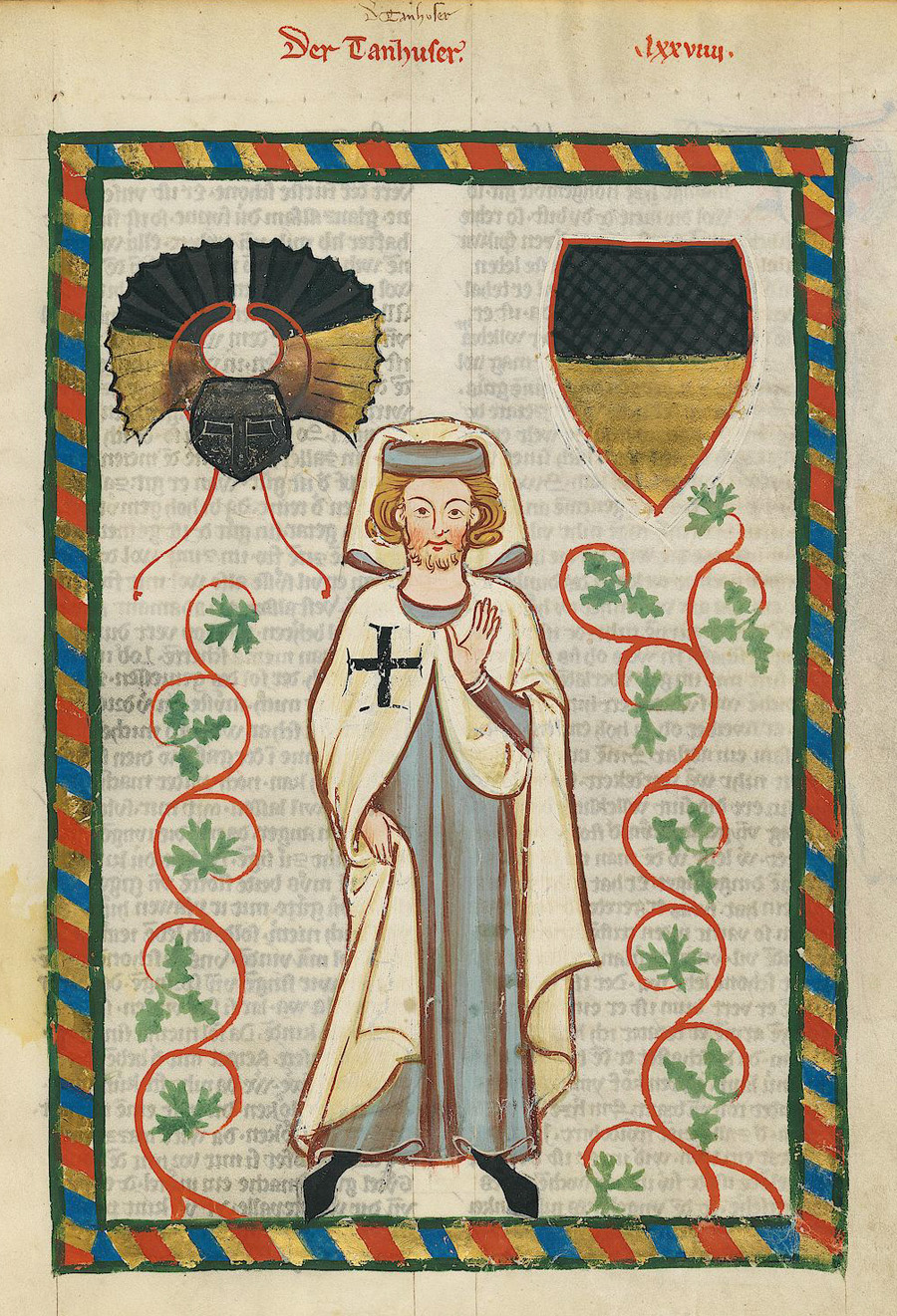
With Tannhäuser (1845) and Lohengrin (1850), Wagner was firmly established. Tannhäuser, set against the backdrop of the legend of the German medieval Minnesinger and the song contest at the city of Wartburg, presents themes that run throughout Wagner's work: on the one hand, a romantic view of medieval life together with idealized Germanic folk legends and Nordic myths, and on the other, the conflict between sacred and profane love, with ultimate redemption through love. All his mature works deal with these main issues in varying degrees.
In 1851, Wagner wrote Opera and Drama, one of a series of essays outlining his theories on opera. He felt that the traditional Italian form paid too much attention to the divisions of aria and recitative and not enough to the dramatic flow of the opera. In Italian opera, Wagner argued, the drama is interrupted by the breaks after arias and choruses, whereas he advocated a drama where music flowed continuously. Because the term opera was so inextricably linked to the Italian form, Wagner coined a new name for his creations: music drama. The concept of a continuous music flow meant that he also had to rethink traditional harmonic structures that required tension and resolution, since every resolution meant a potential stopping point. Wagner's vision of the music drama was that of a total art work (Gesamtkunstwerk) that would encompass a perfect blend of music, literature, acting, poetry, set design, and architecture, with Wagner himself playing all these roles.
By 1862, Wagner had completed four more music dramas:
- Tristan und [and] Isolde
- Die Meistersinger von Nürnberg (The Mastersingers of Nuremberg)
- Der Ring des Nibelungen: Das Rheingold (The Ring of the Nibelung: The Rhine Gold)
- Der Ring des Nibelungen: Die Walküre (The Ring of the Nibelung: The Valkyrie)
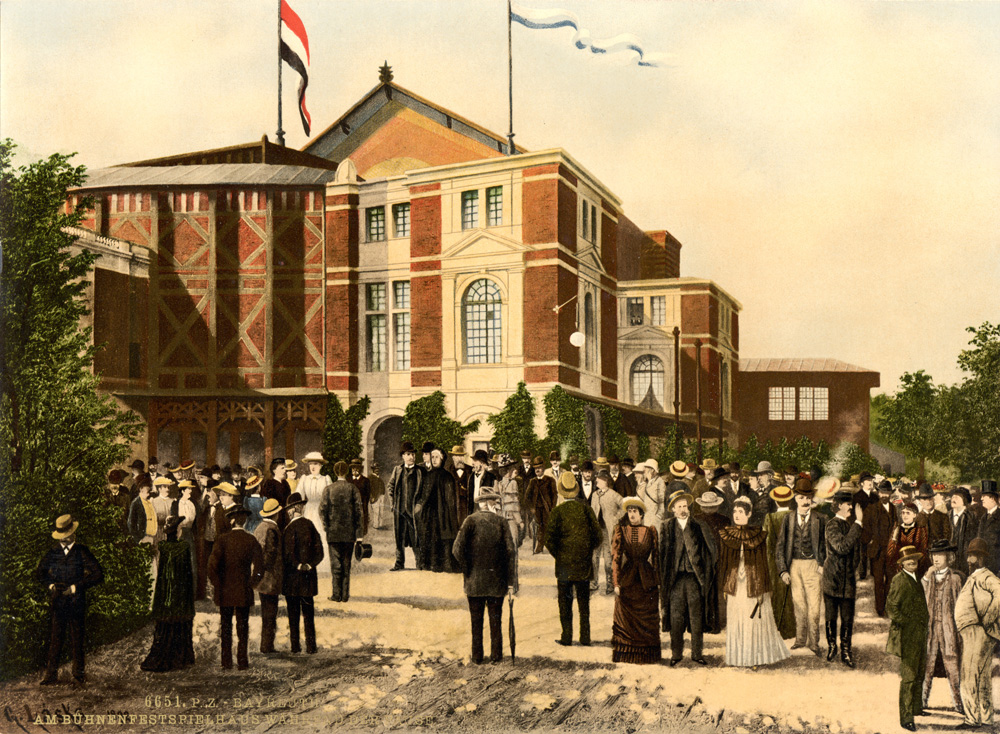
The Ring of the Nibelung, also known simply as The Ring, is a massive set of four dramas that includes Siegfried and Götterdämerung (The Twilight of the Gods) in addition to the two dramas listed above. Together, they form a cycle that tells the story of the gods of Norse mythology. In terms of scope, it is arguably the largest undertaking in the history of Western music, as each of the operas in the cycle may extend over four hours. Wagner had a theater built in Bayreuth specifically to stage The Ring. His design places the orchestra largely beneath the stage and facilitates an excellent integration of orchestral and vocal sound. This integration was extremely important to him, because the orchestra plays as large a role in his music dramas as the singers onstage. Wagner's idea was that the music itself should fully carry the drama: the actions on the stage should be mere visual manifestations of what was already happening in the music.
In order to integrate the drama into the music, as well as create a coherent musical unit, Wagner abandoned the traditional aria and recitative formula altogether, and introduced the leitmotif, a musical theme or motive representing a character, object, or idea. (This concept is similar to Berlioz's idée fixe). A specific leitmotif plays when the person or object it represents appears onstage. Occasionally, a leitmotif is also used when the character is not actually present, in order to make the listener conjure its image. In this way, the leitmotif becomes a powerful psychological tool. An example of this technique is the appearance of the Siegfried leitmotiv at the end of Die Walküre. In this case, the music doesn't represent a character taking part in Die Walküre, but rather implies the main character in Siegfried, the next music drama in The Ring. Leitmotifs are also transformed and placed in interaction with each other, according to the needs of the drama. The leitmotif concept is used today in film music; for example, John Williams gave Luke Skywalker, Princess Leia, and Darth Vader specific themes in his music for the Star Wars series. The themes appear when a character does, or when we are supposed to think of that character.
Composer: John Williams
-
"Star Wars: Princess Leia Theme"
The prelude to Act 3 of Lohengrin provides a good illustration of Wagner’s use of leitmotifs. The Listening Guide on this page will reveal specific ways Wagner puts characters and actions into musical form. Lohengrin is based on the medieval German tale of a knight of the Holy Grail who is searching for a woman who will love him without ever asking who he is—because if he reveals his identity, he must return immediately to his castle at Montsalvat, where the Holy Grail is kept. Naturally, this is what happens at the end of the opera, but not before the knight Lohengrin rights a number of wrongs and marries an innocent, loving woman (hence the famous "Wedding March" , played at many weddings today).
Composer: Richard Wagner
-
"Lohengrin, Act III: Wedding March (arr. for organ)"
Composer: Richard Wagner
-
"Lohengrin, Act III: Prelude"
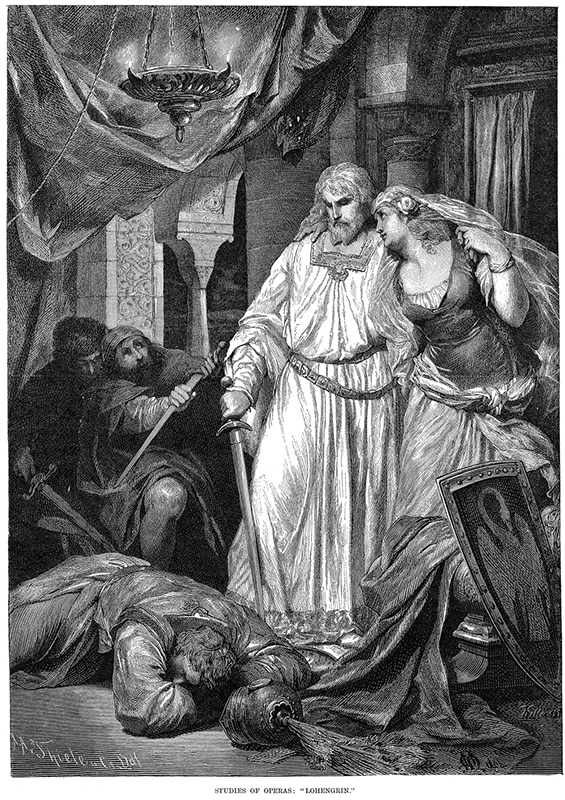
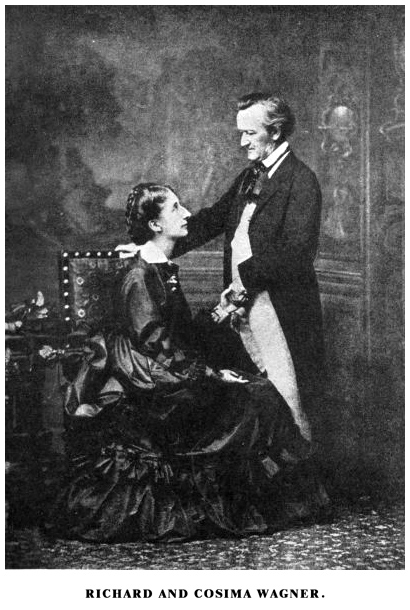
Franz Liszt, friend and supporter of Wagner—and whose daughter, Cosima, Wagner would later marry—conducted the first performance of Lohengrin, in Weimar, Germany. The opera is dedicated to him. Liszt chose August 28 as the premiere date, in honor of the great poet Johann Wolfgang von Goethe, who resided for much of his life in Weimar. Wagner could not attend his own premiere; he was in exile in Switzerland because of his revolutionary agitation in Dresden during the 1848 uprisings.
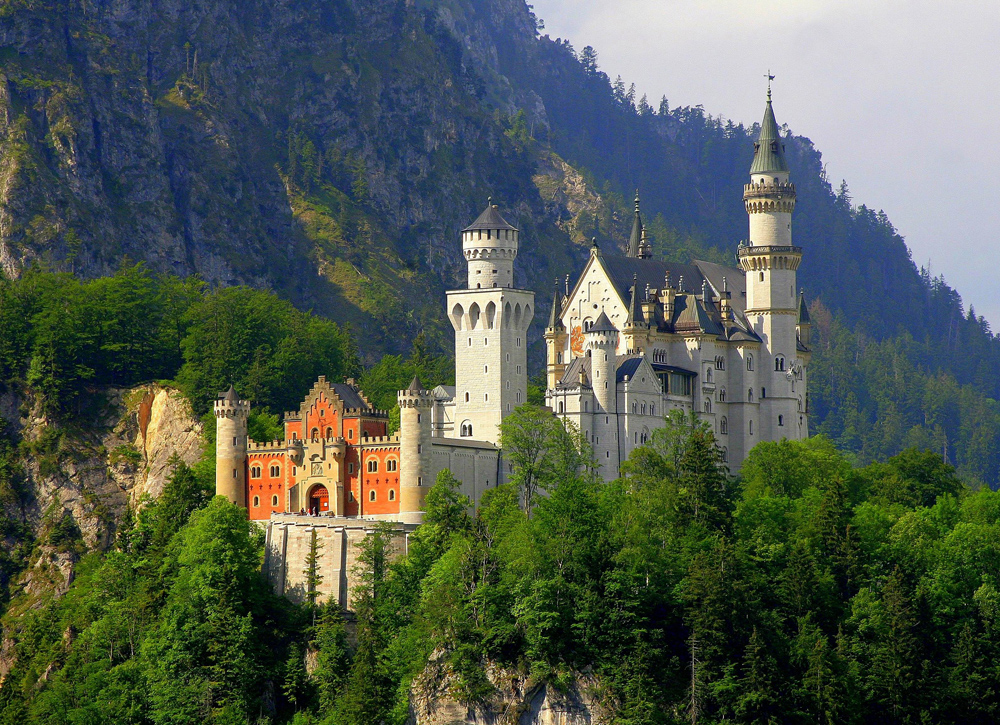
The title character Lohengrin comes and goes by means of a boat pulled by a swan, which particularly enchanted King Ludwig II of Bavaria (1845–1886), whose family coat of arms included a swan. Ludwig knew the Lohengrin story from childhood, and Wagner's music resonated deeply with him. He became fairly obsessed with Wagner and even incorporated numerous murals of Wagner's opera myths on the walls of his fanciful new castle Neuschwanstein (the schwan in the name means "swan" in German). King Ludwig's admiration worked out very well for Wagner, who, due to a lavish lifestyle, was buried in debt. Ludwig ultimately bailed the composer out and gave him enormous resources for the completion and production of his subsequent operas, as well as the new opera house in Bayreuth.
Another aspect of Wagner's music that placed him at the forefront of his generation was his bold use of harmony. The overture to Tristan und Isolde begins on a single note, A. (The opening two measures form the "Isolde" leitmotif.) However, the piece immediately moves away from A minor and returns to it only briefly about 30 measures later.
Composer: Richard Wagner
-
"Tristan and Isolde: Overture"
Especially in his late dramas, Wagner stretched the fabric of tonality almost to its breaking point. If the major/minor tonal system is built on the premise that chord progressions need to lead to a resolution on the tonic, then what happens if we never reach the tonic? The net result is a sense of restlessness or endlessness in the harmony.
You heard an excerpt of the famous "Ride of the Valkyries" in the "First Look" section. Here is the entire scene, in which the Valkyries, female mythological figures who choose which warriors will die in battle, are returning with the bodies of dead heroes for transport to the heavenly realm of Valhalla. Tension is perpetuated throughout by continually shifting harmonies and what Wagner called "endless melody," meaning lines that don't reach resting points but instead elide and extend across entire scenes and even acts.
Composer: Richard Wagner
-
"Die Walküre: Ride of the Valkyries"
Wagner completed the restructuring of traditional opera that began in the 18th century, leading to a new conceptualization of the art as music drama. His seemingly endless delay of any sense of harmonic resolution, as a way to keep the tension building throughout an entire opera, was one contributor to the complete demise of tonality that occurred in the 20th century.
After the first Bayreuth Festival, where the premiere of the entire Ring Cycle was given in 1876, Wagner worked for four years on Parsifal, his last opera. A second festival followed in 1882, after which, already suffering from ill-health due to severe angina attacks, he travelled to Venice. He died there of a heart attack on 13 February 1883, at the age of 69.