
Overview
As mentioned in Lesson 1, the 12-bar blues was one of the most popular African American musical forms in the early to mid-twentieth century. In this lesson, we look at the blues as a genre, focusing on two specific types: the rural blues and the urban blues. These two types of blues share many characteristics, but at the same time, they are clearly distinguishable from each other. Early blues recordings also make an excellent case study of race records and the treatment of African American musicians in the recording studio and by the recording industry. In addition, we will see some other blues-inspired music, such as boogie woogie and blues-based or blues-inspired popular songs.
Objectives
- Examine two specific types of blues to understand the musical form, instrumentation, harmony, and lyric content of each
- Examine the listenership of each type of blues music and how these musics were recorded, marketed, and consumed by both white and African American audiences
- Examine the specific aspects that are key to African American music, such as call and response and blue notes
- Identify the 12-bar blues form
- Identify the performers associated with rural blues
- Identify the performers associated with urban blues
Urban Blues
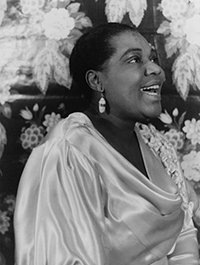
Like the rural blues, the urban bluesa style of blues that featured a female singer backed by a solo piano or small combo typically follow the 12-bar blues form and include blue notes and call and response. Unlike the rural blues, the urban blues are performed by a female singer who is typically backed by either a solo piano or a small combo. The combos backing these singers often resembled Dixieland jazz groups in their personnel with a trumpet, trombone, clarinet, piano, guitar, and bass. During vaudeville performances, female singers would often perform blues songs with an instrumental accompaniment. Some of these vaudeville singers were so successful that they were able to leave vaudeville and build new careers performing the blues.
Many urban blues recordings were released as race recordsa music industry term that designated recordings that were both produced by and marketed toward African Americans, the music industry term for recordings that were produced by and/or marketed toward African Americans. In record companies, race records were seen as a specific genre of music that included nearly all genres of African American music. Labels including OKeh, Emerson, Vocalion, Victor, and Atlantic all marketed race records. A few record companies such as Black Swan were owned by, operated by, and marketed to African Americans, although the majority of race records were released as a division of a major white-owned record label. "Race records" remained the industry term for African American music until 1949, when the term "rhythm and blues" was adopted as a replacement.
Many companies in the recording industry initially rejected singers such as Mamie Smith, Bessie Smith, and Ma Rainey because they did not approve of their "unpolished" vocal styles, southern diction, and raspy vocal timbres. At the time, record companies wanted "pretty" and "lyrical" (read: white) voices, which was not what these singers were offering. These women sang in a style that was typical of African American performers but relatively unknown to white record executives, which meant that they had some difficulty initially receiving record contracts.
In August, 1920, Mamie Smith recorded "Crazy Blues ♫" in the OKeh studios in New York. At the time, Smith was a vaudeville performer, and "Crazy Blues ♫" was penned by her fellow vaudeville performer Perry Bradford.
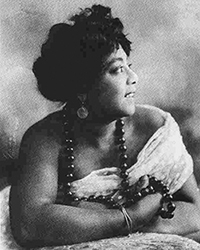
To everyone’s surprise, the tune sold over 75,000 copies in the first month and opened up a big market for a whole field of urban blues singers. Victoria Spivey, Sippie Wallace, and Sara Martin followed at OKeh; Alberta Hunter, Ida Cox, and Ma Rainey came out on Paramount; Bessie Smith and Clara Smith recorded at Columbia; and Trixie Smith performed on the Black Swan label.
Although urban blues singers such as Mamie Smith, Bessie Smith, and Ma Rainey often sang about southern sensibilities, men, and sexual relationships, they also presented themselves as refined, glamorous celebrities. These singers were stars, dressing lavishly with jewels, fancy gowns, and feathers. Their live performances offered their audiences a sense of luxury and opulence. In turn, audiences bestowed titles such as "Empress of the Blues" (Bessie Smith) and "Mother of the Blues" (Ma Rainey) on the singers.



