
Overview
The publishing district of Tin Pan Alley was the leading producer of popular music in the United States at the turn of the twentieth century. A sheet music publishing district in New York, Tin Pan Alley produced sheet music at higher rates and employed more aggressive sales techniques than publishers in the nineteenth century had used. Tin Pan Alley songs had several specific features and styles, all of which will be addressed in this lesson. A popular genre of instrumental music called ragtime also influenced the composition of Tin Pan Alley songs.
Objectives
- Examine the aspects that made Tin Pan Alley songs successful, such as specific forms, sentimental lyrics, and inexpensive sheet music
- Examine how Tin Pan Alley rose in popularity at the turn of the twentieth century
- Identify Tin Pan Alley composers
- Define vaudeville
- Define ragtime
- Identify the features of ragtime music
Tin Pan Alley Song Types
Many different types of songs flourished through Tin Pan Alley. Some genres were still recognizable from those that were popular during the nineteenth century: sentimental ballads, patriotic songs, and popular songs from blackface entertainment. The vast majority of these songs were waltzes. Most depictions of women were honorable and proper, although there are a few exceptions. Paul Dresser’s "My Gal Sal ♫" (1905) describes a woman named Sal who is "a wild sort of devil" and the narrator’s "old pal." Sal is more of a companion than a distant object of admiration, although Sal is quite rare among the women portrayed in Tin Pan Alley songs. Most Tin Pan Alley songs on romantic topics—such as "Sweet Adeline♫" (lyrics by Richard H. Gerard, music by Harry Armstrong) and "You Tell Me Your Dream and I'll Tell You Mine ♫" by Charles N. Daniels—kept the lovers at a distance.
Other songs portrayed specific geographic locations, such as "The Sidewalks of New York ♫" and "Meet Me in St. Louis ♫," a song about the 1904 World’s Fair that was held in St. Louis. Other songs were attempted to represent Irish neighborhoods and ethnic conventions, such as "Daisy Bell ♫," "In the Good Old Summertime ♫," and "My Wild Irish Rose ♫." A number of these songs relied on stereotype and caricature, though.
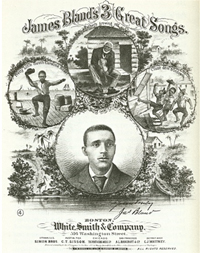
James Bland became the first commercially successful black singer-songwriter with hits such as "Carry Me Back to Old Virginny ♫." Despite the presence of a few other black composers, the majority of them were still white. By the twentieth century, the subtle satire and comic nuance of nineteenth century minstrel shows had been replaced by buffoonish and insulting portrayals of black characters who sang about watermelon, fried chicken, liquor, and gambling. Even the name of the music genre was derived from a racial slur. These coon songs a Tin Pan Alley song type that focused on negative stereotypes of black males portrayed black males as dangerous, shiftless, and foolish, driven by their baser instincts and ruled by little common sense. Songs such as "All Coons Look Alike to Me ♫" and "Gimme Ma Money" typically focused on negative portrayals of African Americans, relying on cheap gags, racist remarks, and outrageous stereotypes in order to entertain audiences and sell sheet music.

"What is scurrilously called ragtime is an invention that is here to stay. That is now conceded by all classes of musicians... All publication s masquerading under the name of ragtime are not the genuine article... That real ragtime of the higher class is rather difficult to play is a painful truth which most pianists have discovered. Syncopations are no indication of light or trashy music... Joplin ragtime is destroyed by careless or imperfect rendering, and very often players lost the effect entirely by playing too fast."


