
Overview:
Most music is created with a key or pitch center; a group of pitches based on a scale in which each pitch has a corresponding chord that in turn, have a unique relationship within the grouping. A key signature contains accidentals (sharps and flats) as a short-hand method of indicating which pitches require the accidentals so that they don’t need to be written throughout the entire composition. The pitch center or scale gives a music composition a sense of stability and cohesiveness through melodic and harmonic progressions of tension and release.
Objectives:
Students will be able to:
- Identify the basic major scale patterns.
- Identify how the scales relate to the key of a music composition.
- Define the meaning of transposition, key, and scale.
- Identify the purpose of meter in musical composition.
- Define how changes in note beams and ties alter duration within the phrase.
- Define the musical term anacrusis.
Ties
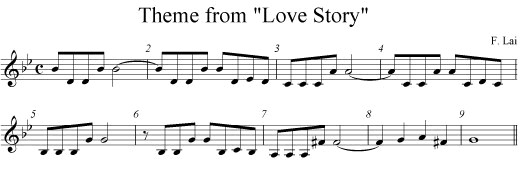
A tie is a curved line that extends the duration of a note by combining its rhythmic value with the value of the immediately following note of the same pitch. When two notes are tied, the second note is held instead of played again. The total duration of tied notes is equal to the sum of their corresponding durations. In the excerpt below, for example, the tie over the barline between m.7 and 8 creates a sound that lasts for three beats.
Ties can be drawn above (m.1 to 2) or below (m.7 to 8) from notehead to notehead and can happen within a bar or over barlines as in the following example.
Be careful not confuse ties with slurs. The slur is a curved line placed between two notes of different pitch (see m.12 in “Scarborough Fair” above) indicating that those notes should be played in a connected way (legato).
In the theme from “Love Story” by Francis Lai, half notes are tied to eighth notes over the barlines between measures one and two, three and four, and seven and eight.
| Rule |
|
“Try To Remember,” from the musical The Fantasticks by Harvey Schmidt and Tom Jones—the longest running musical in the world—combines dotted notes and ties. Measure eight illustrates the use of a tie within the bar. Ties can give composers a wider palette of sound durations than the one offered by regular note values or dots alone.
Listen to this selection while counting the beats and subdivisions of the beat with the method outlined above in “Scarborough Fair,” i.e. ONE, TWO, THREE, or ONE and TWO and THREE and for each bar.