
Objectives
- Recognize the differences between the Medieval and Renaissance periods in terms of society, religion, art, science, and freedom.
- Explain how Renaissance musicians made their living.
- Use relevant musical vocabulary to analyze Renaissance a cappella singing.
- Distinguish the characteristics of Renaissance music, and differentiate between Renaissance music and Medieval music.
- Illustrate how composers used the motet, a sacred genre with a Latin devotional text, to experiment in musical style and texture.
- Describe how Renaissance composers set texts from the Ordinary of the Mass for their polyphonic Masses.
- Describe how instrumental dance music was performed by professional and amateur musicians.
Selected Composers in the Renaissance
Famous Renaissance Composers of Secular Music
Cipriano de Rore (1516-1565)
Rore was a Netherlander who spent most of his career in Italy. (You may have noticed a theme that recurs throughout music history – the foreign-born composer moving to be near the center of activity.) He published the first of his five books of madrigals in 1542, using poetry by Francesco Petrarch (1304-1374), the famous 14th century Italian poet, for his early songs. This example set a precedent for future composers to use high-quality texts.
Carlo Gesualdo (c.1561-1613)
Gesualdo's madrigals contain the most extreme examples of Renaissance dissonance and chromaticism. Igor Stravinsky, one of the 20th century's most daring composers, called Gesualdo "the crank of chromaticism." While not stepping totally beyond acceptable bounds, Gesualdo's madrigals are restless and colorful. Works such as the motet O vos omnes, use an advanced form of harmony that isn't heard again until the late 19th century.
Composer: Carlo Gesualdo
-
"O vos omnes"
After notoriously murdering his wife and her lover in 1590, Gesualdo later married a member of the d'Este family, rulers of Ferrara, strong supporters of music and the arts. Aside from his collection of madrigals, he wrote a quantity of sacred vocal music and a relatively small number of instrumental pieces. The unexpected and sudden changes of tonality, harmonic daring, and intensity of feeling of his music, have found particular favor among some modern theorists.
Thomas Morley (1557-1602)
The madrigal first appeared in England in 1588 with the publication of a translation of Italian madrigals and, like the Italians, the English grew fond of them, ceaselessly clamoring for new works. Morley was an English composer who addressed this demand, specializing in a light and lively form of madrigal that emphasized word-painting and dance rhythms. He often added a chorus of "fa la la's," which contributed a note of whimsy to his music. These madrigals, called balletts, are set primarily in a homophonic texture.
Morley contributed significantly to the development of the English madrigal, initially imitated from Italian models. He was probably a pupil of William Byrd, to whom he dedicated his popular book A Plaine and Easie Introduction to Practicall Musicke, published in 1597. Morley was employed at St. Paul's in London and became a Gentleman of the Chapel Royal in 1592, publishing his first set of part-songs in 1593. He was later involved in printing and publishing music, for which he was granted a share of the monopoly in 1598.
Thomas Weelkes (1576-1623)
Weelkes is the other principal English madrigal composer of the late 16th century. His madrigals, such as As Vesta was, demonstrate the same concern with overall form as Morley's; however, in opposition to Morley, Weelkes retains an element of seriousness and depth. Note the imitation in this delicate madrigal.
Composer: Thomas Weelkes
-
"As Vesta was descending"
Thomas Weelkes would neither have known much about Rome in the early 1600s, nor would he have been aware of Monteverdi's successful synthesis of old and new forms. He was a busy Church of England musician whose music, in a typically English vein, had its own sense of values and destiny according to a national temperament, one which found continental histrionics and emotional outpourings rather embarrassing. Enough changes were afoot at the turn of the 17th century, however, for Weelkes to realize that he was operating in a world of transition; he quickly took advantage of this possibility. The power of representing words and images, central to the upcoming Baroque ethos, was particularly evident in his madrigal writing. His ability to illuminate texts is evident in his exquisitely focused and atmospheric sacred madrigal, When David Heard.
Composer: Thomas Weelkes
-
"When David Heard"
"When David Heard"Thomas Weelkes (1576-1623)
When David Heard that Absalom was slain, he went up to his chamber over the gate, and wept; and thus he said: O my son Absalom would God I had died for thee, O Absalom my son!
William Byrd (1543-1623)
William Byrd, whose Church works rank among the finest ever written in England, is the first superstar among English composers. He belongs to a select group of composers who, during their own lifetime, were recognized as geniuses. His contemporaries referred to him as 'a Father of Musick' and 'Our Phoenix,' perhaps alluding to his role in bringing Elizabethan music to a peak of perfection, particularly in terms of his understanding of the way continental polyphony could be used for effective expressive ends. He composed madrigals, masses, motets and songs, as well as important works for the keyboard. The piece Qui passe, performed here on a virginal (an instrument related to the harpsichord), shows the composer's remarkable skill.
Composer: William Byrd
-
"Qui passe; for my Ladye Nevell"
Although remaining Catholic, a loyalty that cost him considerable trouble in times of religious persecution in England, he served as a member of the Chapel Royal, providing music for the liturgy of the Church of England and, on a more private scale, for his fellow Catholics.
Following the popular fashion of the time, Byrd provided music for various groups of instruments. He frequently performed in homogenous ensembles, generally playing viols, and other bowed and fretted string instruments that were more highly esteemed than the lowly violin. Byrd's consort music, like that of all his English contemporaries, uses the forms of the fantasia, and the dance forms of the stately pavan, and the more vigorous galliard. One such piece is the Galliard a 6, thought to be a relatively late work, probably one of Byrd's last for viol consort.
Composer: William Byrd
-
"Galliard a6"
Interestingly, Queen Elizabeth granted Byrd and his teacher, Thomas Tallis, a monopoly on all music publishing in England. This honor meant that they were the only individuals who had the legal right to print and sell any music (including blank lined music paper) in England! A good deal if you can get it!
John Dowland (1563-1626)
Dowland's chief works were written for the lute and voice. He served as lutenist to the King of Denmark from 1598 to 1607 and, during the age of Shakespeare, composed many songs for voice and lute. This move away from the polyphonic to the solo madrigal foreshadows an important stylistic shift of the impending Baroque era. His A Shepherd in a Shade is an excellent example of the English lute song.
Composer: John Dowland
-
"A Shepherd In A Shade"
Claudio Monteverdi (1567-1643)
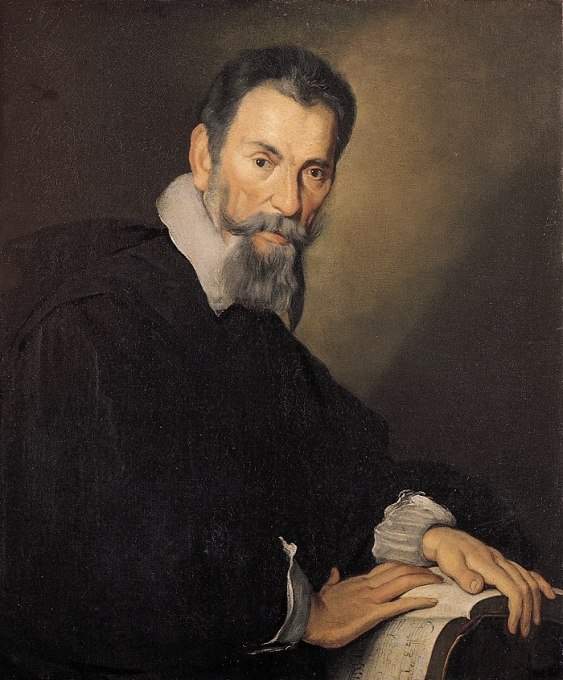
Monteverdi is the most important Italian composer of the late Renaissance, and, indeed, one of the most influential figures in the history of music. His music represents the transition from the Renaissance to the Baroque period.
A pupil of Marcantonio Ingegneri, the culmination of his early career was the publication, in 1587 and 1590, of two books of madrigals some of which show the influence of Luca Marenzio (1553-1599), the greatest madrigalist of his time. In 1607, Monteverdi established himself as a composer of major works with what is considered to be the first great opera, Orfeo. However, he owes his early fame to several books of madrigals he published between 1587 and 1606. Pieces like Canzonette d'amore, although not as extreme in the use of chromaticism as those of Gesualdo, provide further evidence that madrigals featured the most daring music to be found at the end of the 16th century.
Monteverdi's style is based on the premise that the declamation of words and the mood of the verse must be carefully followed by the music.
Composer: Claudio Monteverdi
-
"Canzonette d'Amore; Monteverdi, Claudio"
In his mature musical style, Monteverdi made extensive use of dissonance, which made him the figurehead of the Italian avant-garde movement. To attacks by conservative theorists of his day, chief among which was Giovanni Maria Artusi, Monteverdi responded with an aesthetic statement that had a profound influence in music well into the 19th century. In it, he upheld the tradition which sought to unify all the arts, specially words and music, while, at the same time, defended music as the supreme art as represented in the polyphony of composers such as Josquin des Prez and Palestrina. This view led to the preservation of an old style or "practice" as he called it, in certain types of church music, as opposed to the more modern style featured in operas and cantatas.
Works such as the operas L'Arianna, The Return of Ulysses to His Country, and The Coronation of Poppea and the dramatic cantata The Combat of Tancredi and Clorinda have established Monteverdi's fame as one of the greatest dramatic composers of all time.
Giovanni Pierluigi da Palestrina (c.1525-1594)
Palestrina, his name derived from his probable place of birth, was one of the principal composers of the late 16th century, his style taken as a model by later generations. His musical language represents the climax of musical achievement of the period, above all in his mastery of earlier Franco-Flemish polyphonic techniques, now used with complete assurance, particularly in the provision of music for the Catholic liturgy both before and after the reforming Council of Trent. Palestrina's career was largely spent in Rome, at the basilica of Santa Maria Maggiore, the Cappella Giulia at St. Peter's and at St. John Lateran.
Palestrina wrote a large number of settings of the ordinary of the Mass. Of these the Missa Papae Marcelli,, popularly supposed to have been written to convince the authorities at the Council of Trent that there was still a place for polyphony in the musical performance of the Catholic liturgy, is among the best known. Missa Aeterna Christi Munera, a Mass that makes use of the plainchant of the title as its basis, is a fine example of Palestrina's technical command, but a similar claim might be made for almost any other of the 100 or so surviving Mass settings. The very large number of surviving motets offers a similar richness of choice. Palestrina's liturgical music also includes settings of the Lamentations for Holy Week, taken from the Book of Jeremiah, litanies, settings of the Magnificat and offertories. In addition to generally conservative Italian madrigals, he also wrote a number of five-voice Italian sacred madrigals.
The Netherlands School
Although the following Dutch composers did not form a school of composition, and came from a region that also included parts of Northern France, they were a dominating force in European music for the first 100 years of the Renaissance and are generally known as the Netherlands School.
Johannes Ockeghem (1410-1497)
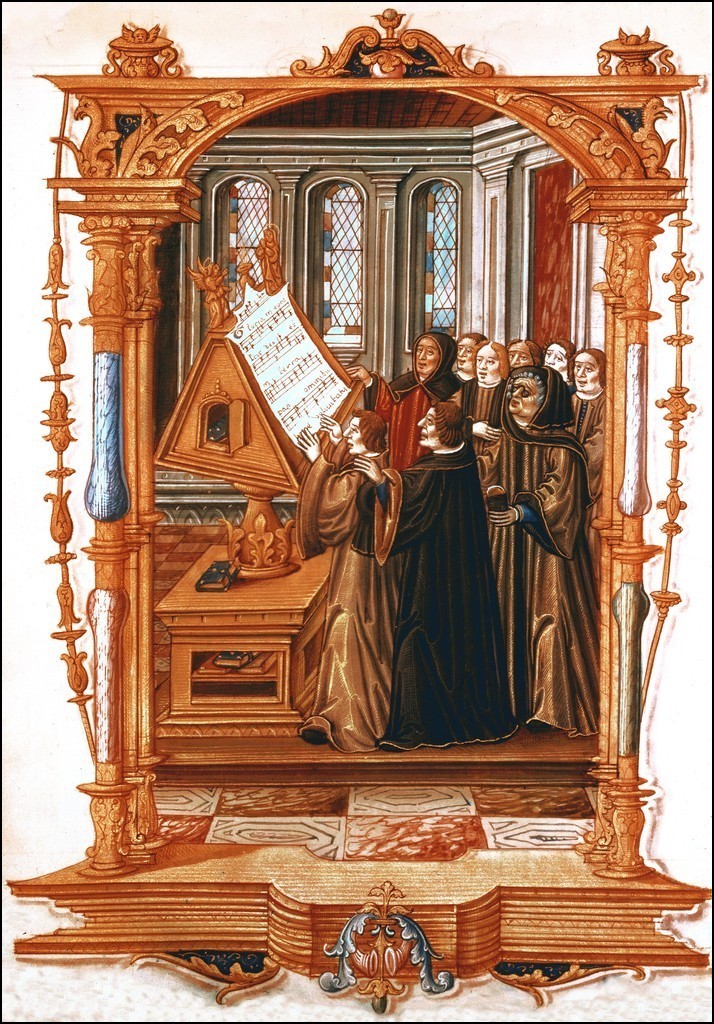
Ockeghem entered the service of the King of France in 1452. From 1465 until his death, he was the most important musician in Europe; his passing in 1497 was universally mourned. Among those mourners was Josquin Desprez, who wrote Déploration sur le trépas De Jean Ockeghem (Deploration on the death of Jean Ockeghem) as a tribute to the late Flemish master.
In his masses, Ockeghem extended the range of each of the voice parts and occasionally varied the texture by including passages for only two or three voices. This shows an attention to the overall form of the piece that, at the time, was uncommon. Note the varying textures in the Agnus Dei from his Missa Prolationum.
Composer: Johannes Ockeghem
-
"Missa Prolationum: Sanctus"
Composer: Josquin des Prez
-
"Ave Maria...virgo serena"
Composer: Johannes Ockeghem
-
"Missa Prolationum: Agnus Dei"
Jacob Obrecht (1450-1505)
Few details are known about the life of Obrecht, other than that he held positions at various cities throughout Europe and that he died of the plague. His surviving works include masses, motets, chansons, and instrumental pieces. Most of his masses use a cantus firmus, which appears in various ingenious ways throughout each of the sections of the mass. Obrecht, unlike Ockeghem, loved imitation between the voices. TheAgnus Dei from his Missa Caput opens with a clear point of imitation between the tenor and the bass parts. Obrecht's works contain some of the finest examples of structure and form in the early Renaissance.
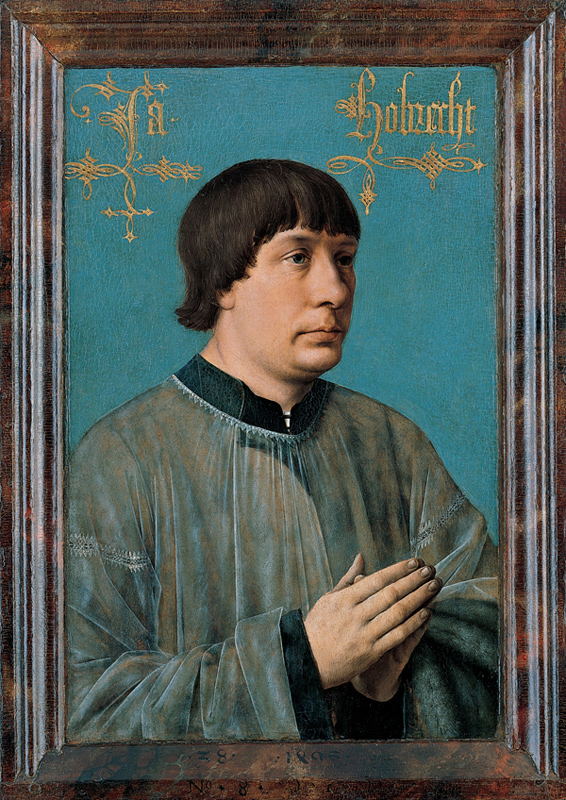
Composer: Jacob Obrecht
-
"Missa Caput: Agnus Dei"
Josquin des Prez (c.1445-1521)
Based on his renown, the respect of his colleagues, and his influence on subsequent generations of composers, Josquin des Prez may be listed among the greatest musicians. Born near the present-day border of France and Belgium, Josquin, as he is commonly known, spent most of his professional career in Italy (Milan, more specifically) and France.
His masses and motets all deserve high praise, as does the rest of his prodigious output. Not bound by the strict protocol of the mass texts, he experimented with harmonic color and melodic line in his motets.
Josquin's works certainly helped make the motet the 16th century's most popular Church music form. One of his greatest motets is Absolom fili mi, O my son, Absolom (1497). In this moving work, possibly written for Pope Alexander VI after the murder of his son Juan Borgia, Josquin includes a descending harmonic passage to the words but go down weeping to the grave" that, for the time, was considered extremely daring. This beautiful passage is an example of word painting, a technique in which the music creates an image of the words in the text. Word painting became one of the most popular devices in choral music during the Renaissance.
Composer: Josquin des Prez
-
"Absalon fili mi"
Composer: Josquin des Prez
-
"Absalon fili mi" [ 03:47-04:28 ]00:41



