Generating page narration, please wait...

Learning Objectives
- Identify the functions of key signatures; key signatures indicate the pitches requiring accidentals for an entire music composition; any accidental in the key signature applies to all the notes it refers to, regardless of octave.
Functions of the Key Signature
| Remember |
|
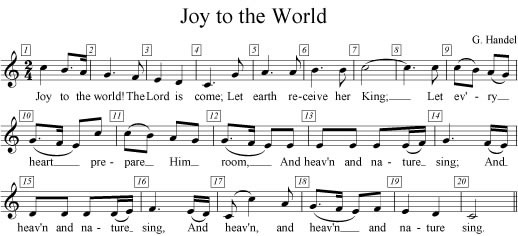
To illustrate these rules, let's use the familiar piece Joy To The World once again.
Joy To The World in the original key of C major. Its key signature has no sharps or flats in it.
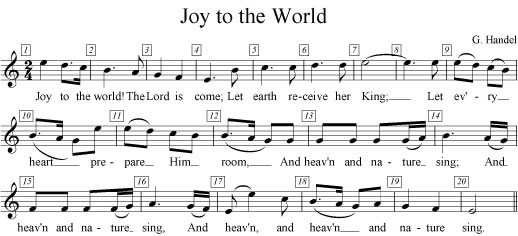
Joy To The World, now starting on E instead of C, suggesting a transposition to E major. But since it is not using the key signature of E major, and since there are no accidentals in the score, the piece sounds completely wrong!

Joy To The World, now starting on E instead of C
Joy To The World, written here in the key of E major, but without a key signature. Instead, sharps have been placed in front of every note that requires them (in front of every F, C, G, and D). It is rather cumbersome to have the sharps appear every time they are needed, although some music is written without key signatures in this way.
Joy To The World in the key of E major
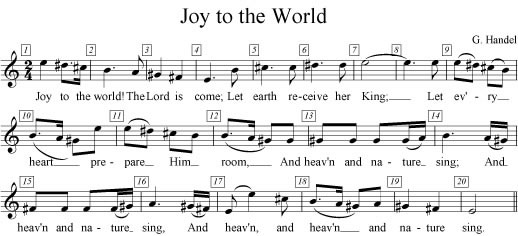
Joy To The World, written here in the key of E major, but without a key signature. Instead, sharps have been placed in front of every note that requires them (in front of every F, C, G, and D). It is rather cumbersome to have the sharps appear every time they are needed, although some music is written without key signatures in this way.
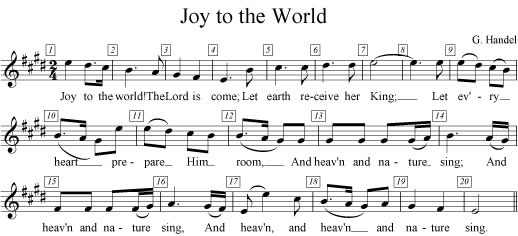
Joy To The World, this time using the key signature for E major (four sharps). The key signature is written after the treble clef and before the time signature. It indicates that all Fs, Cs, Gs, and Ds in this piece are sharp. The score looks much more readable, and the piece obviously sounds fine.
Joy To The World, using the key signature for E major (four sharps)
| Remember |
|