
Overview
Despite their apparent stylistic diversity, different jazz pieces share common elements, such as improvisation and swing feeling, and on a more basic level, common forms and instrumentation. This section’s focus on form and timbre in jazz will hopefully give you a deeper understanding of jazz improvisation. To fully appreciate jazz improvisation, you should be familiar with the standard jazz forms, the sound of various instruments and their role in an ensemble—whether a musician is playing written parts or improvising.
This section also looks at the various cultures that contributed to the early development of jazz’s distinctive style and flavor. Learning where and how jazz was first created will help you understand it better.
Objectives
Upon completion of this part of the lesson, you will be able to do the following:
- Recognize the standard forms of jazz.
- Understand the roles of the various jazz instruments.
- Identify the sounds of these instruments.
- Identify the cultural origins of jazz.
- Identify the musical contribution of brass bands to jazz.
- Identify the significance of ragtime music.
- Identify the blues as a musical style.
- Identify some call-and-response genres that predate jazz.
- Identify New Orleans as a fertile culture that “birthed” jazz.
Piano
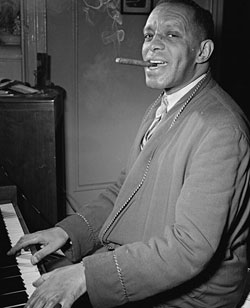
The pianist most often plays the chords that correspond to the pre-set chord progression of the chorus, but the particular arrangement of the notes of the chord — what we call the voicingA term referring to t he particular arrangement of the notes in a chord. — and the rhythmic placement of the chords are decisions made by the pianist during the performance.
This type of intricate improvisation of accompanying chords is characteristic of the modern jazz era, and it is referred to as compingA term that refers to the improvisational techniques deployed when a pianist plays the accompanying chords in a jazz setting. (short for "accompanying"). Sometimes the pianist will substitute a different chord for the expected chord within the chord progression to add a different harmonic color — a technique known as chord substitution The use of a chord in place of another in a chord progression, typically to impart a new and distinct flavor to the chord progression..
In addition to his role within the rhythm section, the pianist will also take his turn as the lead soloist, improvising new melodies over one or more choruses.
Watch and listen now to Arthur Goldstein discuss the art of playing piano in a combo setting.
Bass
The bass player provides the harmonic backbone of a piece, even as he serves a critical timekeeping duty. The standard way to play upright bass (known formally as double bass) in a jazz piece is to pluck a string — a technique known as pizzicatoA playing technique in which the strings of a string instrument are plucked.. (Bowing the strings is the normal way to play bass in the classical style — which is called arco.) Often the bass player plucks a note on each quarter note beat, a style of playing referred to as walking bassA style of playing bass in which the strings are plucked on every quarter-note beat..
The bass player knows the chord progressions of the chorus, and he reinforces the changing harmonies with his choice of notes. But there is also considerable freedom in the walking bass lines, and he improvises within the limits of the bass's role in the rhythm section. And like the pianist, the bass player will often take his turn as soloist, at which time his playing becomes much more rhythmically varied and melodically daring.
Watch and listen now to Professor Robert Nairn discuss the art of playing double bass in a combo setting.



Billie Holiday's "God Bless the Child" was honored with the Grammy Hall of Fame Award in 1976 and the RIAA included it on their list of the "Songs of the Century."
