
Overview
In the early 1940s, a number of innovative and daring jazz musicians began searching for a new style. In after-hours jam sessions, they experimented with new melodic and harmonic vocabularies that challenged listeners and musicians alike. This music would come to be known by its onomatopoeic description: bebop.
In this section, we will first focus on the two principal innovators of this new jazz style: Charlie Parker and Dizzy Gillespie. We will also discover how the swing-style jazz of Count Basie provided a basis for the transition to bebop and the advent of the modern jazz era. In the second half of the section, we will discover other influential musicians who helped shape bebop and modern jazz.
Objectives
Upon completion of this lesson, you will be able to do the following:
- Identify Charlie Parker and Dizzy Gillespie as the principal innovators who contributed to the development of bebop
- Appreciate bebop as a new approach that ushered in modern jazz
Charlie Parker
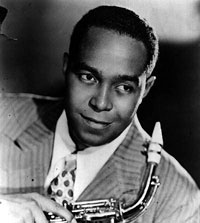
Just as the development of the mature swing style owe much to the midwestern city of KayCee, so too did the great experimenters and innovators who developed the emerging bebop sound. The player with the most direct connection — as well as the most outstanding practitioner of this new style — was Charlie Parker.
Charlie Parker (1920-1955) was born in Kansas City, Kansas, and when he was seven, his family moved across the state line to Kansas City, Missouri. This was the KayCee famous for its jazz and the associated vices of its nightlife. Parker grew up in this environment, intrigued by the music of his hometown. He picked up the alto saxophone at age 13 and began playing gigs a few years later.
Parker was not a prodigy though. The story has often been recounted of the teenager's first effort to sit in on a jam session with members of the Count Basie band. After initially catching the interest of Basie's bandmembers, Parker soon found himself unable to keep up, losing the melody and freezing in place. Drummer Jo Jones reached into his kit, grabbed a cymbal, and tossed it across the bandstand so as to come crashing at the young altoist's feet. Parker had been dismissed. Amid boisterous laughter, he walked off stage1.
Rather than allowing that humbling experience to defeat him, Parker redoubled his efforts to learn his instrument. While he absorbed many influences, Parker held the artistry of Lester Young in highest esteem. As part of his development, Parker learned many of Young's solos note-for-note. The phenomenal technical prowess and artistry he achieved on alto saxophone were the results of intense discipline and practice over the next several years. That same measure of discipline, unfortunately, did not carry over into other areas of his life. Parker struggled with alcohol and heroin addiction throughout the remainder of his life. Like far too many jazz luminaries, Parker's light blazed and then was gone, before he had even reached his 35th birthday.



Charlie Parker's nickname "Bird" (or "Yardbird") was reflected in some of the songs he composed, such as "Ornithology," "Bird of Paradise," and "Yardbird suite."
