
Learning Objectives
- List the characteristics of the Baroque era (1600-1750) in context of social change including religious wars (Protestants vs. Catholics), the exploration and colonization of the New World, and the rise of middle-class culture.
- Identify a new style—monody—that featured solo song with instrumental accompaniment in the Baroque period through listening examples.
- Define figured bass, a shorthand that allowed the performer to supply chords through improvisation.
- Compare and contrast the major-minor tonality system and the equal temperament tuning system.
- Explain the significance of the union of text and music as expressed in the Baroque Doctrine of the Affections and reflected in genres such as opera, oratorio, and cantata.
- Define and compare the genres of opera, oratorio, and cantata.
- Compare and contrast the development of two types of concertos: the solo concerto and the concerto grosso.
- Correctly identify visually and aurally the main keyboard instruments of the Baroque era: organ, harpsichord, and clavichord.
- Describe the main characteristics of J. S. Bach's keyboard music, in particular his Well-Tempered Clavier.
Baroque Period (1600–1750)
Introduction to Church Music
Throughout the 17th and 18th centuries, music continued to play a very important religious role within community life. Music could move and involve a congregation, intensifying the spiritual experience. Although Protestants were skeptical of visual displays and the use of statues, paintings, and ornaments in church, they approved of the use of music during church services. Thus, in the 17th century, major Protestant congregations began forming orchestras and choirs, hiring organists, soloists, and music masters in the process.
As in previous periods, much of the music was produced for religious purposes. However, during the Baroque period, it became common practice for composers to write secular music for all types of ceremonies, including marriages and other private occasions. Another important development during this period was that churches and orphanages started providing music education for talented young boys (and sometimes girls) who manifested the desire to become musicians.
Most choral works of the time were sacred music. In the Catholic Church, Baroque composers were still required to conform to the stile antico (literally "ancient style") of polyphonic writing à la Palestrina; i.e., in the smooth polyphonic "Palestrina style" that minimizes the use of dissonance and strives for text clarity above all. Several composers, notably the Venetian Antonio Lotti (c. 1667-1740), created some magnificent music in this style. Lotti's sacred choral music used the older polyphonic form to express poignant, Baroque emotions. His Crucifixus, with text taken from the Catholic Creed, is a relatively short but nevertheless intense piece from its gradual build up of the voice parts—including sparing use of dissonance to emphasize Christ's agony—to the reiteration of Christ's suffering under Pontius Pilate and his death. Notice that rather than ending in the minor key in which the piece is written, the last chord closes the piece in a bright major key, as if to stress the positive consequences of Christ's suffering.
Composer: Antonio Lotti
-
"Crucifixus a 8"
In England, composers such as John Blow (1649-1708) and Henry Purcell (1659-1695) specialized in writing music for the Anglican Church. Purcell's "I Will Sing Unto the Lord" is an excellent example of the English anthem in the Baroque period.
Composer: Henry Purcell
-
"I will sing unto the Lord"
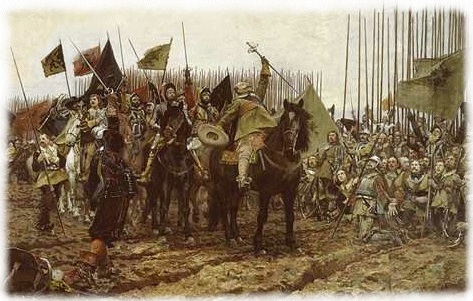
In Germany, the Thirty Years' War disrupted all aspects of German society including the church. The Lutheran church, under the tutelage of Heinrich Schütz (1585-1672)—the greatest composer of the early Baroque era—was one of the first segments of the society to rebound. Although Schütz usually set Latin texts to music in a contrapuntal fashion, the influence of Italian style may be heard in his larger works—for instance, in the alternation of soloist and chorus in the opening chorus and recitative from Christmas Oratorio. His later works are the most important examples of Lutheran music prior to Bach.
Composer: Heinrich Schütz
-
"Weinachtshistorie, SWV 435 (The Christmas Story): Eingang Chorus"