
Irregular and Mixed Meter
Irregular Meter
The third category of meter, introduced briefly in the first lesson of this section, is called irregular meter or asymmetric meter, since it involves irregular combinations of twos and threes. Irregular meters are found in the folk music of many Central European and some Asian countries. They were also increasingly used by composers during the 20th century as interest in folk music grew. However, they are far less common that simple and compound meters.
The most common irregular meters are quintuple meter (with five beats per measure) and septuple meter (with seven beats per measure). These combine duple and triple meters in various patterns. Quintuple meter can feature either a 2+3 or a 3+2 beat pattern. Septuple meter can feature a 2+2+3, a 2+3+2, or a 3+2+2 pattern. Beaming patterns and the placement of accents (>) usually help musicians to determine which pattern is present in any given musical situation.

Remember:
Irregular meters involve different combinations of twos and threes
Time Signatures
The top number in an irregular time signature is always greater than four, but never six (6), nine (9), or twelve (12). Five-four, five-eight, seven-four, and seven-eight are typical irregular meters.
Five-eight meter
Five-four meter

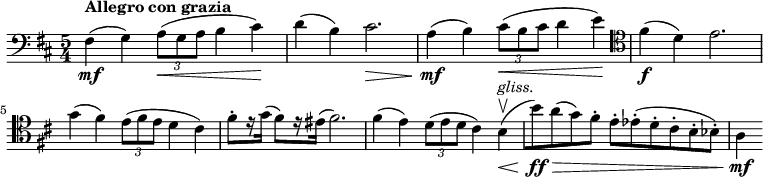
Five-four is a fairly common time signature among the irregular meters. The two beats per bar can be grouped in a pattern of 2+3 quarter notes or 3+2 quarter notes. Two notable examples are the second movement of Tchaikovsky's "Pathétique Symphony"—often described as a "limping waltz"—and Paul Desmond's "Take Five" originally recorded by the Dave Brubeck Quartet and the biggest-selling jazz single ever.
It is important to note that even though the time signature indicates there are five quarter notes in each bar, in reality there are only two—not five—beats per bar. Indeed, watch how Karajan conducts this excerpt in what appears to be two beats per bar. These two beats have different lengths: the first is a half note long (two eighth notes), the second a dotted half note long (three eighth notes). This grouping is created by the placement of the rhythmic emphasis, which is indicated by the articulation markings on the score (see m.2 below in particular).
Even though time signatures with a 5 at the top have two beats per bar, they are not in duple time because the two beats don't have the same length. Duple time signatures must have two beats of equal length in each bar. Time signatures with a 5 at the top are in quintuple time.
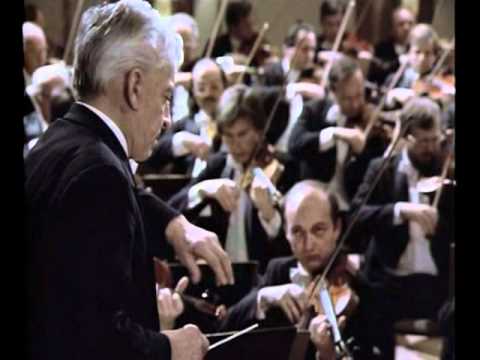
Tchaikovsky: Symphony No. 6 (Pathetique), II: Allegro con grazia [ 00:05-00:24 ]
Vienna Philarmonic Orchestra conducted by Herbert von Karajan
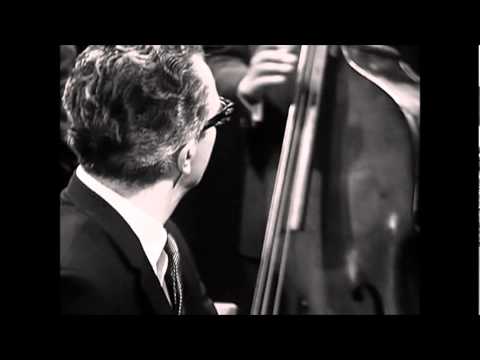
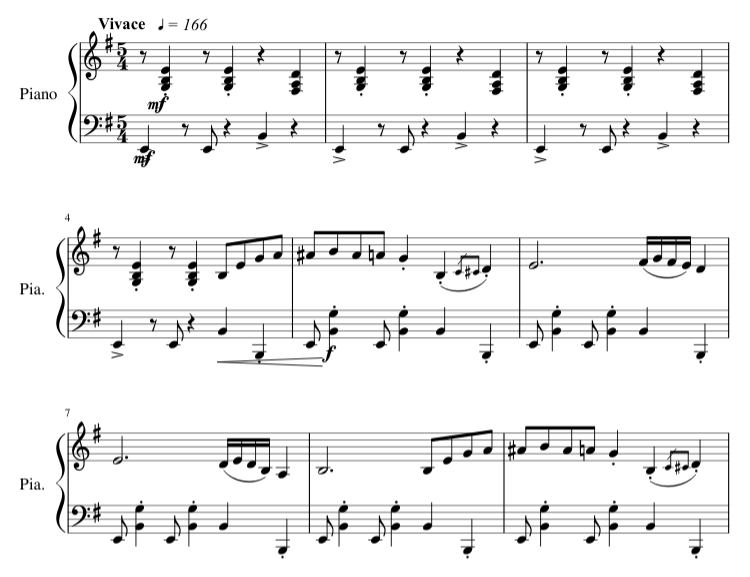

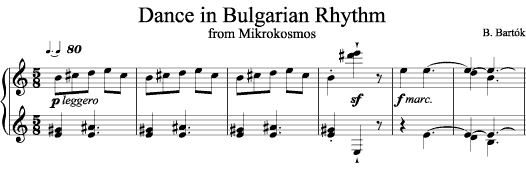
Five-eight is probably the most frequently found of the irregular meters. It can be grouped in a pattern of 2+3 eighth notes or 3+2 eighth notes. The following example from Béla Bartók's (1881-1945) Bulgarian Dance illustrates five-eight meter. Notice that the beaming of eighth notes in the top staff suggests a 3+2 beat pattern. However, the durations played in the bottom staff alternatively suggest a 2+3 pattern (a quarter note followed by a dotted-quarter note). Click on the score to hear the music played. What pattern do you hear—3+2 or 2+3?

Dance in Bulgarian Rhythm by B. Bartók
Seven-eight meter

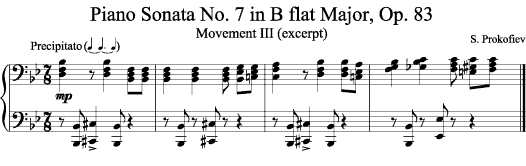
Seven-eight meter can be grouped into twos and threes in various ways. In his Piano Sonata No. 7 in B-flat Major, Russian composer Sergei Prokofiev groups his seven-eight meter in the pattern 2+3+2 (this is indicated after the Precipitato expression marking). Since there are no measures filled only with eighth notes in this opening passage, there is no clear beaming pattern to help us identify this grouping. The last two eighth notes in each measure are always beamed together, however, supporting the 2+3+2 grouping that Prokofiev indicates. Click on the score or the audio link below to see if you can detect this grouping. (Good luck!)
Piano Sonata No. 7 in B-flat Major Op. 83
Composer: Sergei Prokofiev
-
"Piano Sonata No. 7 in B-Flat Major, Op. 83: III. Precipitato" [ 00:00-00:05 ]00:05
Composer: Sergei Prokofiev
-
"Piano Sonata No. 7 in B-Flat Major, Op. 83: III. Precipitato"
Mixed Meter
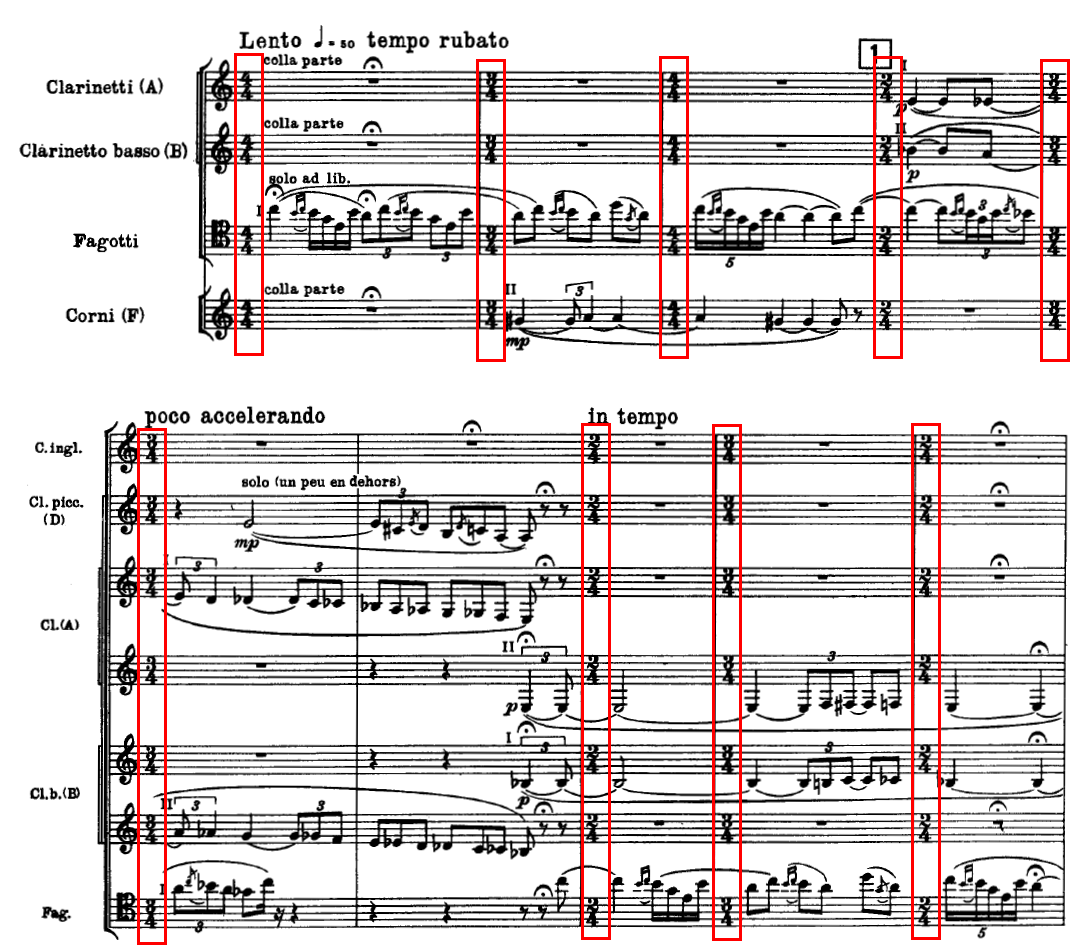
In pieces that include mixed meter the time signature changes frequently—sometimes every measure—which means that there is no consistent beat or beat pattern.
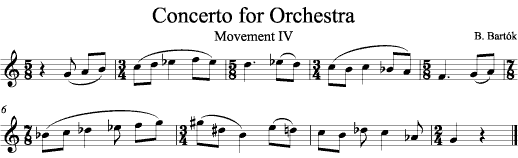
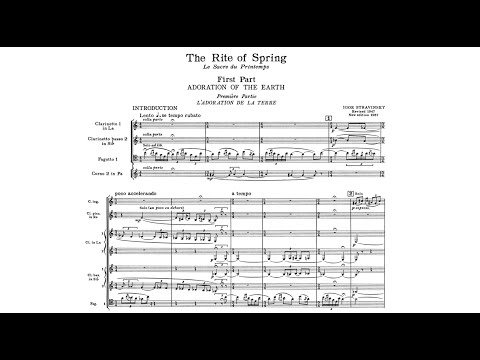
The following two passages, one from Béla Bartók's Concerto for Orchestra and the other from Igor Stravinsky's Rite of Spring illustrate the use of mixed meter, including simple meters (3/4 and 2/4) and irregular meters (5/8 and 7/8).
Take a moment now to review what you have learned about simple, compound, irregular, and mixed meters (and their time signatures) for the practice exercises that follow.