
Learning Objectives
- Define unisons, fourths, fifths, and octaves as perfect intervals.
- Examine how perfect intervals may become augmented or diminished.
- Learn about the interval of the tritone.
Intervals IV: Perfect Intervals
Perfect Intervals
Perfect intervals derive their name from the relatively stable and pure quality of their sound. This label goes back to the Middle Ages and the Renaissance, when these types of intervals were often used to create points of rest and stability in the music. Listen to the perfect intervals below to get a sense of their pure, open quality.
Perfect Intervals
Perfect Intervals
Only unisons, fourths, fifths, and octaves can be called perfect. The other interval sizes (seconds, thirds, sixths, and sevenths) can never be perfect.
| Perfect Interval Rule 1 |
|
Unisons and Octaves
When two musicians play or sing the very same pitch (in tune), we say that they are in perfect unison. When they play the same pitch an octave apart, we can similarly say that they are performing a perfect octave. Perfect unisons and octaves are easy to identify and write because they involve pitches with the same letter name and accidental. Here are some perfect unisons (P1) and perfect octaves (P8):
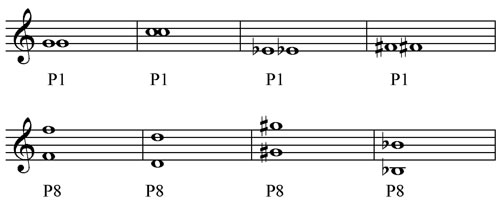
Note that there are always 0 semitones in a perfect unison and 12 semitones in a perfect octave.
Fourths and Fifths
A perfect fourth is a fourth that contains 5 semitones. A perfect fifth is a fifth that contains 7 semitones. Here are some perfect fourths (P4) and perfect fifths (P5):
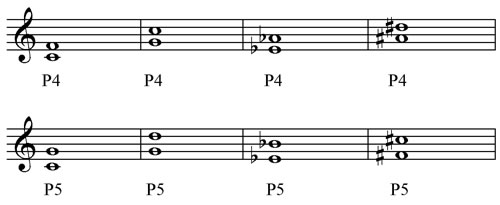
Note that both of the pitches in each of these intervals use the same accidental (or have no accidental). This is almost always the case with perfect fourths and fifths (with one exception to be discussed later). You can also determine whether fourths and fifths are perfect by counting the number of semitones between the two pitches on a piano keyboard. For example, if you were given the two pitches D and A, you would start on the note D and count the number of semitones between D and A. Click "Show Me" in the example below to see how this is done.
Counting the number of semitones from D to A
Note that you do not count the initial D, because you are not counting all of the piano keys used. Rather, you are counting the distance between the keys: a semitone from D to D#, a semitone from D# to E, and so on. Since there are seven semitones, this is a perfect fifth.
Counting half-steps in this manner is always accurate if you are careful and use a keyboard for reference. But this method can sometimes be tedious and is prone to counting errors, particularly with larger intervals. We will discuss a simpler method for spelling and identifying perfect intervals in the next lesson.
Augmented and Diminished Intervals
Now, listen to the three intervals below. All of them are fifths because they each contain five letter names (C, D, E, F, and G), but not all of them are perfect, since each one has a different number of semitones.
Diminished Fifth: C to G♭
Perfect Fifth: C to G
Augmented Fifth: C to G#
Only the second interval (C-G) is a perfect fifth, since it contains 7 semitones (you can verify this on a piano keyboard). The first interval is one half-step smaller than a perfect fifth (6 semitones). This is called a diminished fifth because the distance between the two notes has decreased from perfect. The last interval is one half-step larger than a perfect fifth (8 semitones). This is called an augmented fifth because the distance between the two notes has increased from perfect. You'll notice that in both cases the interval loses its stable (hence perfect) quality.
The relationship between perfect, diminished, and augmented can be expressed as a rule:
| Perfect Interval Rule 2 |
(smaller) dim — P — aug (larger) |
The interactive example below illustrates this rule. Click "Show Me" in the first example to see how altering the top note affects the quality of the interval, with an increased distance between the two pitches creating an augmented fifth and a decreased distance creating a diminished fifth. (If you were to think of the lower note as the "floor" and the upper note as the "roof," you might picture these alterations as "raising the roof" or "lowering the roof.") You can also click on "P," "dim," or "aug" in the example to see how the intervals change.
Perfect Interval Quality Altering Top Note
| Interval quality altering top note |
Perfect Interval Quality Altering Bottom Note
| Interval quality altering bottom note |
The second example illustrates how altering the bottom note affects the quality of the interval (Click "Show Me"). Note particularly that adding a flat to the bottom note does not create an diminished interval, because by lowering the bottom note the distance between the two pitches actually becomes larger ("lowering the floor"). Similarly, raising the bottom note with a sharp ("raising the floor") makes the interval smaller. Avoid the common mistake of simply associating sharps with augmented intervals and flats with diminished intervals.
Note as well that in each of these examples, the numeric interval size does not change. That is, the letter names C and G are always used. If we were to use C and F# instead of C and G♭, this would not be a diminished fifth, since the interval size has changed to a fourth (C-D-E-F). Keep the letter names (and the interval size) the same when altering intervals.
One additional point should be made regarding perfect intervals. While they can be altered to become augmented or diminished, perfect intervals can never be altered to become major or minor. There are only three "states" for perfect intervals: diminished, perfect, and augmented.
| Perfect Interval Rule 3 |
|
Not all intervals are equally likely to occur in tonal music. For example, diminished fourths and augmented fifths are rare. But augmented fourths and diminished fifths are common, as we will see next.
The Tritone
There is one interval class that deserves special mention here because of its prevalent role in tonal music. As illustrated in the example below, the intervals of the augmented fourth and the diminished fifth share the same number of semitones (6), dividing the octave (of 12 semitones) neatly in half. In other words, Fsharp is exactly halfway between C and C on the keyboard.
Augmented Fourth: C to F#
Diminished Fifth: F# to C
This special dividing interval has been given its own name: the tritone. The name tritone comes from the fact that the interval contains three whole tones (2 + 2 + 2 = 6 semitones). Both the augmented fourth and the diminished fifth can be called tritones, which is sometimes abbreviated Tt.
The tritone occurs natually between the white keys of B and F (or F and B). You cannot see this clearly on the staff, but you can verify that it is true by counting the half steps on a keyboard. Either a B♭ or an F# (not both) must be used to alter this natural tritone so that it is perfect, as illustrated below.

Listen again to the tritones above. In contrast to the pure, open sound of the perfect fourth and fifth, the tritone is highly dissonant and unstable, leading early musicians to call it the diabolus in musica or "the devil in music."