
Learning Objectives
- Learn how to invert intervals.
- Examine the consistent patterns associated with interval inversions.
- Use inversion to spell and identify sixths and sevenths.
Intervals IX: Interval Inversions
Interval Inversion
Every interval can be inverted. To invert an interval means to reverse the order of the two pitches in the interval. For example, the inversion of the interval from F to A (a major third) is A to F (a minor sixth). As the example below illustrates, when you invert an interval, you essentially move one of the pitches by an octave so that it "flips over" the other note, which remains stationary. (Click "Show Me" to see this illustrated.)
When inverting an interval, the note on the bottom becomes the note on top, and vice versa. To invert, you can move the top note below the bottom note (click on "M3" in the example above) or you can move the bottom note above the top note (click on "m6" in the example above).
The most important thing to remember when inverting intervals is that the letter names of the two pitches involved do not change. So F-A becomes A-F, C-Eb becomes Eb-C, F#-D becomes D-F#, and so on. You cannot invert an interval in such a way that you would get two different letter names than the ones you started out with (although their order from bottom to top is going to be switched).
| Remember |
|
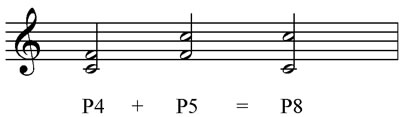
Any interval combined with its inversion creates an octave. For example, if we combine the interval from C up to F (a perfect fourth) with the interval from F up to C (a perfect fifth), we will get a perfect octave (from C up to C). In other words, the inversion of a perfect fourth is a perfect fifth, since these two intervals combine to form an octave.
Inversion Patterns
Looking at inversions more closely, you will begin to see some interesting patterns. For example, seconds always invert into sevenths, thirds invert into sixths, and fourths invert into fifths (as illustrated below—be sure to click "Show Me").
Interval size and inversion
Inversion
4-5 Inversion
Note that the sum of the two interval sizes always equals 9 (2+7, 3+6, and 4+5). So, what would the inversion of an octave be? ... A unison (8+1=9). These points are summarized in the rule given below.
| Remember | ||||||||||||||||
|
There is also a consistent pattern with the qualities of inverted intervals. When you invert a perfect interval, it remains perfect. But major intervals become minor when inverted, and minor intervals become major. Augmented intervals become diminished when inverted, and diminished intervals become augmented (as illustrated below—click on "Show Me" to see the inversions).
Interval qualities and inversion
M3 m6 Inversion
min3-M6 inversion
A4 d5 Inversion
d3 A6 Inversion
| Remember | ||||||||||
|
Using Inversion to Spell and Identify Larger Intervals
You can use your knowledge of inversion patterns to help you more easily spell and identify larger intervals, like sixths and sevenths. These sixths and sevenths invert into thirds and seconds, which are much easier to work with. Here are the two steps involved in spelling large intervals by means of inversion:
- Spell the smaller inversion
- Invert the result
For example, if you wanted to spell a minor seventh above F#, you could spell it by counting up 10 half steps. Or, you could use interval inversion to simplify this task. Instead of writing a minor seventh above F#, begin by spelling its inversion: a major second below F# (since m7 inverts to M2). What is a M2 (or a whole step) below F#? ... E. Now we just need to invert the result by moving this E up an octave (flipping it over the F#) and we have a minor seventh from F# to E (click "Show Me" below to see this illustrated).
Spelling a minor seventh above F#
Similarly, if you wanted to spell a major sixth above E, you can begin by figuring out the smaller inversion: a minor third below E (click "Show Me" below). C is a third below E, but C to E is a major third. You can fix this by raising the C to a C#. There are three semitones between C# and E (a minor third). Now you simply flip the C# up an octave and you have a major sixth from E to C#.
Spelling a major sixth above E
Identifying large intervals works in much the same way. Again, there are two steps involved:
- Identify the smaller inversion
- Invert the result
For example, what kind of seventh would you have from A♭ to G (as shown below)? You could count the half steps between these two pitches, or you could invert the interval (G to A♭), identify the smaller inversion (a half-step, or minor second), and invert the result (a minor second inverts to a major seventh). So, this is a major seventh.
Identifying the seventh from A♭ to G
Here is a more complicated example. What kind of sixth would you have from A♭ to F#? The inversion is F# to A♭. What kind of third is that? Using the white-key method, we would first ignore both accidentals. F to A is a major third. Now how do the accidentals alter that interval? The F# makes it smaller by one (minor) and so does the A♭ (diminished). So we have a diminished third. What kind of sixth would this be, then? ... Diminished inverts to augmented, so this would be an augmented sixth. Click "Show Me" below to see this illustrated.
Identifying the sixth from A♭ to F#